


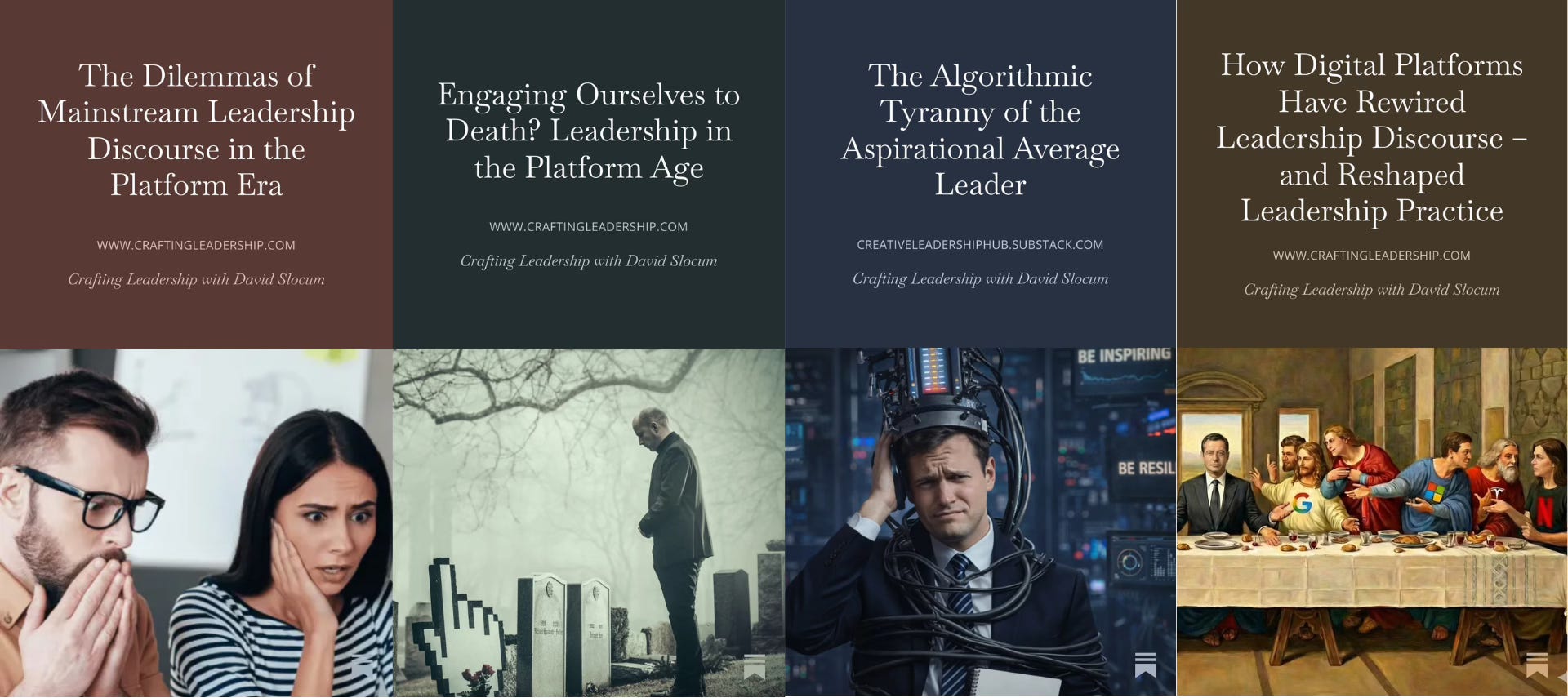
Across four articles, written between March 2025 and February 2026, I have published more than 15,000 words examining how hyper-connected, data-centric, algorithmically-governed, and AI-augmented platform ecosystems are reshaping leadership discourse and practice. This sustained inquiry reflects a deliberate effort to clarify what leadership increasingly requires when visibility, engagement, and repetition become not just conditions of communication, but dominant evaluative logics.
Taken together, these articles advance a single, cumulative claim: in the platform era, leadership is being quietly redefined as a function of visibility rather than judgment. Digital platforms do not merely accelerate the circulation of leadership ideas; they reorganize the incentives that determine which forms of leadership are noticed, rewarded, and emulated. Over time, those incentives shape leaders’ aspirations, learning, and practice themselves.
I am not launching a broadside against platforms, nor am I mounting a nostalgic defense of pre-digital authority. Platforms are now infrastructural realities of organizational and social life. My argument is diagnostic. When leadership discourse is governed by engagement metrics, algorithmic amplification, and performative coherence, capacities central to effective leadership – contextual judgment, sensemaking, and relational depth – become harder to cultivate and easier to overlook. In each article, I’ve approached this problem from a different angle, moving from discourse format, to cognition and behavior, to aspiration and identity, and finally to leadership practice under conditions of digital reversal.
1. The Dilemmas of Mainstream Leadership Discourse in the Platform Era (March 21, 2025)
The first article establishes the foundational problem by examining how platform formats shape leadership discourse itself. Beginning with a reflection on optimal LinkedIn post length, it argues that platforms impose implicit epistemic constraints. Length, tone, cadence, and emotional valence are not neutral stylistic choices; they function as filters that privilege certain kinds of ideas while systematically disadvantaging others. As I write directly about leadership discourse today, “platforms and formats are not neutral: they reshape not only what we say, but how we think about it” (Slocum, 2025a).
Drawing on media theory and the evolution of business publishing, the article traces the shifts from books to summaries, from arguments to snippets, and from institutional vetting to algorithmic relevance (Postman, 1985; Tufekci, 2017). While these transitions have democratized participation, the have also displaced traditional signals of expertise with engagement metrics. Authority increasingly accrues not to those who deepen understanding, but to those who maintain visibility. Leadership thus begins to be understood less as the capacity to hold complexity over time and more as the capacity to render oneself and one’s thinking immediately communicable within platform-friendly formats.
In practice, this is visible when complex leadership questions – around power, trade-offs, or organizational politics – are routinely reframed as short lists, personal reflections, or motivational takeaways because those formats travel best on platforms. The resulting dilemma is structural rather than personal: leaders and leadership thinkers must participate in platform ecosystems to remain relevant, yet meaningful participation often requires compressing or adapting ideas into forms that erode nuance, context, and relevance to particular situations and settings.
2. Engaging Ourselves to Death? Leadership in the Platform Age (April 2, 2025)
If the first article diagnoses distortion at the level of discourse, the second descends into its cognitive and behavioral consequences. Building on the late media ecologist Neil Postman’s critiques of entertainment and information overload (Postman, 1985; Postman, 1990), I argued that contemporary leadership operates under conditions of compulsory engagement. Platforms are engineered around persuasive design, dopamine-driven feedback loops, and metrics that reward constant interaction (Fogg, 2002; Alter, 2017; Lembke, 2021).
For leaders, this engagement imperative has two destabilizing effects. First, as I wrote, “Leadership becomes inseparable from performance when engagement itself becomes the metric” (Slocum, 2025b). Responsiveness, frequency, and emotional clarity increasingly substitute for judgment and substance as proxies for effectiveness. Second, engagement metrics migrate from indicators to evaluators, encouraging a form of metric myopia in which what is easiest to measure crowds out what is most substantive or consequential.
Under such conditions of compulsory engagement, leadership increasingly comes to mean visible responsiveness – being seen to react, acknowledge, communicate, and signal care – rather than the slower work of judgment, decision-making, and relationship-building.
This dynamic is readily visible inside organizations, where leaders’ responsiveness on Slack or Teams – consider reaction emojis, rapid replies, visible presence – can become informal signals of care and competence, even when deeper strategic thinking or difficult conversations occur elsewhere and remain largely invisible. The article also introduces context collapse as one of today’s defining leadership challenges, in which messages lose deeper meanings as they are continuously reinterpreted across overlapping audiences and time horizons (boyd, 2014; Davis, 2020).
3. The Algorithmic Tyranny of the Aspirational Average Leader (December 21, 2025)
The third article shifts the analysis from engagement to aspiration. In it, I examine how leadership development itself is filtered through algorithmic media, and I argue that the “average leader is produced not by failure, but by algorithmic normalization” (Slocum, 2025c). This figure, marked by their aspirations to become a better leader, emerges through constant exposure to homogenized leadership content optimized for scale and repetition.
Drawing on critiques of the leadership industry (Kellerman, 2012; Pfeffer, 2015) and psychological research on repetition and illusory truth effects (Fazio et al., 2015), I show how algorithms amplify consensus rather than inquiry. Familiar frameworks gain authority through visibility, while alternative and often systemically grounded perspectives struggle to surface. In this environment, I contend that “repetition, not rigor, becomes the primary source of authority” (Slocum, 2025c). Generative AI models trained on popular leadership content increasingly reproduce the same narrow repertoire of virtues and formulations, reinforcing the consensus they are typically prompted to summarize.
Leadership in discourse and practice becomes, in turn, less defined by situated effectiveness than by proximity to a normalized ideal – one produced, circulated, and reinforced through algorithmic repetition.
Many leaders encounter this dynamic through an endless stream of podcasts, newsletters, and posts that recycle a narrow set of leadership virtues – authenticity, vulnerability, purpose – largely detached from the organizational contexts in which those qualities become difficult to enact. The tyranny here is pervasive yet subtle. Leaders are not coerced into conformity; they are invited into it. By aspiring to improve themselves, they internalize platform norms that reward clarity over complexity and inspiration over confrontation with uncomfortable realities.
4. How Digital Platforms Have Rewired Leadership Discourse – and Reshaped Leadership Practice(February 5, 2026)
My fourth and most recent article synthesizes the preceding analyses through media ecologist Andrey Mir’s concept of digital reversal (Mir, 2025). It argues that platforms do not merely amplify leadership messages but reshape leadership practice itself. As I put one of its central claims, “platforms do not merely amplify leadership; they quietly retrain it” (Slocum, 2026). When media systems scale to extremes of speed and reach, their original benefits invert. Information abundance becomes meaning scarcity. In the process, expressive freedom collapses into algorithmic conformity.
What emerges is a form of leadership optimized for platform compatibility: influence that travels, resonates, and persists within algorithmic systems, even when detached from institutional responsibility or long-term consequence.
Within this reversed ecology, leadership becomes increasingly gamified. Engagement dashboards, badges, and algorithmic rewards condition leaders to communicate for reach and reaction rather than understanding (Alter, 2017; Eyal, 2014). High-arousal emotions spread faster than deliberation (Brady et al., 2017), pulling leadership discourse into agonistic arenas where influence is measured by attention and interaction rather than judgment.
Public figures such as entrepreneur Elon Musk illustrate how leadership communication can be performed through platforms themselves, where volatility, provocation, and attention shocks generate disproportionate influence independent of its institutional role. Generative AI intensifies these tendencies. AI-generated leadership content tends toward emotionally smooth, agreeable tones, reinforcing homogenization and a social-desirability bias (Dentella et al., 2023; Salecha et al., 2024). In this way, generative AI does not introduce a new logic into leadership discourse so much as it operationalizes existing platform preferences – speed, positivity, and stylistic coherence – at scale.
Crucially, the discussion in this article pivots toward practice. It argues that reclaiming leadership requires deliberate counterweights to platform logic: slower communicative modes, stronger relational infrastructures, and disciplined reflective routines (Newport, 2016; Heifetz et al., 2009). These are not retreats from technology, but conditions for exercising judgment within it.
(Provisional) Conclusion: Leadership Beyond Platform Logic
Across these articles, leadership emerges as increasingly constrained not by a lack of tools or case examples, but by surplus mediation. Platforms reward visibility, emotional clarity, and repetition, while undervaluing judgment, contextual intelligence, and meaning-making. Over time, these incentives reshape not only leadership discourse, but leadership aspiration and evaluation.
Taken together, these shifts point toward an emergent re-definition of leadership in the platform era. Leadership is increasingly understood as the ability to sustain visibility, signal coherence, and generate engagement across mediated environments. More and more, influence accrues through emotional legibility, stylistic consistency, and algorithmic reinforcement rather than through contextual judgment, institutional stewardship, or the navigation of difficult trade-offs. This emerging definition is rarely stated explicitly, yet it is enacted daily in how leaders are evaluated, promoted, imitated, and developed.
Guiding my writing on this topic is the goal to contribute to leadership studies and practice by showing that platforms do not merely influence or facilitate leadership communication; they redefine leadership itself as an activity that is becoming more and more performative and metric-driven unless consciously resisted. My aim is neither to argue for platform exit nor to propose a new leadership model. Rather, my purpose across these articles is diagnostic and developmental: to help leaders to become more aware of the structural pressures shaping contemporary leadership so that they can engage platforms more deliberately rather than unconsciously conforming to platform logics.
Leadership capable of enduring impact must therefore learn to operate both within and beyond platform logics, cultivating forms of influence that remain meaningful even when they are not immediately visible. That task may be unfashionable in an attention economy, but I believe it is an aspiration that remains central to any leadership worthy of the name.
References
Adam Alter (2017) Irresistible: The Rise of Addictive Technology and the Business of Keeping Us Hooked, Penguin Press.
danah boyd (2014) It’s Complicated: The Social Lives of Networked Teens, Yale University Press.
William J. Brady, Julian A. Wills, John T. Jost, Joshua A. Tucker, and Jay J. Van Bavel (2017) “Emotion Shapes the Diffusion of Moralized Content in Social Networks,” Proceedings of the National Academy of Sciences, 114(28), 7313–7318;
https://doi.org/10.1073/pnas.1618923114
Jenny L. Davis (2020) How Artifacts Afford: The Power and Politics of Everyday Things, MIT Press.
Vittoria Dentella, Fritz Günther, and Evelina Leivada (2023) “Systematic Testing of Three Language Models Reveals Low Language Accuracy, Absence of Response Stability, and a Yes-Response Bias,” Procedings of the National Academy of Sciences, 120 (51) e2309583120; https://doi.org/10.1073/pnas.2309583120
Nir Eyal (2025) Hooked: How to Build Habit-forming Products, Portfolio.
Lisa K. Fazio, Nadia M. Brashier, B. Keith Payne, and Elizabeth J. Marsh (2015). “Knowledge Does Not Protect Against Illusory Truth,” Journal of Experimental Psychology: General, 144(5), 993-1002; https://doi.org/10.1037/xge0000098
B.J. Fogg (2002) Persuasive Technology: Using Computers to Change What We Think and Do, Morgan Kaufmann.
Ronald A. Heifetz, Alexander Grashow, and Marty Linsky (2009) The Practice of Adaptive Leadership: Tools and Tactics for Changing Your Organization and the World, Harvard Business Press.
Barbara Kellerman (2012) The End of Leadership, HarperCollins.
Anna Lembke (2021) Dopamine Nation: Finding Balance in the Age of Indulgence, Dutton.
Andrey Mir (2025) The Digital Reversal: Thread-Saga of Media Evolution, Andrey Mir [Self-published].
Cal Newport (2016) Deep Work: Rules for Focused Success in a Distracted World, Grand Central Publishing.
Jeffrey Pfeffer (2015) Leadership BS: Fixing Workplaces and Careers One Truth at a Time, Harper Business.
Neil Postman (1985) Amusing Ourselves to Death: Public Discourse in the Age of Show Business, Viking.
------------ (1990) “Informing Ourselves to Death,” Speech presented to the German Informatics Society, Stuttgart, October 11, 1990; https://web.williams.edu/HistSci/curriculum/101/informing.html
Aadesh Salecha, Molly E. Ireland, Shashanka Subrahmanya, João Sedoc, Lyle H. Ungar, and Johannes C. Eichstaedt (2024) “Large Language Models Display Human-like Social Desirability Biases in Big Five Personality Surveys,” PNAS Nexus, Volume 3, Issue 12, December 2024, pgae533; https://doi.org/10.1093/pnasnexus/pgae533
David Slocum (2025a) “The Dilemmas of Mainstream Leadership Discourse in the Platform Era,” Creative Leadership Hub, Substack, February 21, 2025; https://www.craftingleadership.com/p/the-dilemmas-of-mainstream-leadership
David Slocum (2025b) “Engaging Ourselves to Death? Leadership in the Platform Age,” Creative Leadership Hub, Substack, April 2, 2026; https://www.craftingleadership.com/p/engaging-ourselves-to-death-leadership
David Slocum (2025c) “The Algorithmic Tyranny of the Aspirational Average Leader,” Creative Leadership Hub, Substack, December 21, 2025; https://www.craftingleadership.com/p/the-algorithmic-tyranny-of-the-aspirational
David Slocum (2026) “How Digital Platforms Have Rewired Leadership Discourse – and Reshaped Leadership Practice,” Creative Leadership Hub, Substack, February 6, 2026);

Zeynep Tufekci (2017) Twitter and Tear Gas: The Power and Fragility of Networked Protest, Yale University Press.
A recent article in the MIT Sloan Management Review discusses "How Visibility has Become the New Test of Leadership" (https://sloanreview.mit.edu/article/why-visibility-has-become-the-new-test-of-leadership/?utm_campaign=8909855-Enews&utm_medium=email&_hsenc=p2ANqtz-9w3VuskLXjJxWs47zcNtrUFByl8FzMBD97OPD8tttk3mcrFORYnezOTgNG6Hkw4dpZZFljjZVHQeHxhD--e76tHIo0-Q&_hsmi=408515623&utm_content=408515623&utm_source=hs_email)
While directionally helpful, the article's argument, confined to consultants and PSF's, makes today's demands for visibility into a lever for traditional leadership reputation- and trust-building. As I've been discussing in this and related articles, "visibility" in today's media and platform environments is the driver of a much more fundamental transformation and redefinition of leadership.