



A preregistered field experiment at Boston Consulting Group introduced the concept of the “jagged technological frontier” – the uneven boundary where AI excels at certain tasks yet fails unpredictably at seemingly similar ones. The study showed that while GPT-4 improved the quality of consultants’ work inside this frontier, relying on it outside those boundaries actually lowered the accuracy of their recommendations (Dell’Acqua et al., 2026). This installment extends that research by asking where leadership judgment sits relative to the frontier, what the machine can stand in for in a leadership program, how it changes the five positional figures and their shadows of dissent in the leadership industry, whether the machine is another management fashion, and how buyers can turn the field’s own findings toward evidence. The installment takes its title from the condition that the experiment documented persuasion without proof.
Readers short on time can take three points from this installment. First, leadership judgment probably lies outside the machine’s jagged frontier, and the experiment that locates that frontier also shows fluent output persuading evaluators who cannot verify it, the condition in which the Gatekeeper already buys. Second, the machine makes fluent dissent as cheap as fluent assent, which strips critique that costs nothing of its signal and makes critique that costs something, such as a refusal to renew without evidence, the information that buyers should seek. Third, buyers can turn the motive of defensibility toward evidence through contract terms and a short set of questions for every vendor, including questions about the machine’s role in an offering, and enthusiasm for the machine deserves the same scrutiny as any other fashion.
It may also be helpful to explain why this installment calls generative AI, large language models, and agents “the machine” whenever the argument concerns the class of technology and not a particular system. Those words name what I am convinced the findings share, which is fluent output produced at near-zero marginal cost by something with no stake, interest, or accountability of its own, and that description fits a chat assistant, a coaching bot, a training agent, and a procurement dashboard alike. “The machine” also declines the labels that current fashion supplies, since “intelligence” and “agent” import the claims about judgment and autonomy that I want to foreground and examine, and marketing revises those labels with each wave. Above all, the phrase keeps responsibility with people, because the machine answers to those who build, deploy, and buy it. Where the differences among systems matter, as with GPT-4, an AI coach, or a generative AI program, I name the system and use the studies’ own terms.
I. Where Leadership Judgment Sits Relative to the Frontier
Two lessons for leadership development follow from the jagged technological frontier, one about evaluation and one about location. The frontier marks the boundary between what the machine does well and what it does badly, and since that boundary fails to track the apparent difficulty of tasks, work that looks hard can sit comfortably inside it while work that looks easy falls outside (Dell’Acqua et al., 2026, p. 1).
In the experiment, consultants who brainstormed a new shoe model and outlined its launch worked inside the frontier, whereas consultants who had to reconcile a spreadsheet with interview notes to recommend a brand worked outside it, and nothing on the surface of the two tasks announced the difference. Users cannot see where the line runs without testing it, and the consultants, who gained speed and quality inside the frontier and lost accuracy outside it while still persuading their graders, show what happens when no one runs the test. The result bears on both location and evaluation, because the position of the work that leadership programs claim to teach determines how much of it the machine can already do.
A leadership program contains two kinds of work that the frontier treats differently. Its delivery, which consists of content, practice exercises, role plays, group work, and summaries of feedback, resembles the ideation and content creation tasks where the machine has shown large gains. In a randomized experiment with 453 college-educated professionals, ChatGPT cut the time taken on mid-level writing tasks by 40 percent and raised graded quality by 18 percent (Noy & Zhang, 2023). A model can already play the difficult direct report in a role play, draft the case study, and condense a cohort’s feedback into a tidy page, and it does so at a price that few facilitators can match.
Better judgment in ambiguous situations, the outcome that programs claim, resembles the task that fell outside the frontier, in which consultants had to integrate quantitative data with subtle contextual cues. With no label to tell a buyer which side of the line either one occupies, each placement needs argument and cannot be assumed. Delivery will probably grow cheap in the coming years, even as the effects of programs and tools remain unverified unless someone measures them. A meta-analysis of 106 experiments (370 effect sizes) provides indirect evidence on how to place outcomes. Human-AI combinations performed significantly worse on average than the better of humans or AI alone, with losses in decision tasks and gains in content creation (Vaccaro et al., 2024).
That finding speaks to how people and machines can combine and says less about where the machine’s capability ends. AI alone often outperformed the combination of humans and AI on structured decision tasks, a result that cautions against treating every leadership decision as outside the frontier. Based on consultant evidence and the nature of ambiguity, I believe leadership judgment falls largely beyond the current frontier. While this conclusion is likely logical, it remains open to change as new evidence emerges. The consultants were early-career, the study measured performance and left learning unexamined, and the frontier moves each time a new model arrives (Dell’Acqua et al., 2026, p. 18 and note 6). For a buyer, the practical reading is that whether an offering uses AI tells little, while which task it performs and who checks the result tells a great deal.
An offering that promises an AI leadership coach, an automated assessment of a manager’s decisions, or a simulated boardroom invites participants to trust the machine’s feedback on the kind of judgment that lies near or beyond the frontier, which makes the placement matter most where vendors are most eager to sell. Participants then share the evaluators’ predicament and can rarely check whether confident advice on an ambiguous decision is sound. The graders in the consultant experiment, who did not know the correct answer, rated recommendations as more persuasive even when their conclusions were wrong, and a mid-career manager reading a polished assessment of her own judgment is unlikely to fare better. The Gatekeeper’s difficulty reappears inside the product, and the offering that promises to build judgment may demand in advance the very judgment that buyers hope to acquire.
Distinguishing delivery from outcome sharpens the argument I am making here, because machines that cheapen delivery while leaving effects unverified raise the value of evidence about effects just as they lower the price of everything else a program offers. Buyers who once inferred quality from the polish of a curriculum will find it available to nearly every vendor, and signals such as a well-built workbook or a facilitator guide will carry less and less information in the near future. Where each machine-supported component sits relative to the frontier becomes a purchasing criterion as well as a research question.
II. What the Machine Can Stand In For
According to the idea of functional alternatives, when one practice serves an undeclared function, other practices can serve it equally well. The BCG experiment’s most suggestive result for that idea concerns who benefited from the effected results, with consultants in the bottom half of a baseline assessment gaining more from the tool than those in the top half, although both groups improved (Dell’Acqua et al., 2026, pp. 8-9). Two other studies show a similar slope, with ChatGPT narrowing the inequality between workers in a writing experiment and a conversational assistant helping customer support agents most when they were less experienced and lower-skilled (Noy & Zhang, 2023; Brynjolfsson et al., 2025). For a leadership program, the analogue is the manager who has no access to a skilled mentor or an executive coach, and I suspect that she stands to gain more from a patient machine than the senior executive does.
This pattern suggests that new tools can provide expertise that used to come only from rare human specialists. As management fashion theory notes, experts often create complex jargon and then charge to translate it (Kieser, 1997, pp. 59-60). When a tool breaks down those barriers, it mass-produces that specialized language and destroys its scarcity. Because leadership development relies heavily on proprietary terms and branded frameworks, the value of explaining concepts will drop long before the value of human presence does. This distinction is critical for buyers: it separates what will soon be cheap (like a clear breakdown of a framework) from what remains rare, such as a skilled coach watching you lead and offering direct feedback.
Coaching supplies the nearest direct evidence, and it points in two directions at once. In two randomized trials with students, both an AI coach and human coaches significantly outperformed their respective control groups in self-reported goal attainment, showing no significant difference between them. However, these two coaching groups came from separate studies and only tracked goal attainment (Terblanche et al., 2022). A later trial with 114 middle and senior managers at a global education company placed human and AI coaching in one design and found gains in goal success, self-efficacy, and stress for human coaching. The chatbot differed from the waiting-list control on self-efficacy alone, a difference that did not survive regression (de Haan et al., 2026). The two results resist a tidy reconciliation through task structure, since both trials measured goal attainment and only the first found the machine matching human coaches.
Sample and design may therefore matter as much as the kind of task. The later trial compares its samples within a single design, so it carries more weight on equivalence, even though it studied managers in only one organization. The frontier may still map onto coaching, and I suspect it does, but neither trial has shown it. An executive who reads a vendor’s claim that an AI coach rivals human coaches should ask which trial, or which similar study, supports the claim. She should also ask what kind of conversation she is buying, because a coach that tracks commitments and a coach that helps her see her own blind spots sit at different distances from the line.
A functional account also forecasts which benefits the machine will replace first. The private functions of a program, such as anxiety relief, reach participants whether or not leaders improve, and a patient, always-available machine serves them well, whatever later trials show about behavior. The institutional functions, defensibility above all, should yield last, because a model can supply a conversation but not institutional standing. Belonging remains the open case. A cohort that studies generative AI together acquires a shared vocabulary and a shared worry, goods that arise among the participants and that a machine can host but cannot provide. I hold the belonging claim as a hypothesis and the whole forecast as an extension of the functional framework, since none of the studies measured reassurance or belonging.
Compliance, the function served when a designation or license compels continuing education, sharpens the forecast because it gives an association, rather than the learner or the employer, the power to decide which hours count. Where such a regime exists, as at the CFA Institute for its CIPM designation and in the IEEE credits that count toward engineering license renewal, demand should erode more slowly than voluntary demand does (CFA Institute, n.d.; IEEE Spectrum, n.d.). A potential complication follows. If an association accredits machine-delivered hours, it becomes the most consequential gatekeeper for the machine’s entry into development.
That possibility points buyers toward the observable sign of whether associations require behavioral evidence alongside attendance. An association that demanded such evidence would change what machine-delivered hours can count for. The sponsor’s practical question then becomes which hours the association will credit, and that decision will govern how fast the machine enters more than any vendor’s claim.
III. Five Figures, Five Hazards, and a Candidate Sixth
As I have proposed, five figures occupy positions in the circulation of legitimacy that sustains the leadership industry, each trailed by a shadow of dissent. The Zombie supplies content, the Hero recognition, the Craftsperson development, the Gatekeeper funding, and the Participant attention, while the debunker, the celebrated critic, the exemplar, the inspector, and the skeptic who attends cast their respective shadows. Because people work with the machine in different modes, it does not arrive as a single force. A study of 244 consultants who used GPT-4 on the same business problem identified three of them (Randazzo et al., 2025). Cyborgs, about 60 percent of the sample, wove their thinking together with the model in a continuous exchange; centaurs, about 14 percent, kept control of the task and used the model for targeted help; and self-automators, about 27 percent, handed the task over with minimal iteration.
Results differed across the three modes, with centaurs achieving the highest accuracy, cyborgs and centaurs proving about equally persuasive, and self-automators lagging on persuasiveness. The result for cyborgs matters most for my concerns in this series, since persuasive output from blended judgment is hard to attribute and hard to check, which is the condition under which the Gatekeeper already operates. To be clear, each of the five figures can work in any of the three modes, and Table 1 pairs each with the mode most likely to yield its characteristic hazard. I treat the hazards as hypotheses that follow from the experiments’ logic, given that no study has yet examined these positions directly.
Table 1. How the machine changes the five figures and their shadows
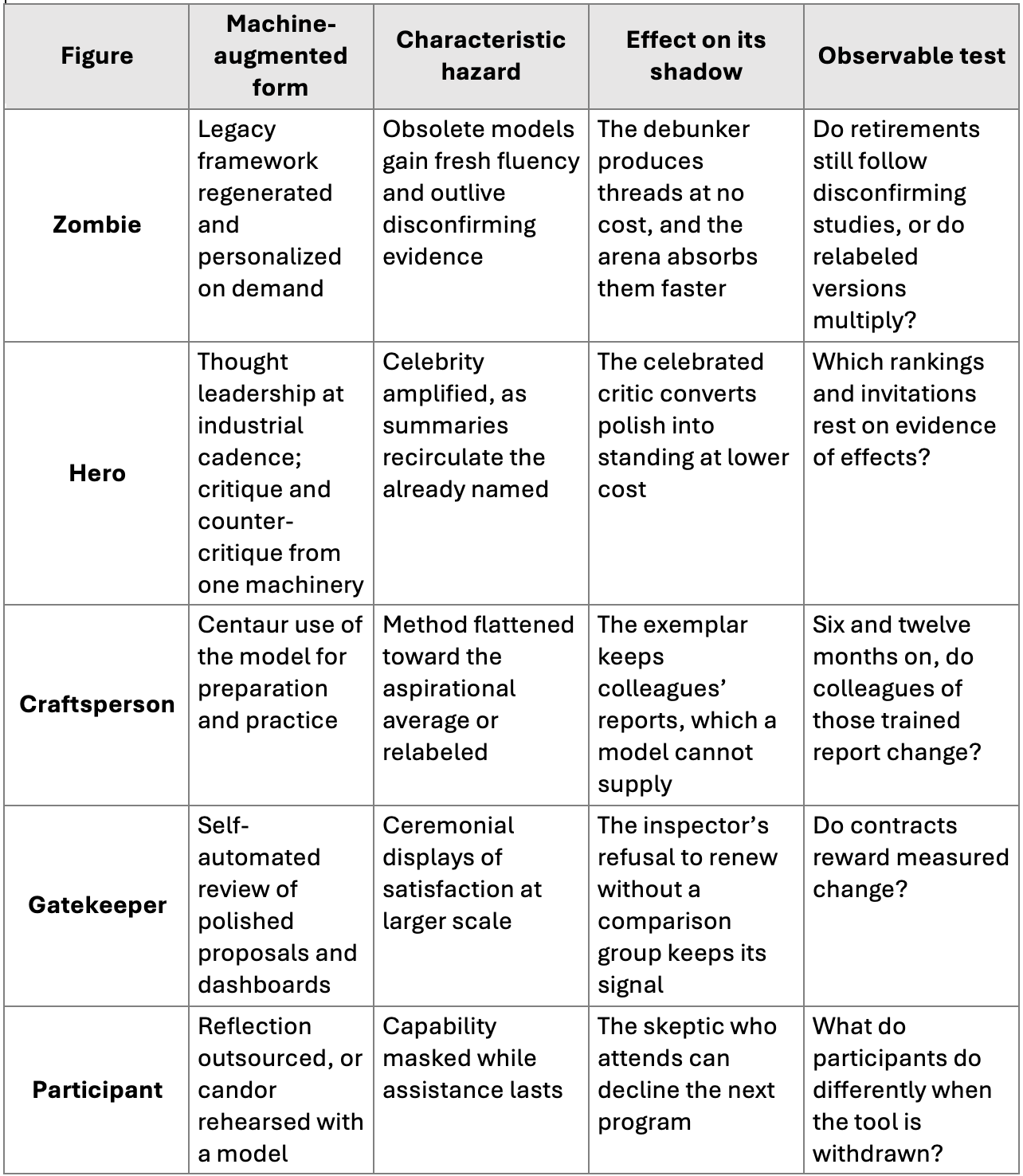
Each hazard in Table 1 traces to the single asymmetry that the machine makes output cheap while verification stays costly. A dashboard can now be generated for any program in minutes, so the Gatekeeper can stage ceremonial displays of satisfaction at a larger scale than before. The Craftsperson faces a subtler risk. Preparing and practicing with the model can flatten her method toward the aspirational average, and she loses most because distinctiveness is the asset she sells.
Outsourced reflection is one risk for the Participant, and it echoes fashion theory’s observation that fashions relieve managers of detailed reasoning (Kieser, 1997, p. 65). A survey of 319 knowledge workers adds the suggestive correlation that those with greater confidence in generative AI reported less critical thinking when using the tools (Lee et al., 2025). The Participant may instead rehearse candor with a model, a use that could accelerate psychological safety or substitute for it, in what has been called safety by proxy (Seth & Edmondson, 2026). I find rehearsed candor the more interesting possibility, because it matters only if it eventually reaches the colleagues who need to hear it.
Because every figure can adopt the cyborg mode, the remaining question for our discussion is whether the machine adds a new figure. A new figure earns a separate place only if it occupies a distinct position in the circulation of legitimacy, with its own incentives and failure modes. Neither augmented humans nor the model qualifies in that regard. Augmented humans share the positions and incentives of their unaugmented counterparts, and the model participates in the arena without interests of its own. Developers of the models do hold a position, but they sell capability into the arena without circulating legitimacy within it, so I place them outside the figures. The builders and owners of learning platforms differ. They hold a position that the five figures lack, owning the infrastructure where the recognition and procurement channels meet and converting a famous instructor or a university brand into a catalog that the Gatekeeper can defend.
Looking closely at Udemy’s terms shows the platform's position at work. Instructors host their courses exclusively on Udemy Business, receive payment from a pool divided by minutes consumed, and join the generative AI program unless they opt out (Udemy, n.d.-a, n.d.-b, n.d.-c, n.d.-d). With Coursera’s completed combination with Udemy in May 2026, the position now sits inside a larger platform, and I treat the dashboards and metrics that such platforms supply as instruments of the Gatekeeper (Coursera, 2026). For those who build and own them, I reserve a provisional sixth figure, the Platform Entrepreneur, whose incentives lie in scale, data, and engagement and who answers to investors more than to participants. The evidence supports this characterization in direction but leaves it untested in detail. Although the sixth position may cast a shadow of its own, I will keep the five figures as the core set.
IV. Fluent Dissent Is Cheap, Costly Dissent Is Information
Through the machine, a debunking thread, a counter-critique, or a well-crafted skeptic’s memo now costs as little as a keynote, and the shadows of each figure change accordingly. A reader scrolling a professional feed cannot readily tell a considered critique from a machine-drafted imitation of one. The recognition channel converts a well-crafted critique into standing for its author whatever it cost to write, and an augmented critic faces the same absorption as an augmented celebrant. Signaling logic explains why the signal weakens, since a signal informs only when it is costly for those who lack the underlying quality to send. When fluent dissent costs nothing, it tells a buyer little about the dissenter’s conviction, and the supply of critique can grow without matching growth in the kind that moves purchasing.
Judging quality from polish or visibility is a difficulty that predates the machine, which has made counterfeit polish and algorithmically-driven visibility cheaper and harder to detect. In controlled physics classrooms, students taught by active methods learned more but felt that they had learned less than classmates who heard polished lectures from highly rated instructors, and the researchers identifying the contrast warned that evaluating instruction by perceived learning could favor inferior methods (Deslauriers et al., 2019).
A meta-analysis of training criteria likewise found weak relations among the levels of Kirkpatrick’s model, which include participants’ reactions, their learning, and their behavior on the job (Alliger et al., 1997). It also found that reaction items asking participants to judge the usefulness of the material predicted later transfer better than items measuring enjoyment, so a sponsor who keeps reaction forms can at least ask for the better kind. Satisfaction scores tracked outcomes poorly before any model arrived, and a model that refines every artifact a buyer sees makes satisfaction cheaper still to counterfeit.
Fluency also has a constructive use, and acknowledging it keeps the argument honest. In a large experiment, personalized dialogues with GPT-4 Turbo reduced belief in conspiracy theories by about 20 percent among 2,190 believers, and the effect persisted two months later (Costello et al., 2024). I take the result seriously, because it shows that fluency alone does not make output unreliable and shifts the weight to what the output contains and who verifies it. In leadership development, that weight falls on the Gatekeeper, who sets the terms on which output is checked, whether or not she can check it herself.
Ordinarily, dissent keeps its force where and when it costs its author something, and the machine strains that condition, because the technology that cheapens fluent critique also threatens to counterfeit the sacrifices that once gave dissent its credibility. The machine can draft a memo of refusal but cannot refuse a renewal. It can imitate a testimonial but cannot by itself supply the ratings of colleagues who spent six and twelve months observing a leader. Dissent therefore keeps its signal when it takes the form of an act that leaves a verifiable record in the procurement or trust channel, an inference that rests on the cost logic of signaling and on the experiment’s demonstration that fluent dialogue can move belief.
Applied to the five shadows, this cost logic sorts them in a way that executives can use directly. The debunker and the celebrated critic work mainly in the recognition channel, where a machine can now match their output at negligible cost, and their dissent loses its signal first. The inspector, the exemplar, and the skeptic who attends work in the procurement and trust channels, where dissent takes the form of a decision with consequences, and the machine can describe such decisions without making them. A finance director’s pointed memo can be answered within minutes by a vendor’s equally pointed reply, whereas a withheld renewal leaves a record that no reply can erase, and a skeptic who declines the next program leaves a smaller record of the same kind. The contrast among the figures yields a practical conclusion for buyers, who should read the cost of dissent as the clearest indication of its worth.
It is important for readers to recognize that I am mixing findings of different strength in this installment, and a plain accounting of that strength will help them weigh my larger argument. The experiments, the meta-analysis, and the coaching trials document only what they measured. Every extension of them to leadership development is my inference, including the placement of leadership judgment outside the frontier, the forecast that private functions give way to the machine first, and the claim that costly dissent keeps its signal. The belonging hypothesis, the reading of the coaching trials, the hazards in Table 1, and the incentives of the Platform Entrepreneur are conjectures. The evidence points in their direction, but no study has tested them directly and in detail. The last column of Table 1 lists observable tests for the hazards.
V. Is the Machine Another Fashion?
Some members of the research community have begun to prepare the ground for the machine’s entry before the evidence shows where its frontier lies. One article in the special issue of Academy of Management Learning & Education (AMLE) proposes that recent technology can help every employee draw leadership lessons from everyday work (Ashford et al., 2026, p. 313). An editor of the issue, quoted in the AOM Insights summary, observes that digital and AI tools can now highlight opportunities for practice in an integrated way, and the summary discloses that generative AI helped draft it (Bratsis, 2026, p. 3). I view that disclosure as commendable transparency. I cite the pairing only because it shows enthusiasm for the technology and reliance on it arriving together, at least in this instance. The same pattern appears even in critiques of the field: the technology enters the remedy first, and the evidence follows later, if at all.
Management fashion theory lists the rhetorical ingredients of a successful fashion with unsettling precision, and much current discourse about the machine in leadership development contains most of them. In its fullest form, that discourse declares a single neglected factor the key to success and announces that everything has changed. It presents adoption as unavoidable and backs the claim with a catalog of menacing dangers for those who hesitate, among which the theory’s own list already counts rapid technological advance. It attaches the new principles to treasured values such as creativity and innovativeness. It also tends to draw its examples from extraordinary pioneers, whose early adoption assures later adopters that they too can join the vanguard (Kieser, 1997, p. 58).
Simplicity and ambiguity combine to leave the promise clear and the method vague enough for every buyer to project a preferred meaning onto it, while the stress on how difficult implementation proves places the blame for any failure on the adopter and leaves the consultant blameless (59-60).
A second mechanism strengthens the suspicion that the machine is a fashion, since adoption itself becomes evidence for further adoption. Decision makers who watch what their peers adopt, and not what their peers achieve, can carry a practice through an entire field until its true value is revealed to be negative (Bort & Kieser, 2011, p. 657). Reports that competitors have launched an AI academy or vendors’ counts of the organizations that have licensed their AI-enabled catalogs supply the signal that such a cascade requires, and neither says anything about whether anyone’s leadership improved. I treat counts of adopters, pilots, and licensed seats as measures of fashion and withhold from them the status of measures of effect. I apply the same reasoning to those researchers whose interest in the machine mirrors the buyers’ and rests on the same shortage of tested results.
Fashions can nonetheless leave something useful behind, and a fair reading of the machine has to say what. Lean production and business process reengineering outlived their years as management fashions because they proved useful in the organizations that adopted them, while the balanced scorecard more or less disappeared from discourse and from practice (Bort & Kieser, 2011, p. 673). Companies that kept their re-engineered processes and lean systems long after the hype had passed show that a fashion’s ingredients can outlast the fashion itself (657). Looking ahead, the machine will probably divide between lasting use and passing fashion, and the frontier shows where.
Inside the frontier, the machine has already earned a place in drafting, summarizing, practice scenarios, and the other work of delivery, and that place seems likely to last. No skepticism about the discourse should obscure it. Outside the frontier, claims that the machine builds judgment, replaces the coach in open-ended work, or readies the leader for an age of agents have so far earned only the attention that a fashion commands. The difficulty lies in industry talk about the tool, which runs ahead of anything the tool has been shown to do. I believe it is crucial to separate the technology from the discourse around it, crediting the technology where evidence exists and holding the discourse to the standard that buyers should apply to any vendor claim.
My own argument carries the same obligation to expose itself to disconfirmation. I place leadership judgment outside the frontier on logic and a limited body of evidence, and I predict that costly dissent will keep its signal, and either claim could prove wrong. A comparison-group evaluation showing that machine-supported development changes how managers behave, as their colleagues observe it at six and twelve months, would show that such development can reach the outcome that programs claim. A direct test in which a model’s recommendations on ambiguous leadership cases matched expert and colleague judgment would move leadership judgment toward the frontier.
Evidence that buyers who receive machine-written proposals respond by demanding more verification would weaken the claim that defensibility dominates the purchase. Widespread machine-assisted gaming of colleague ratings would suggest that even costly dissent can be counterfeited, which would undercut the claim that it keeps its signal. As someone who teaches in this field, I feel the same pull toward the fashionable topic as the figures I describe, and I take naming disconfirming evidence in advance as the minimum that a critic of ceremony owes.
VI. Making Defensibility Serve Evidence
Having completed the diagnosis, this installment turns to prescription, beginning with the motive at the center of the purchase. If many buyers want defensibility above all, that motive can serve as evidence once someone with authority acts on it. The Gatekeeper’s shadow, the skeptical finance director who questions the purchase, shows the way. She turns her question into procurement criteria, converting dissent that costs the buyer comfort into a rule that every vendor must meet. I offer the claim that defensibility can serve evidence as a hypothesis, one that history supports in part and warns against in part.
Education offers a natural test in the Every Student Succeeds Act, under which districts that use federal school-improvement money must choose interventions backed by strong, moderate, or promising evidence (Klein, 2019). Defensibility did turn toward evidence there, and vendors now advertise their tier ratings as a selling point (Lexia Learning, n.d.). The same case invites the risk that a ceremonial account of purchasing predicts. A requirement for evidence may become one more credential that buyers file and vendors display, although these sources document only the display. Procurement criteria in leadership development therefore need to specify the kind of evidence and who produced it, and they need to anticipate Goodhart’s law, under which a measure loses its reliability once it becomes a target.
Buyers also find cover in the field’s own research tradition, which favors the designs that work. A meta-analysis of leadership training that pooled 335 independent samples found stronger results from programs built around needs analysis, feedback and practice, and spaced sessions, and procurement criteria that reward those features would shift vendors’ incentives along with buyers’ habits (Lacerenza et al., 2017). Practitioner analyses point the same way, and an analysis of why leadership training fails by Harvard’s Michael Beer and colleagues argues that diagnosis should begin with the organizational context that will either support or smother whatever people learn (Beer et al., 2016). Gains also fade without follow-through, as a study of six programs around the world found for well-being, although that study describes no comparison group (Yemiscigil et al., 2023).
Authority over purchasing sits with those who set the rules, which makes chief financial officers, boards, and procurement teams more important than participants. Contracts that these buyers write can tie part of the fee to observed change, measured through structured observation by managers and repeat ratings by colleagues at six and twelve months. This design echoes a survey of the co-workers of 11,480 managers in eight companies, which found improvement among managers who followed up with colleagues and little change beyond chance among those who did not (Goldsmith & Morgan, 2004). Four signs, then, give buyers something to ask for: fees tied to such change, requests that specify outcomes beyond participant reactions, published evaluations that name a comparison group, and associations that require behavioral evidence alongside attendance.
Sponsors should anticipate the costs of attributing change to a program, establishing a baseline, guarding against gamed ratings, and paying for measurement. A randomized trial that assigned 76 leaders to a facilitated program, a self-directed version, or no treatment, and found medium-sized gains in team engagement for both programs, shows that rigorous evaluation is manageable (Haslam et al., 2023). Organizations with ceremonial habits will nonetheless resist inspection unless sponsors ask for the data before they renew.
Six questions from the AMLE special issue give buyers a screen that they can adopt tomorrow, and the AOM Insights summary conveys its spirit in the advice to think like a doctor, understand the symptoms before choosing a provider, and distrust what looks and feels good (Bratsis, 2026, p. 3). Written answers to the what, how, when, who, why, and where of any proposal would expose three of the traps that the special issue’s editors name. The first is the set of lesson plans, activities, or other instructional strategies assembled by searching the web at the last minute (pedagoogling), the second the workshop that entertains in the hope that ideas will stick (edutainment), and the third the curriculum that serves every participant with one set of content (the hammer problem) (Leroy et al., 2026, pp. 305-306).
The screen tests the coherence of a proposal, not its effect, and a vendor fluent in the six questions can answer them persuasively, as the consultant experiment suggests. Moreover, no clear standard marks an end point for leader development against which answers could be checked (Palanski & Barclay, 2026, p. 347). The screen opens the buyer’s inquiry, and the contract terms described above close it.
VII. Asking the Machine to Earn Its Place
The machine raises questions of its own, and buyers should put them to every vendor. A model can plausibly supply the practice, feedback, and spacing that the meta-analysis found effective, yet the consultant experiment warns that fluent output can persuade evaluators even when the analysis behind it fails. Buyers should ask four things. Where does each machine-supported component sit relative to the tool’s frontier? Does the vendor’s own training increase reliance in the places where reliance hurts? What evidence of learning, beyond fluent output or satisfaction, can the vendor show? And who will verify correctness when the reviewers cannot (Dell’Acqua et al., 2026, pp. 7, 11)?
Two further checks concern how participants use the tool. Buyers can ask whether participants learn to work as centaurs, who kept control of the task and reached the highest accuracy, or as self-automators, who gave up skill development for speed. They can also withdraw the tool at the end and see what participants can still do, using post-program assessments administered without assistance.
Consider a hypothetical version of that finance director, who receives a proposal for a leadership program that the vendor describes as AI-enabled. The answers to the six questions are crisp, the dashboard is persuasive, and every component carries a plausible rationale, and a model can produce all of it in an afternoon. She sets the polish aside and asks for three things. The first is an unassisted assessment of participants’ judgment, given before and after the program, on a case whose expert-rated resolution is fixed in advance. The second is ratings of participants’ behavior by managers and colleagues at six and twelve months. The third is a contract that makes twenty percent of the fee payable only if those ratings, compared with a group of non-participants, show change.
The vendor’s response is informative either way. A vendor that accepts stakes its revenue on effects it can demonstrate, which no proposal can do on its own. A vendor that declines leaves her with only the polish, which she already knows costs almost nothing to produce. Neither response is conclusive, since an overconfident vendor may accept and a cautious one may decline, but the terms move the decision from rhetoric to risk.
Past the finance director’s desk, the prescription also reaches the sponsors, craftspeople, and leaders who share her stake in what programs deliver. Sponsors who bring the machine into their own programs should test each tool on tasks with known answers, pilot it against a control group, and keep reviewers who can verify correctness in the loop. The evidence for caution is modest. Consultants who received instruction in the tool lost more accuracy outside the frontier, but that difference reached significance only at the 10 percent level, which argues for testing rather than for a verdict. Craftspeople should make their evidence legible without flattening it, through documented cases, observed change in colleagues, and clients willing to speak for the results. Those who license recorded versions of their work into platform catalogs should read the terms on exclusivity and on AI use of their content before they sign.
Leaders who wish to learn can form small peer circles that practice critical performativity, which means engaging fully in practice while remaining critical of it (Alvesson & Spicer, 2012). Such circles examine real decisions with real stakes. Whether they can supply belonging and reassurance without the credential, against a machine that is always available, is a question that experience will answer before research does.
Because the frontier keeps moving, buyers should repeat these questions whenever a vendor’s tool changes, and a purchase that can be re-tested is the one a Gatekeeper can defend longest. The field’s own research tradition, with its design features, meta-analytic evidence, and vocabulary for inspecting claims, gave buyers the means to do this long before the machine arrived. The machine adds urgency and a new way of failing. Fluent output can now imitate every artifact of evidence except the evidence itself, and persuasion without proof costs almost nothing. The machine will serve whatever motive the buyer brings. Buyers who treat defensibility as a reason to demand evidence will find it a useful instrument, and buyers who treat defensibility as cover will find it an equally accommodating one.
In the conclusion to the series, Part V, I will make clear what the evidence supports, mark where it runs out, test which of the five shadows can move the field, and ask how the field can practice what it teaches.
References
Alliger, G. M., Tannenbaum, S. I., Bennett, W., Jr., Traver, H., & Shotland, A. (1997). A meta-analysis of the relations among training criteria. Personnel Psychology, 50(2), 341-358. https://doi.org/10.1111/j.1744-6570.1997.tb00911.x
Alvesson, M., & Spicer, A. (2012). Critical leadership studies: The case for critical performativity. Human Relations, 65(3), 367-390. https://openaccess.city.ac.uk/id/eprint/15571/
Ashford, S. J., Wellman, N., & Sweeten, J. R. (2026). Leadership should not be a luxury good: Scaling leader development for the forgotten majority. Academy of Management Learning & Education, 25(3), 313-330. https://doi.org/10.5465/amle.2024.0590
Beer, M., Finnström, M., & Schrader, D. (2016, October). Why leadership training fails, and what to do about it. Harvard Business Review. https://hbr.org/2016/10/why-leadership-training-fails-and-what-to-do-about-it
Bort, S., & Kieser, A. (2011). Fashion in organization theory: An empirical analysis of the diffusion of theoretical concepts. Organization Studies, 32(5), 655-681. https://doi.org/10.1177/0170840611405427
Bratsis, M. E. (2026, September 22). Six traps to avoid in leadership development programs. AOM Insights. Academy of Management. https://journals.aom.org/doi/10.5465/amle.2026.0496.summary
Brynjolfsson, E., Li, D., & Raymond, L. R. (2025). Generative AI at work. Quarterly Journal of Economics, 140(2), 889-942. https://www.nber.org/papers/w31161
CFA Institute. (n.d.). Mandatory professional learning (MPL) guidebook. https://www.cfainstitute.org/sites/default/files/-/media/documents/professional-learning/mpl-guidebook.pdf
Costello, T. H., Pennycook, G., & Rand, D. G. (2024). Durably reducing conspiracy beliefs through dialogues with AI. Science, 385(6714), Article eadq1814. https://doi.org/10.1126/science.adq1814
Coursera, Inc. (2026). Quarterly report on Form 10-Q for the quarter ended June 30, 2026. U.S. Securities and Exchange Commission. https://www.sec.gov/Archives/edgar/data/0001651562/000165156226000063/cour-20260630.htm
de Haan, E., Terblanche, N., & Nowack, K. (2026). A randomised controlled comparison of the effectiveness of human and AI chatbot coaching with goal attainment, wellbeing and self-efficacy. Human Resource Development International. Advance online publication. https://doi.org/10.1080/13678868.2026.2633990
Dell’Acqua, F., McFowland, E., III, Mollick, E., Lifshitz, H., Kellogg, K. C., Rajendran, S., Krayer, L., Candelon, F., & Lakhani, K. R. (2026). Navigating the jagged technological frontier: Field experimental evidence of the effects of artificial intelligence on knowledge worker productivity and quality. Organization Science. Advance online publication. https://doi.org/10.1287/orsc.2025.21838
Deslauriers, L., McCarty, L. S., Miller, K., Callaghan, K., & Kestin, G. (2019). Measuring actual learning versus feeling of learning in response to being actively engaged in the classroom. Proceedings of the National Academy of Sciences, 116(39), 19251-19257. https://doi.org/10.1073/pnas.1821936116
Goldsmith, M., & Morgan, H. (2004, August 25). Leadership is a contact sport: The “follow-up factor” in management development. strategy+business, 36. https://www.strategy-business.com/article/04307?pg=all
Haslam, S. A., Reutas, J., Bentley, S. V., McMillan, B., Lindfield, M., Luong, M., Peters, K., & Steffens, N. K. (2023). Developing engaged and “teamful” leaders: A randomized controlled trial of the 5R identity leadership program. PLOS ONE, 18(5), Article e0286263. https://doi.org/10.1371/journal.pone.0286263
IEEE Spectrum. (n.d.). IEEE professional development suite teaches in-demand skills. https://spectrum.ieee.org/ieee-professional-development-suite
Kieser, A. (1997). Rhetoric and myth in management fashion. Organization, 4(1), 49-74. https://doi.org/10.1177/135050849741004
Klein, A. (2019, April 2). States hunt for evidence to underpin school turnaround efforts. Education Week. https://www.edweek.org/policy-politics/states-hunt-for-evidence-to-underpin-school-turnaround-efforts/2019/04
Lacerenza, C. N., Reyes, D. L., Marlow, S. L., Joseph, D. L., & Salas, E. (2017). Leadership training design, delivery, and implementation: A meta-analysis. Journal of Applied Psychology, 102(12), 1686-1718. https://doi.org/10.1037/apl0000241
Lee, H.-P., Sarkar, A., Tankelevitch, L., Drosos, I., Rintel, S., Banks, R., & Wilson, N. (2025). The impact of generative AI on critical thinking: Self-reported reductions in cognitive effort and confidence effects from a survey of knowledge workers. In Proceedings of the 2025 CHI Conference on Human Factors in Computing Systems (Article 1121). https://doi.org/10.1145/3706598.3713778
Leroy, H., Dragoni, L., Avolio, B., Giessner, S., Anisman-Razin, M., & Van Quaquebeke, N.
(2026). Putting the science beneath the practice: Advancing theory in leadership development. Academy of Management Learning & Education, 25(3), 305-312. https://doi.org/10.5465/amle.2026.0496
Lexia Learning. (n.d.). ESSA tiers of evidence vs. Evidence for ESSA: Key differences. https://www.lexialearning.com/blog/essa-tiers-of-evidence-vs.-evidence-for-essa-key-differences
Noy, S., & Zhang, W. (2023). Experimental evidence on the productivity effects of generative artificial intelligence. Science, 381(6654), 187-192. https://doi.org/10.1126/science.adh2586
Palanski, M., & Barclay, L. J. (2026). The leader in context: Developing leaders by adopting a self-in-systems approach. Academy of Management Learning & Education, 25(3), 331-349. https://doi.org/10.5465/amle.2024.0562
Randazzo, S., Lifshitz, H., Kellogg, K. C., Dell’Acqua, F., Mollick, E. R., Candelon, F., & Lakhani, K. R. (2025). Cyborgs, centaurs and self-automators: The three modes of human-GenAI knowledge work and their implications for skilling and the future of expertise (Harvard Business School Working Paper No. 26-036). https://ssrn.com/abstract=4921696
Seth, J., & Edmondson, A. C. (2026, September 17). What leaders need to know about AI and psychological safety. Harvard Business Review. https://hbr.org/2026/09/what-leaders-need-to-know-about-ai-and-psychological-safety
Terblanche, N., Molyn, J., de Haan, E., & Nilsson, V. O. (2022). Comparing artificial intelligence and human coaching goal attainment efficacy. PLOS ONE, 17(6), Article e0270255. https://doi.org/10.1371/journal.pone.0270255
Udemy. (n.d.-a). About Udemy Business. Teach on Udemy. https://teach.udemy.com/teaching-on-udemy/about-udemy-for-business/
Udemy. (n.d.-b). Updating subscription terms to enable key investments and business growth. Teach on Udemy. https://teach.udemy.com/enabling-investment-subscription-terms-update/
Udemy. (n.d.-c). Our principles for GenAI and instructor content. Teach on Udemy. https://teach.udemy.com/genai-principles/
Udemy. (n.d.-d). GenAI program: Instructor FAQs. Teach on Udemy. https://teach.udemy.com/genai-program-faqs/
Vaccaro, M., Almaatouq, A., & Malone, T. (2024). When combinations of humans and AI are useful: A systematic review and meta-analysis. Nature Human Behaviour, 8(12), 2293-2303. https://doi.org/10.1038/s41562-024-02024-1
Yemiscigil, A., Born, D., & Ling, H. (2023, February). What makes leadership development programs succeed? Harvard Business Review. https://hbr.org/2023/02/what-makes-leadership-development-programs-succeed