


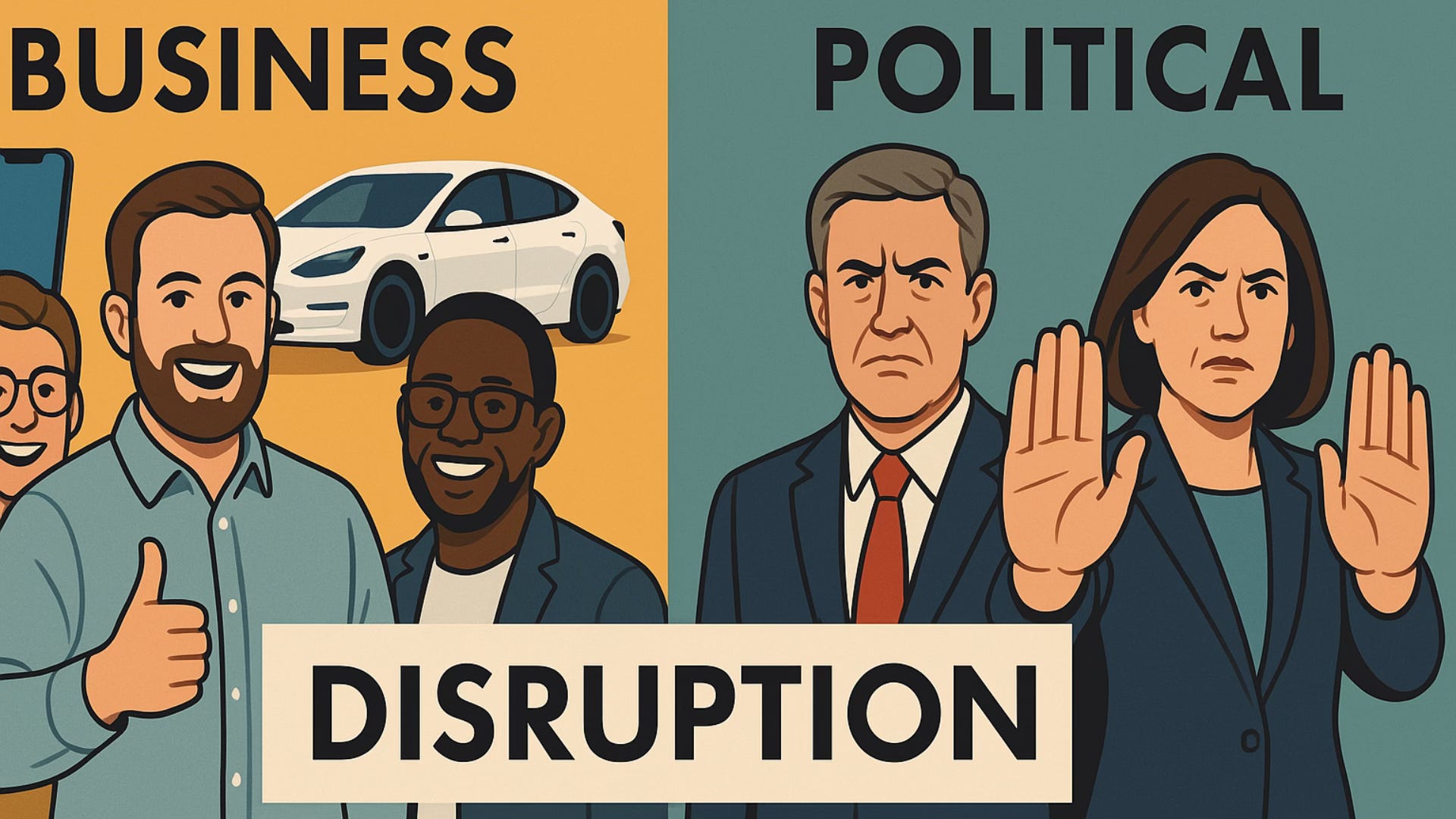
While the Creative Leadership Hub and this newsletter were not launched to be overtly political, the world that creative leaders today occupy unavoidably blurs the lines between public and private sectors, political and business leadership, and ultimately the combined identities of creative leaders as leaders, citizens, and human beings. Elon Musk is currently the most high-profile example, but, by far, he’s hardly the only one. In many cases, like when creative businesses deliver products or services of value to markets and societies or form benvolent public-private partnerships, this reach and impact can be positive. In other instances, like when leadership in politics or business are self-serving, ill-considered, and arbitrary, the implications for individuals and communities can be negative and even destructive. Overall, the dissonance in public discourse about leadership emerging from words and actions of business and political leadership warrants greater discussion than it receives. As a recurring feature, these issues will be addressed as ‘The Disruption Dilemma’ – which captures a core observation that the disruption of existing practices, norms, and institutions is approached very differently in the realms of political and business. The aim is to broaden and deepen the conversation and understanding of leadership in its many forms and incarnations today – always with the hope of improving the creative leadership of tomorrow.
As a first entry, I’m sharing what may be considered a ‘deep cut’: my reflections on a neglected thinker, Nobel Laureate in Economics Thomas C. Schelling, and his mid-twentieth century book, The Strategy of Conflict. In 2025, with politics in my home country roiling the world, I’ve revisited this masterpiece of social science to help think through and better understand what’s happening. Since the groundbreaking book is long and dense, I also recommend (and reference) a summary of the book by another Nobel Laureate, Roger B. Myerson.
Thomas C. Schelling’s The Strategy of Conflict (1960) help explains why disruption is viewed and tolerated differently in business versus political/institutional contexts through a few key principles, illustrated by game theory and coordination problems. One of the book’s central concepts is that the ability to coordinate expectations is the essence of leadership. While we may, decades later, think about how to influence and persuasion others, Schelling emphasis was more holistic, emphasizing that leaders (in business or politics) must create mechanisms (contracts, personal interactions, institutional structures) that reshape others’ expectations and guide groups toward a commitment to shared solutions in situations with multiple possible outcomes.
That insight about coordinating expectations bears directly on the challenges of leading disruption. For Schelling, business contexts welcome disruption because market participants engage voluntarily and costs/benefits affect mainly willing stakeholders. Success metrics are clear and measurable (and, we might say years later, predominate more and more), while failed ventures primarily impact direct participants only. Markets are (mostly) self-correcting through competition, allowing for productive creative destruction. Here, Schelling presents another major idea: business innovators succeed not just through superior products or efficiency – not just by breaking (or even fixing) things – but by creating new focal points that coordinate the expectations of customers, employees, and investors. Essentially, businesses succeed by finding ways to coordinate the expectations of groups, who, in the process, become voluntary participants, users, or customers in the changes being offered or shared.
In contrast, political and institutional contexts resist disruption because changes affect all citizens, not just voluntary participants. Stability and predictability are core functions of these institutions and therefore any significant change requires broad social coordination. Moreover, success in such potential change is far harder to measure than with business-style metrics. Maintaining trust in governance, particularly when the opportunities for ‘switching’ that exist with most business expectations and resulting transactions, are largely absent for individuals and communities in political and institutional settings. The costs of failure in efforts to disrupt by political leaders can, as a consequence, be damaging, difficult to reverse, and even catastrophic.
For creative leaders, these distinctions have crucial implications. Business-style disruptions (certainly imperatives like “scale fast and exit completely”) typically fail in government because they ignore the need for broader social coordination and cohesion. Lasting institutional change ordinarily requires shifting shared expectations – again,for Schelling, focal points – gradually rather than through rapid upheaval or replacement. Leadership in political and institutional contexts thus depends more on fostering legitimacy than effecting rapid innovation. As Roger B. Myerson noted decades later, such change “requires some form of socially accepted leadership and, thus, may depend on factors that are essentially political.”
“Even today,” Myerson concluded (in 2009 but remaining apt), “we still need to learn Schelling’s basic lesson that, in a realistic analysis of international conflict, we should consider our adversaries as rational intelligent decisionmakers whose interests are different from ours but with whom we share a fundamental problem of coordinating mutual strategic expectations.” Put differently, we need to recognize more fully and provide better and more creative leadership through the ever-present tensions between potential conflict and cooperation.This insight applies equally to understanding why strategies that succeed in disrupting markets often largely fail when applied to governmental or institutional change.