



The “garrison state” is a political term introduced eight decades ago that continues to shape descriptions in policy debates, empirical research, and popular discourse of possible future societal and economic development. Proposed by American political scientist Harold D. Lasswell in 1941, the concept was intended as a provocative speculation and developmental construct that would clarify how societies might evolve under conditions of persistent insecurity (Lasswell, 1941). Today, the underlying logics of a “digital garrison state,” which prioritizes its resources, technonological innovations, and decision-making to security above all else, appear to be increasingly current and operational – and worthy of closer consideration.
The core of Lasswell’s original argument was stark: modern societies could shift from the dominance of “specialists on bargaining” to the supremacy of “specialists on violence,” not through rupture but through a gradual reordering of priorities driven by fear. As a scholar, Lasswell worked across the social sciences and is considered the founder of the field of political psychology. He remains well-known for the breadth of his writing, which included studies of power, a communications model that emphasizes the importance of the channels used, and an early account of wartime propaganda (Lasswell, 1927/2025).
At the center of the societal shift toward a political-military elite was what Lasswell called the socialization of danger. Threat here becomes ambient and shared, and populations come to accept and even to demand the prioritization of security over competing values. As a result, authority centralizes, symbolic management intensifies, and economic life is subtly reorganized around preparedness. Lasswell nevertheless made equally clear that this shift was not inevitable. Rather, it was one possible trajectory among several, to be weighed rather than assumed.
That caution is essential, since contemporary discussions of a digital garrison state often move too quickly from emerging tendencies to systemic claims. The question is not whether elements of Lasswell’s construct are visible today (they are), but whether they cohere into a unified order or instead reflect a more uneven and contested transformation.
Revisiting the Concept: From Militarization to Securitization
Subsequent scholarship has reframed the garrison state less as a binary condition than as a spectrum. What matters is not formal military rule, for example, but the degree to which security considerations dominate decision-making across domains. Israeli political scientist Eyal Rubinson’s “garrison index” captures this variation, demonstrating that states differ significantly in how deeply security logics penetrate domestic and external policy (Rubinson, 2024).
The mechanisms driving this shift are also more complex than Lasswell’s original formulation might suggest. U.S. political scientists Stephen Walker and S. Ivy Lang’s late Cold War study of the “garrison state syndrome” in “the Third World” highlights how threat environments interact with institutional structures in contingent ways. Their research also acknowledges that professional military institutions or a civilan police state, in different contexts, could restrain or amplify the coercive tendencies of policymakers (Walker & Lang, 1988).
What distinguishes our contemporary moment, therefore, is not militarization alone but the expansion of securitization. Economic systems, technological infrastructures, and even everyday behaviors are increasingly framed by politicians and media through the lens of risk and survival. This expansion provides the bridge to the digital domain.
This expansion is visible not only in institutional practice but in language itself. In the United States, for example, the creation of the Department of Homeland Security after the attacks of September 11, 2001, integrated 22 separate governmental offcies or programs into a single Presidential cabinet-level department with the mission “to safeguard the American people, our homeland, and our values” (U.S. Department of Homeland Security, n.d.). Doing so signaled the elevation of “security” into a master category through which a wide range of policy domains – immigration, infrastructure, public health, and even education – could be reframed.
Since the end of the Cold War, similar moves have been evident in Europe and elsewhere, where political and media discourse increasingly aggregates disparate risks under a common security rubric, from energy dependence to supply chains and digital platforms (Buzan, Waever, & de Wilde, 1997). The cumulative effect of more and more issues being recoded as matters of security is that they become subject to exceptional treatment, reduced tolerance for trade-offs, and heightened executive discretion. Securitization thus comes to operate not only through budgets and institutions, but through the gradual redefinition of what counts as normal political and economic concerns.
The Digital Turn: Surveillance and the Integration of Civilian Life
The novelty of the present lies in the infrastructure through which securitization operates. Whereas Lasswell anticipated the integration of science and governance, contemporary systems embed surveillance and analysis in the fabric of everyday life. Financial transactions, location data, and communication patterns are continuously captured and rendered into analyzable forms, creating a pervasive informational substrate for both commercial and security purposes.
We should consequently attend to the deep historical roots of this integration. The postwar “warfare state,” as described by sociologist John Bellamy Foster and communications scholar Robert W. McChesney, relied on the close coupling of military demand, industrial production, and scientific research, producing a durable institutional nexus between state and market (Foster & McChesney, 2014). That nexus has since expanded into digital infrastructures that extend far beyond traditional defense domains.
Former Harvard Business School researcher Shoshana Zuboff’s concept of surveillance capitalism captures clearly a contemporary extension of this logic. Data extraction and behavioral prediction constitute a new regime of accumulation, producing what she calls “Big Other” – a distributed architecture of monitoring and control that reshapes power relations across society (Zuboff, 2015). As the comparative cases and table below illustrate, this infrastructure enables multiple configurations depending on how states, firms, and institutions interact.
What further distinguishes the present moment is the expansion of the security ecosystem beyond traditional defense contractors to include technology firms whose capabilities lie upstream of physical force. Companies such as Palantir, which provides data integration and analytics platforms to military and intelligence agencies, exemplify this shift toward software-defined security infrastructures. At the same time, advances in artificial intelligence – driven by firms such as OpenAI, Google DeepMind, and others – are reshaping the boundaries between civilian and defense applications, as machine learning models are adapted for intelligence analysis, autonomous systems, and cyber operations.
The result is not a replacement of the military-industrial complex, but its extension into a broader security–industrial-technological complex, in which data, prediction, and algorithmic control become central to both commercial and strategic competition. As Palantir co-founder Alexander C. Karp and his corporate affairs head Nicholas W. Zamiska have written, more fundamental still is the continuing need to link current technological innovation more directly to “a larger project for which to fight” and “defend our collective security” (Karp, 2023, p. 66). This reinforces the integration of everyday and emergent digital systems, including AI, into security logics further blurring the distinction between civilian infrastructure and strategic asset.
Core Archetypes: Divergent Paths, Shared Pressures
The current activities and priorities of the United States arguably illustrate a hybrid trajectory toward being a garrison state. The expansion of emergency powers, particularly around immigration, the integration of technology firms into national security functions, and the persistence of a vast security-industrial-technological base all point toward a garrison-like configuration (Esman, 2007; Gotein, 2024). At the same time, institutional fragmentation and (varying levels of) political contestation continue to constrain the consolidation of the digital garrison state.
Israel represents a more mature case. Its persistent exposure to existential threat has institutionalized the influence of the security community across policy domains, producing one of the highest levels of “garrisonization” identified in comparative research (Rubinson, 2024). The integration of defense, intelligence, and technological innovation has created a powerful security-innovation loop in which surveillance and cyber capabilities are developed operationally and exported commercially (Senor & Singer, 2009).
Since February 2022, and the invasion by Russia, Ukraine has undertaken a rapid transformation of digital resources. The national government has implemented a centralized civilian digital infrastructure that integrates wider security operations, enabling real-time intelligence sharing and decentralized coordination, notably through the “Diia” (“action” in Ukrainian) ecosystem (Ministry of Digital Transformation of Ukraine, n.d.; Gustafson, et al., 2025). This “state in a smartphone” service seamlessly combines an array of public services, from renewing drivers’ licenses and getting married to registering businesses, with wartime survival and recovery needs, including opportunities to contribute information and money to the war effort.
Importantly, these individual state archetypes have not developed in isolation. They are embedded within a global system defined by both persistent political insecurity and dense interdependence. Threat perceptions are shaped not only by national histories and other conditions but by alliance structures, shared intelligence networks, and coordinated procurement systems, particularly within frameworks such as NATO and U.S.-aligned security partnerships in Asia.
Also critical here are the economic interdependencies – marked by supply chains, technology standards, and financial flows – that bind states together even as they prepare for conflict. These produce a paradoxical condition in which competition and cooperation coexist, and where the security posture of any one state is partly a function of the collective dynamics, politial and economic, in which it is embedded. The archetypes identified above are therefore best understood less as discrete models and more as nodes within a broader system of mutually conditioning pressures and incentives toward securitization.
Regional Pivots: Europe and Asia
Regional considerations help to illuminate this system, and we might view Europe as representing a revealing normative reversal. For much of the post–Cold War period, the European project was organized around the promise of “peace dividends,” welfare provision, and, more recently, ecological transition. The current turn toward rearmament signals a substantive reordering of priorities in which security increasingly displaces these earlier commitments.
Poland has emerged as a leading example of what could be considered a frontier garrison state, shaped by its geographic proximity to Russia and its role within NATO’s eastern flank. The state’s military expenditures have surged to 4.8% percent of GDP in 2026 ($54.1 billion USD, or roughly 200 billion PLN), a dramatic increase from only 2.2% ($13.7 billion USD) in 2020 (Notes from Poland, 2025; SIPRI, n.d.).
Particularly telling here is the expansion of debt-based and supranational funding. Whereas in 2020, nearly the entire allocation came from the Polish State Budget, the current funding arrives from three sources: the Central State Budget ($33.8 billion USD/125 billion PLN), loans from the Armed Forces Support Fund, or FWSZ ($13.7 billion USD/51 billion PLN – essentially loans that contribute to national debt); and loans from the EU Security Action for Europe (SAFE) program ($6.6 billion USD/24 billion PLN – an initial tranche of the €43 billion to be given to Poland over the next five years) (Notes from Poland, 2025; Głowacki, 2026).
Potentially more striking is the societal dimension that accompanies these growing expenditures: programs aimed at training civilians in military readiness and resilience have reframed defense as a shared civic responsibility. Together, these represent a broader shift toward total preparedness, in which the boundary between civilian and military spheres becomes increasingly blurred, not through coercion, but through normalization.
At the same time, the expansion of military spending and activities must be situated within the broader European shift toward rearmament. Since 2022, EU member states have collectively reversed decades of underinvestment in defense, increasing procurement, industrial coordination, and joint capability development (SIPRI, n.d.). Poland’s trajectory is thus both national and systemic, reflecting a wider recalibration – and deeper coordination – of security and economic priorities across the continent.
In Asia, South Korea and Taiwan illustrate a different configuration in which security imperatives are deeply embedded within economic and industrial systems. South Korea’s political economy is characterized by close integration between state policy and large industry and technology conglomerates (chaebol), many of which operate across both civilian and military sectors, and over the last decade have greatly increased their global defense exports (Bae and Fishwick, 2026). This has generated a form of normalized and ongoing mobilization, in which economic growth and military capability are mutually reinforcing.
Taiwan offers a complementary model centered on technological centrality. Its semiconductor industry functions as a so-called “Silicon Shield,” linking global supply chains to national security (Šimov, 2025). By positioning its technological infrastructure as indispensable, Taiwan enhances deterrence while justifying expanded investment in defense and surveillance capabilities. Across both regions, security has become not only a policy domain but a structuring logic of economic life.
Mutually Reinforcing Militarization
A defining feature of the current moment is the transnational reinforcement of militarization through interconnected security-industrial-technological systems. States increasingly collaborate on production, procurement, and development, creating feedback loops that tie national security strategies to global supply chains. Once established, these networks generate strong incentives for continuity, as they become embedded in employment, regional economies, and political constituencies.
The continuing expansion of the global arms trade amplify inter-state collaboration and consolidate global supply chains. International arms transfers have reached near-record levels, with the United States, France, and South Korea among leading exporters and Europe and Asia among the fastest-growing import regions (SIPRI, n.d.). The war in Ukraine and tensions in East Asia have accelerated procurement cycles, perhaps most notably in Europe’s shift toward rearmament.
Flows of arms and the capital supporting them both mark and reinforce geopolitical alignments. Defense contracts lock states into long-term technological dependencies, reinforcing alliances while making retrenchment economically and strategically costly. The arms trade thus functions as a central transmission mechanism of garrison dynamics, linking national trajectories into a broader system of mutually reinforcing militarization.
Again, these dynamics do not unfold in an institutional vacuum. As security-industrial-technological integration deepens, it does so within fiscal systems already shaped by stagnation, debt, and competing social demands. The expansion of security infrastructures therefore raises not only strategic questions, but distributive ones. The central issue is no longer whether states can mobilize resources for defense, but how that mobilization is financed and what it displaces.
The Fiscal Squeeze: Security, Austerity, and the Reordering of Priorities
This transformation is rarely fiscally neutral. As security expenditures rise, they exert sustained pressure on other areas of public spending. Longtime Cornell professor of government Milton Esman’s analysis of the American case, albeit from two decades ago, highlights how the costs of the garrison state are often deferred or obscured, allowing expansion to proceed without immediate disruption (Esman, 2007). Over time, however, these trade-offs become more visible, particularly as social programs face stagnation.
Recent developments in Europe, in particular, cast these dynamics into sharper relief. Since 2022, EU member states have undertaken a rapid and coordinated campaign toward rearmament, reversing decades of underinvestment. Conspicuously, this shift has coincided with slow growth, high debt levels, and already strained welfare systems. As a result, what could appear as a straightforward increase in defense spending is better understood as a reallocation of political and economic priority, in which security investment begins to displace other collective projects.
As French sociologist Frédéric Lebaron and journalist Pierre Rimbert argue, this shift amounts to a form of military or security Keynesianism, in which large-scale public spending is justified not through social investment but through security imperatives (Lebaron and Rimbert, 2025). Crucially, this expansion coexists with continued commitments to fiscal restraint in other domains. The result is not a generalized return of the state, but a selective one: expansive in military and security, restrictive in infrastructure and welfare.
The distributive implications are significant. Proposals to increase defense spending toward 5 percent of GDP – now being openly discussed within NATO and individual member states – would entail, at constant output, hundreds of billions of euros in additional annual expenditure across Europe. In practice, such increases are unlikely to be financed through immediate taxation alone. Instead, they are being enabled through borrowing, accounting flexibility, and exceptional fiscal measures. While this defers political conflict in the short term, it creates longer-term pressures that are likely to materialize as constraints on social spending, public investment, and redistribution.
At the same time, the political mediation of these trade-offs follows a familiar pattern. As Lebaron and Rimbert go on to note, the language of “pedagogy” increasingly accompanies calls for increased defense spending, a term historically associated with the normalization of austerity measures in Europe. Security is thus framed not as one priority among others, but as the condition for all others, rendering trade-offs less visible and dissent more difficult to articulate.
A further layer complicates this picture. Much of Europe’s increased defense spending flows outward rather than inward. The United States remains the dominant supplier of advanced military and technological systems, accounting for a majority share of European arms imports in recent years. Defense expansion therefore operates, in part, as a transnational fiscal transfer, linking European public expenditure to American defense-industrial-technological production. This dynamic reinforces existing geopolitical alignments while limiting the development of autonomous industrial capacity.
Taken together, these developments point to a structural tension that is rarely addressed substantively by politicians. While security imperatives justify expanded public spending, the costs of that expansion are displaced into the future or onto other domains. Over time, this produces a gradual but consequential reordering of state priorities, in which welfare, climate transition, and social investment risk being subordinated to defense and security. What emerges is not simply a fiscal constraint, but a transformation in the underlying logic of political economy – one in which security becomes the primary organizing principle of public finance and institutional decision-making.
Table 1: Comparative Analysis of Congtemporary Garrison and Security-Technology States and Systems
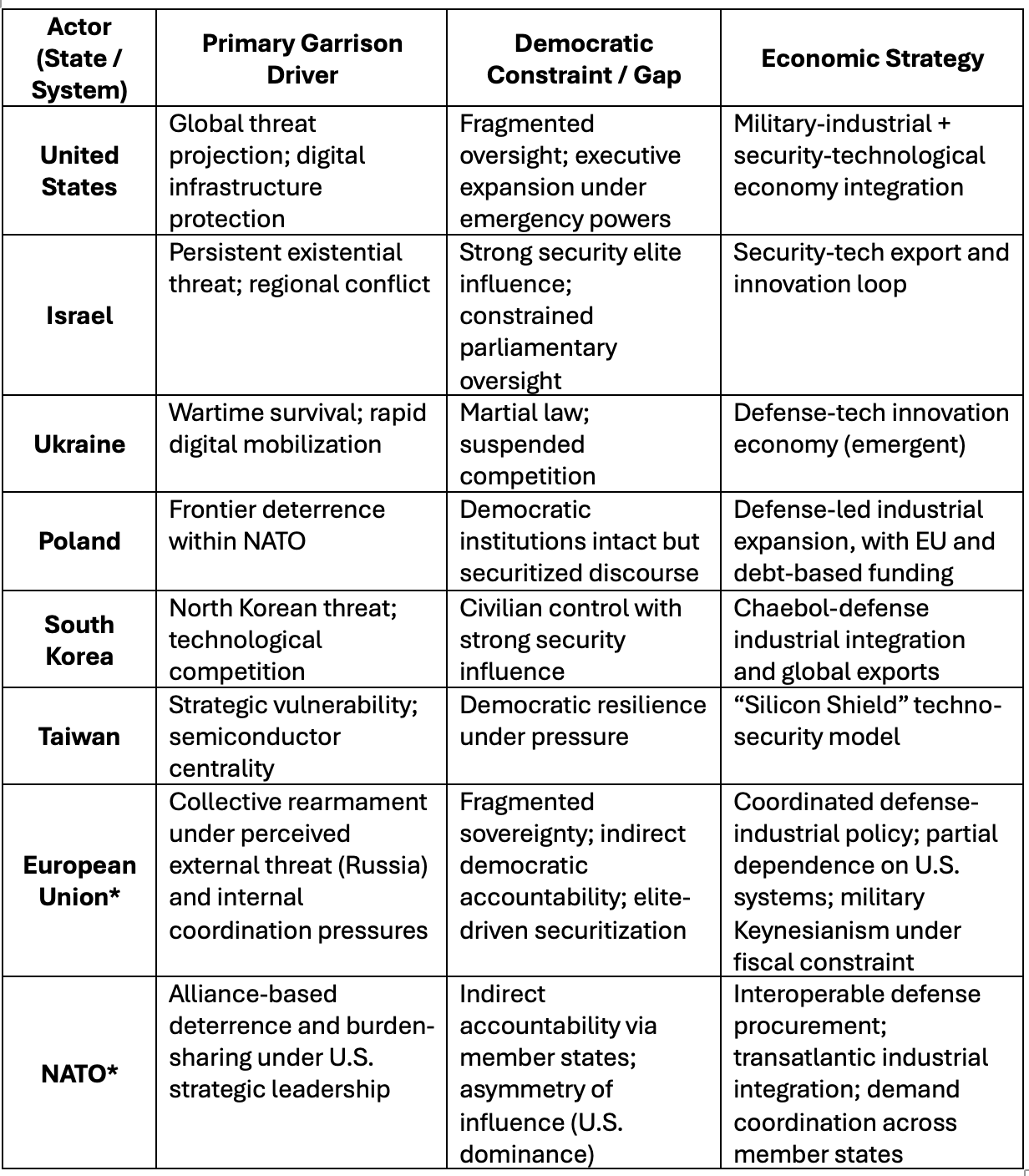
* While not conventional “states,” these systems function less as unitary actors and more as coordination architecturesthat shape and amplify members’ national trajectories.
Conclusion: Between Convergence and Contingency
What emerges from this exploration is not a singular institutional form, but a patterned convergence of pressures operating across distinct political economies. The cases discussed above (and their synthesis in the table) suggest that while threat perception, technological integration, and state-market coupling are increasingly shared conditions, their institutional expression remains uneven. The United States exhibits fragmentation within expansion; Israel demonstrates consolidation under sustained threat; Ukraine reveals rapid wartime adaptation; and Poland, South Korea, and Taiwan illustrate the diffusion of security logics into society and industry. The result is not uniformity, but structured variation.
This distinction matters analytically and politically, both for our efforts to make sense of shifting realities and to work to change them. To treat the “digital garrison state” as a settled condition risks obscuring both the mechanisms through which it develops and the points at which it may be redirected. Lasswell’s original construct was valuable precisely because it foregrounded contingency: that is, with the concept, he invited observers to consider how expectations of danger might reshape institutional arrangements before those arrangements hardened into durable forms. In the present, we can make a parallel move to examine both the expansion of security practices and the deeper processes through which they are normalized through law, technology, economic incentives, and public discourse.
At the same time, we should not understate the extent of current transformations around the globe. The integration of surveillance infrastructures with economic and political systems has altered the terrain on which authority operates. Control is exercised less through overt coercion than through continuous monitoring, prediction, and adjustment. In this sense, the contemporary evolution extends one of Lasswell’s core insights, that the “specialists on violence” are no longer the sole, or even primary, bearers of power. They are joined by specialists in data, algorithms, and systems whose capacity to shape behavior operates upstream of traditional forms of force.
The resulting tension is ongoing and structural rather than temporary and subsidiary. Security logics, once they are embedded in technological and economic systems, generate their own momentum, reinforced by institutional incentives and geopolitical competition. Yet this momentum coexists with countervailing forces such as legal constraints, market diversification, civic resistance, and the persistent plurality of democratic systems. The trajectory, therefore, remains open, but not unconstrained.
We might therefore best understand the digital garrison state as a direction of travel defined by reinforcing tendencies rather than a fixed destination. Its evolution depends not only on external threats, but on how societies interpret and respond to them, that is, on whether the socialization of danger becomes a self-sustaining logic or remains one influence among others in the ongoing reordering of political and economic life. In the U.S. and Europe in particular, this shift is already visible in the emerging trade-offs between defense expansion and social provision, suggesting that the material consequences of securitization may be as significant as its institutional forms.
So What Can Citizens and Leaders Do?
For citizens, the first task is diagnostic rather than reactive. In the opening of his 1941 article, Lasswell notes an earlier discussion in which he contrasted the garrison state and the civilian state in the context of the “Sino-Japanese Crisis” (Lasswell, 1937/1997). He then emphasized the “enormous importance of symbolic manipulation” and the “use of coercion” in the transition to the garrison state (1941: 459). The socialization of danger emerges over time, he is making clear, through a steady expansion of what is generally treated as urgent, exceptional, and non-negotiable in media and everyday discourse and civil society as well as its institutionalization through politics and economics.
The practical question persisting today is not whether threats are real, but how they should be framed, aggregated, and sustained (and by whom). When security becomes the default lens through which economic, technological, and social issues are interpreted, trade-offs recede from view. The civic challenge is to reintroduce transparency into those trade-offs by asking what is being protected, at what cost, for whom, and with what long-term consequences.
For leaders across business, government, and civil society, the challenge is increasingly structural. The terrain of decision-making is shifting with incentives aligning more and more around risk mitigation, data control, and security positioning, while constraints are diffused across geopolitical pressures and technological dependencies. In these conditions, strategy can easily become reactive. The needed leadership discipline involves, instead, an ongoing differentiation of existential from amplified risks, resilience from dependency, and adaptation from structural drift or path dependence.
What unites citizens and leaders is the problem of judgment under conditions of sustained uncertainty and of mediated perception. Navigating this terrain requires more than ongoing adaptation. It requires greater sensemaking, discernment, and judgment – which together contribute to the capacity to engage real security challenges without allowing them to silently reorder the broader architecture of purpose, value, and decision in which we live and lead.
References
Minjeong Bae and Patrick Fishwick (2026, March 2) “Arms Development on the Korean Peninsula: Divergent Strategic Pathways in an Era of Intensifying Competition,” AOAV; https://aoav.org.uk/2026/arms-development-on-the-korean-peninsula-divergent-strategic-pathways-in-an-era-of-intensifying-competition/
Barry Buzan, Ole Wæver, and Jaap de Wilde (1997) Security: A New Framework for Analysis, Lynne Rienner.
Milton J. Esman (2007) “Toward the American Garrison State,” Peace Review: A Journal of Social Justice, 19(3), 407-416; https://doi.org/10.1080/10402650701525003
John Bellamy Foster and Robert W. McChesney (2014) “Surveillance Capitalism: Monopoly-Finance capital, the Military-Industrial Complex, and the Digital Age,” Monthly Review, 66(3);
https://monthlyreview.org/2014/07/01/surveillance-capitalism/
Bartosz Głowacki (2026, February 27) “Poland Unveils Detailed Defense Spending for $51B in EU SAFE Loans,” Breaking Defense; https://breakingdefense.com/2026/02/poland-unveils-detailed-defense-spending-for-51b-in-eu-safe-loans/
Elizabeth Goitein (2024, December 3) “Deployment of the U.S. Military for Immigration Enforcement: A Primer,” Just Security; https://www.justsecurity.org/105321/military-immigration-enforcement-deportation/
Mariana Gustafsson, Olga Matveieva, Elin Wihlborg, Yevgeniy Borodin, Tetiana Mamatova, and Sergiy Kvitka (2025) “Adaptive Governance Amidst the War: Overcoming Challenges and Strengthening Collaborative Digital Service Provision in Ukraine,” Government Information Quarterly, Volume 42, Issue 3, September 2025, 102056; https://doi.org/10.1016/j.giq.2025.102056
Alexander C. Karp and Nicholas W. Zamiska (2023) The Technological Republic: Hard Power, Soft Belief, and the Future of the West, Crown Currency.
Harold D. Lasswell (1941) “The Garrison State,” American Journal of Sociology, 46(4), 455–468; https://www.jstor.org/stable/2769918
---------- (1927/2025) Propaganda Technique in the World War, Restored Editions/Knopf.
---------- (1937/1997) “The Sino-Japanese Crisis: The Garrison State versus the Civilian State,” in Essays on the Garrison State, ed with and introduction by Jay Stanley, Routledge, pp. 43-54.
Frédéric Lebaron & Pierre Rimbert (2025) “L’Europe martiale, une bombe antisociale,” Le Monde Diplomatique, March, 2025, p.3; https://www.monde-diplomatique.fr/2025/03/LEBARON/68091
Ministry of Digital Transformation of Ukraine (n.d.) “Govtech: Diia,” Digital State UA; https://digitalstate.gov.ua/projects/govtech/diia
Notes from Poland (2025, August 29) “Poland Plans Record Defense Spending of 4.8% GDP in 2026 Budget Along with Lower Deficit”; https://notesfrompoland.com/2025/08/29/poland-plans-record-defence-spending-of-4-8-gdp-in-2026-budget-along-with-lower-deficit/
Eyal Rubinson (2024) “Measuring Garrison States in International Politics,” Studies in Conflict & Terrorism; https://doi.org/10.1080/1057610X.2024.2347881
Dan Senor and Saul Singer (2009) Start-Up Nation: The Story of Israel’s Economic Miracle, Eleven.
Victor Šimov (2025, May 6) “The Silicon Shield Erosion: Fortifying Taiwan Against Geopolitical Shocks,” Institute for Security & Development Policy; https://www.isdp.eu/the-silicon-shield-erosion-fortifying-taiwan-against-geopolitical-shocks/
SIPRI (n.d.) Military Expenditure Database, Stockholm International Peace Research Institute; https://www.sipri.org/databases/milex
U.S. Department of Homeland Security (n.d.) “Mission,” accessed March 21, 2026; https://www.dhs.gov/mission
Stephen G. Walker and S. Ivy Lang (1988) “The ‘Garrison State Syndrome’ in the Third World: A Research Note,” Journal of Political and Military Sociology, 16(1), 105–116; https://www.jstor.org/stable/45293468
Shoshana Zuboff (2015) “Big Other: Surveillance Capitalism,” Journal of Information Technology, 30(1), 75–89; https://doi.org/10.1057/jit.2015.5