


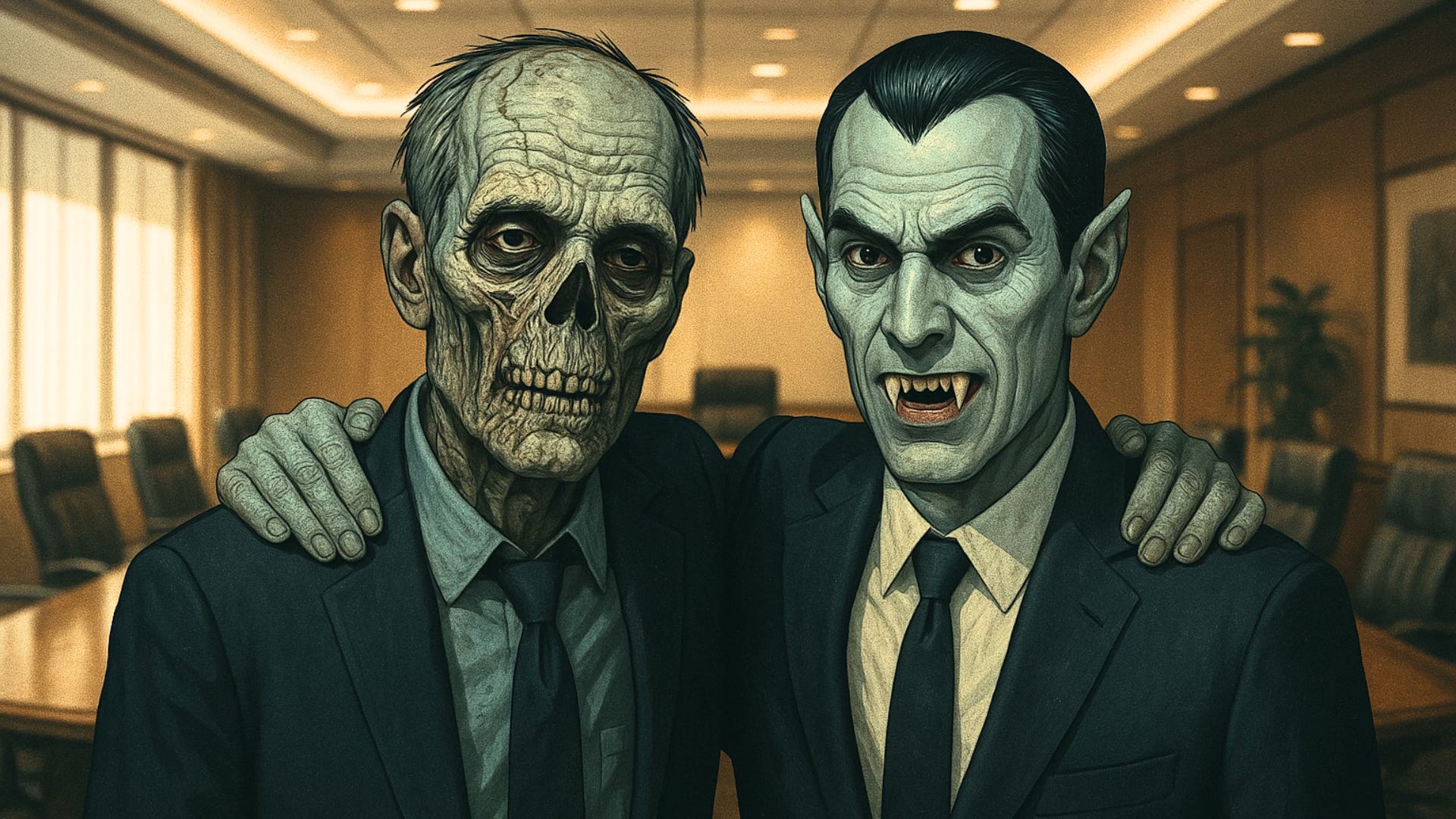
In Robert Eggers’ 2024 film adaptation of Nosferatu, Count Orlok is portrayed as a grotesque, rat-like creature, his elongated fingers grasping hungrily at his victims. This disturbing image of the vampire as a predatory, parasitic entity whose irrational power extends over the living finds its parallel in the notion of the ‘undead’ leader – one who operates in a liminal state between forward movement and stasis, draining the lifeblood from colleagues and organizations while refusing to release their grip on power. While a centuries old embodiment of cultural fears and anxieties, the vampire can be added to another archetypal figure in contemporary discussions of dysfunctional leadership, the ‘zombie leader’. Together, they speak to some of the recurring challenges of both exercising and perceiving leadership today.
In their article, “Zombie Leadership: Dead Ideas That Still Walk Among Us,” S. Alexander Haslam, Mats Alvesson, and Stephen D. Reicher define zombie leadership as “a strong residual commitment to an older set of ideas which have been repeatedly debunked but which nevertheless resolutely refuse to die” (2024: 1). These ‘dead ideas’ include notions such as the ‘great man’ theory of leadership, the idea that leaders are born rather than made, and the belief that leadership is about the leader rather than the led (or the relationship between the two). The continuing embrace of these ideas – by leaders themselves, their immediate followers and other stakeholders, and in popular leadership discourses – undermine attempts to adapt to contemporary and, especially, future conditions.
Like the undead creatures of horror films, these ideas about leadership continue to shamble on, not because they have relevant empirical support but because “they accord with the interests of particular groups (e.g., venture capitalists, the uber-wealthy, and disciples of neoliberal ideology more generally)” (2024: 1). Zombie leadership is characterized by a mindless, inflexible adherence to outmoded notions of leadership, a decaying but persistent presence that hampers organizational agility and effectiveness. While clinging to thinking and practices that may have been successful in the past is an understandable psychological response to the complexity of the present and uncertainty of the future, it ultimately corrodes organizations and risks destroying value.
The Vampire Leader
In contrast, the vampire leader is very much alive and strategically minded – but in a predatory and parasitic way. Vampire leaders are characterized by superficial charm, ruthless self-interest, and a talent for exploiting others. Opening a fascinating analysis of the use of the vampire metaphor in Marx’s writings, Amedeo Policante claims, “At the beginning it is creativity, living labour…. At the end, it is capital: ‘dead labour which, vampire-like, lives only by sucking living labour, and loves the more, the more the labour it sucks’” (2010: 1). Those last words, quoted from the first volume of Capital, raise a central question of how capital, and by extension its embodied leaders, both live off the living and transform them into dead labour. While a theoretical point, Policante’s more general concern is about how economic structures and dynamics and, we may add, the leadership shaping and guiding them, give or take the value of being human.
To adopt a more psychological description, such vampiric leaders are often blithely unbothered by the chaos that they cause and the disasters that may befall those around them. In The Wisdom of Psychopaths (2012), Kevin Dutton explores how certain psychopathic traits, such as charm, confidence, and ruthlessness, can be advantageous in given leadership roles. However, he also acknowledges the destructive potential of these traits when taken to extremes. The vampire leader personifies this dark side of charisma – they are skilled at manipulation and exploitation, rising to positions of power and abusing that power, and leaving a trail of destruction in their wake.
The concept of vampire leadership resonates with several other constructs in the leadership literature. Organizational behavior professor Jean Lipman-Blumen describes ‘the allure of toxic leaders’ who undermine, demoralize, and ultimately incapacitate their followers, prioritizing their own needs over those of the organization (2004). Public leadership scholars Seth A. Rosenthal and Todd L. Pittinsky likewise reviewed the substantial research on narcissistic leadership, characterizing narcissistic leaders as exploitative, self-absorbed, and entitled (2006). The superficial charm, lack of empathy (or, conversely, seemingly exaggerated empathy), and manipulativeness of these individuals can elicit passionate support among followers eager to believe in or profit from their singleminded vision. These descriptions all evoke the image of the vampire leader draining the lifeblood from their organization and its employees for personal gain.
Real-world examples of vampire leadership are particularly prevalent among entrepreneurs, who can epitomize the tension between seductive charisma and toxic destructiveness. Consider Adam Neumann, the co-founder and former CEO of WeWork. Neumann was known for his magnetic personality, bold vision, and rock-star aura. He attracted billions in investment with grandiose promises to revolutionize not just the office rental market but the very nature of work and community. Behind the scenes and ‘reality distortion field’, however, Neumann was engaging in self-dealing, burning through cash, and building a cult-like company marked by excess and recklessness. When WeWork's IPO attempt collapsed in 2019, Neumann walked away with a $1.7 billion exit package while the company laid off thousands of employees. The charismatic visionary was revealed as a corporate vampire, leaving his organization drained and disillusioned (Wiedeman 2020).
A similar arc can be seen in the story of Travis Kalanick, the co-founder and former CEO of Uber. Kalanick built Uber into a global ride-hailing behemoth through a combination of aggressive innovation, regulatory arbitrage, and a notoriously ruthless and competitive corporate culture. His confrontational leadership style and willingness to flout convention were initially seen as assets, fueling Uber's meteoric growth. “Travis’s biggest strength is that he will run through a wall to accomplish his goals,” observed investor Mark Cuban, who mentored Mr. Kalanick, before continuing, “Travis’s biggest weakness is that he will run through a wall to accomplish his goals” (Isaac, 2017). But Kalanick’s win-at-all-costs mentality also led to a series of scandals, from the mishandling of sexual harassment complaints to the use of software to evade law enforcement. Kalanick was ultimately ousted in 2017, but not before his vampire leadership had taken a significant toll on Uber’s reputation and employee morale (Isaac, 2019). The brash disruptor was unmasked as a toxic liability.
Neumann and Kalanick are extreme examples, but they illustrate a broader pattern in the veneration of entrepreneurial leadership. The ‘reality distortion field’ that allows startup founders to inspire investors and employees with grand visions can easily shade into delusion and denial. The ‘run through a wall’ mentality that drives relentless growth can curdle into callousness and cruelty. In a culture that celebrates rapid and disruptive entrepreneurial leadership, the line between visionary and vampire can be dangerously thin.
The Leadership Industry’s Perpetuation of the Undead
These risks are amplified by the leadership industry and its perpetuation through social media, algorithmic platforms, and personal branding. As public leadership expert Barbara Kellerman argues in The End of Leadership (2012), the leadership industry – with its endless supply of books, seminars, and coaching services – often propagates leader-centric models that prioritize individual charisma and ongoing skill development over organizational effectiveness, particularly in the long term. By celebrating the cult of the visionary founder and larger-than-life organizational leader, the mediated leadership discourse shaped and advanced by the industry creates an environment where both zombie and vampire leaders can thrive.
Social media, algorithmic, and other digital media platforms have only accelerated and complicated the dynamics outlined by Kellerman a decade ago. Today’s always-on, personality-driven leadership discourse provides an ideal hunting ground for vampire leaders seeking investors, collaborators, clients, and other workers eager to find original ideas offered by authentic and visionary leaders. These platforms reward bold claims, provocative posturing, and self-promotional grandstanding – all behaviors that come naturally to the charismatic narcissist. By gaming algorithms and building fervent online followings, vampire leaders can create an illusion of competence and vision that masks their underlying parasitism.
Personal branding, too, plays into the hands of the vampire leader. In an era where everyone is encouraged to cultivate a distinctive ‘leadership brand’, style can easily trump substance. Vampire leaders excel at crafting compelling personal narratives – of their origins, their crucible moments, their ‘why’ – and projecting an image of charismatic leadership, even as they hollow out the organizations, teams, or projects they purport to lead. Near the end of the 2024 Nosferatu, Count Orlok says he is ‘appetite, and nothing more’. In leadership, that characterization evokes both the desire felt by followers (employees, investors, clients) for daring, outsized leaders and the craving for followers upon whose passions, obedience, and labor they rely.
To speak of appetite or desire raises a central trope in the conventional vampire narrative: the triumph of enlightenment science over traditional folk tales. Eggers’ recent film upends that narrative. In the ‘modern’ Germany of the 1830s, amidst the ascendance of science, people no longer believe in the supernatural, making them vulnerable to the realm of vampirism precisely because they no longer believe in the supernatural. On the contrary, it is the peasants and nuns in Transylvania who continue to recognize and are prepared to counter this shadow realm. The Van Helsing character, a doctor and professor played by Willem Defoe, has lost his social and institutional position precisely because of his insistent focus on acknowledging forces and figures beyond empirical science.
If the contest between empirical science and folk tales is no longer a stable grounding for confronting vampires, one might make a similar claim for the challenge to those trying make sense today of the endless torrent of leadership claims, advice, and recommendations of uncertain origin or justification. In an earlier vampire film, Bram Stoker’s Dracula, the title character, played by Gary Oldman, memorably says to the woman he’s fallen in love with, “I swam across seas of time to be with you” (Coppola, 1992). That sense of time passing is crucial to vampire stories and the wider historical and cultural conflicts that define them. Despite the insistent claims of management researchers that more humble, collaborative, and empathic leaders should be embraced for the collective successes they promise, both actual would-followers and the wider popular leadership discourse continue to elevate heroic, charismatic, and charming individual leaders and entrepreneurs seemingly from another time.
Leadership in the Eternal Present
Today’s digital mediation of leadership discourse contributes to this ‘de-temporalization’ of our thinking about leadership. As cultural critic Jason Farago argued in The New York Times, the digitalization of cultural content from every era has flattened history, creating an ‘eternal present’ in which all artifacts are equally accessible and decontextualized. “Trapped on a modernist game board where there are no more moves to make,” Farago writes, “a growing number of young artists essentially pivoted to political activism – plant a tree and call it a sculpture – while others leaned hard into absurdity to try to express the sense of digital disorientation” (2023).
The de-temporalization is evident in the leadership industry’s endless recycling of old ideas in new packaging, as well as in the ahistorical posturing of many contemporary leaders. Just as the endless content libraries of Spotify and Netflix create the illusion of infinite choice while obscuring the specific historical and cultural contexts of individual works, the leadership discourse on social media presents a smorgasbord of decontextualized quotes, clips, and self-help bromides. In this environment, it becomes increasingly difficult to situate any given leadership idea or example in either the specific context from which it emerged or in a larger historical narrative of evolving thought and practice. Everything is ‘content’, and all content is fungible.
This flattening of history in leadership discourse is dangerous for another reason. Leadership sensemaking, decision-making, and relationship-building require an understanding of precedent, context, and consequence. By untethering leadership from any coherent historical narrative, the digital de-temporalization of culture leaves us vulnerable to the seductions of zombie and vampire leaders, who exploit our disorientation or lack of grounding and peddle simple solutions and self-serving visions. Besides reversing the typical historical evolution of science superseding folk knowledge in vampire narratives, Eggers returns the recent Nosferatu to the expressionistic and atmospheric visuals of F.W. Murnau’s 1922 Nosferatu: A Symphony of Horror. Yet, confoundingly, appearing on the cinematic screen a century later, that artistic decision both celebrates the cinematic past while, for many, also blurring the places in cinematic history of both the new film and Murnau’s original.
As Farago suggests, the path forward may lie in accepting that we are ‘no longer modern’, and in finding new ways to speak through the fragments of the past that indiscriminately litter our digital present. For the study and practice of leadership, this might mean cultivating a more critical, historically informed engagement with the ideas and examples that circulate online – one that resists the lure of the eternal present in favor of a richer, more contextualized understanding of how leadership has evolved over time (and contrinues to). It might also mean developing new forms of leadership education that prioritize historical and cultural literacy alongside the development of individual skills and competencies.
Ultimately, in an age of zombie and vampire leaders, the challenge is to cultivate a more vital, nourishing form of leadership – one that draws on the wisdom of the past without being trapped by it, and that remains responsive to the needs of the present without succumbing to the tyranny of the now. By resisting the de-temporalizing effects of digital culture, recognizing the seductive snares of charismatic narcissism, and reclaiming a sense of leadership as an historically situated, culturally embedded practice, we may yet find a way to banish the undead from the executive suite – and to build teams and organizations that are both animated by and serve the living.
References
Francis Ford Coppola, dir. (1992) Bram Stoker’s Dracula [film], American Zoetrope; Osiris Films.
Kevin Dutton (2012) The Wisdom of Psychopaths: What Saints, Spies, and Serial Killers Can Teach Us About Success, Scientific American / Farrar, Straus and Giroux.
Robert Eggers, dir. (2024) Nosferatu [film], Maiden Voyage Pictures; Studio 8; Birch Hill Road Entertainment.
Jason Farago (2023) “What Happens to Culture When History Slows Down?” The New York Times Magazine, October 10, 2023; https://www.nytimes.com/2023/10/10/magazine/stale-culture.html.
S. Alexander Haslam, Mats Alvesson, and Stephen D. Reicher (2024) “Zombie Leadership: Dead Ideas that Still Walk Among Us,” The Leadership Quarterly, 35, 101770.
Mike Isaac (2017) “Uber’s C.E.O. Plays with Fire,” The New York Times, April 23, 2017; https://www.nytimes.com/2017/04/23/technology/travis-kalanick-pushes-uber-and-himself-to-the-precipice.html.
Mike Isaac (2019) Super Pumped: The Battle for Uber, W. W. Norton & Company.
Robert Kegan and Lisa Laskow Lahey (2016) An Everyone Culture: Becoming a Deliberately Developmental Organization, Harvard Business Review Press.
Barbara Kellerman (2012) The End of Leadership, Harper Business.
Jean Lipman-Blumen (2004) The Allure of Toxic Leaders: Why We Follow Destructive Bosses and Corrupt Politicians – and How We Can Survive Them, Oxford University Press.
F.W. Murnau, dir. (1922) Nosferatu: A Symphony of Horror [Film], Prana Film.
Amedeo Policante (2010) “Vampires of Capital: Gothic Reflections between Horror and Hope,” Cultural Logic: A Journal of Marxist Theory & Practice, Vol. 17; https://ojs.library.ubc.ca/index.php/clogic/article/view/191528.
Seth A. Rosenthal and Todd L. Pittinsky (2006) “Narcissistic Leadership,” The Leadership Quarterly, 17(6), 617-633.
Reeves Wiedeman (2020) Billion Dollar Loser: The Epic Rise and Spectacular Fall of Adam Neumann and WeWork, New York, Little, Brown and Company.