


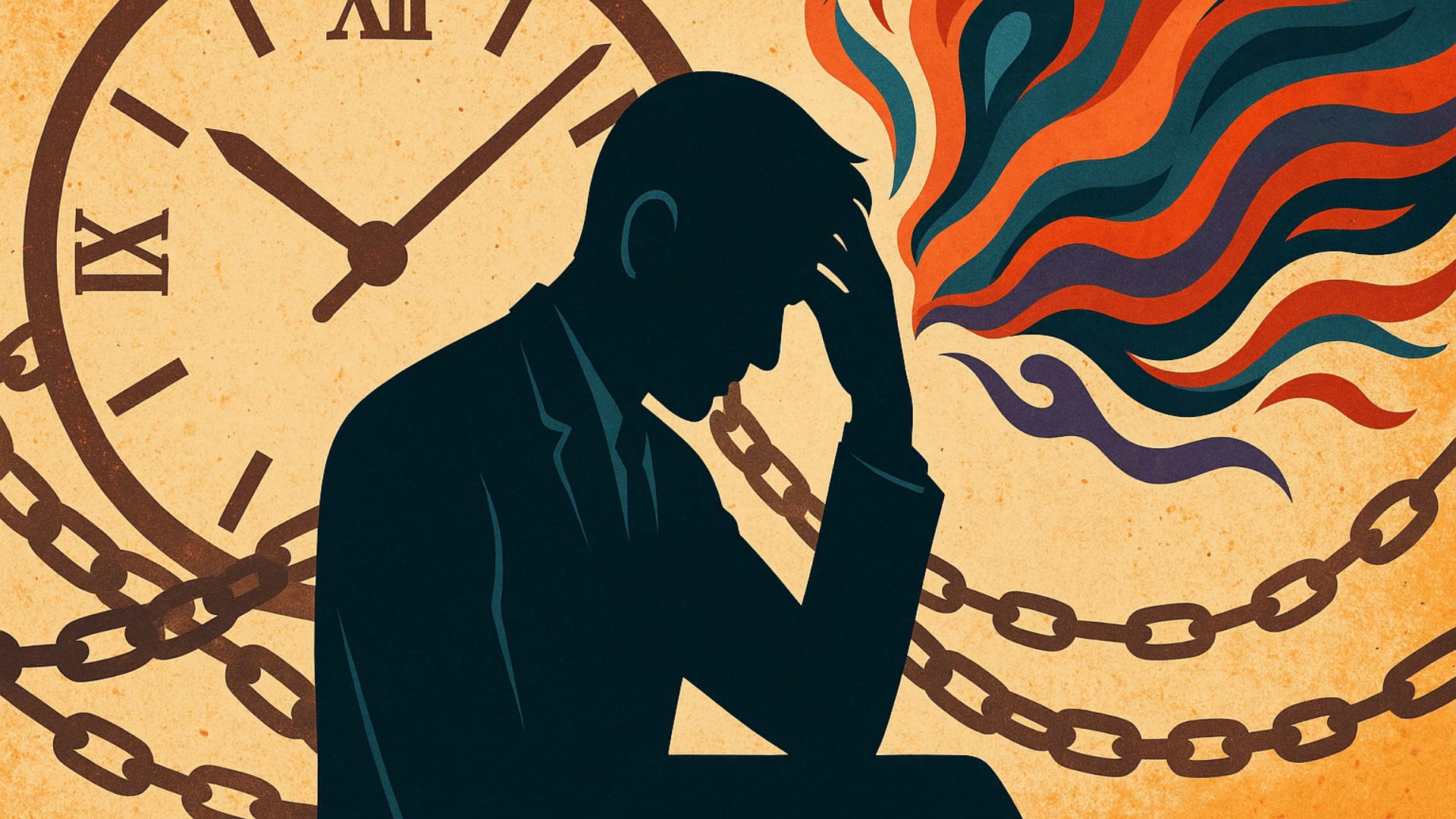
The following thoughts emerged from conversations with Marie Reig Florensa about contemporary preoccupations with time and, specifically, opportunities for creative leaders to progress beyond conventional, often hack-based, and efficiency-driven approaches to time management to more holistic and purpose-driven time leadership. My great thanks to her for those enriching and illuminating exchanges.
In today's hyperconnected world, an insidious form of behavioral addiction has emerged among creative leaders and producers: time addiction. While not formally recognized by clinicians, this obsessive pursuit of temporal efficiency manifests as a compulsive need to optimize every moment, amplified by the constant pressure to engage with new technologies and digital platforms. As the creative industries face unprecedented pressure to innovate and embrace new technologies and ways of working, all while maintaining productivity, understanding and addressing this phenomenon becomes crucial for sustainable creative leadership.
The Everyday Reality
Consider Sarah, the (fictional) creative director of a leading design agency. Her Google Calendar is a technicolor mosaic of back-to-back meetings, punctuated by alerts from multiple AI-powered project management tools. Her productivity apps track every minute, while her team receives Slack messages at all hours as she attempts to “optimize” their collective time use. Between managing her agency's social media presence, evaluating new AI tools, and maintaining traditional creative responsibilities, her attention splinters into ever-smaller fragments. Despite her apparent efficiency, breakthrough ideas have become rare, and her once-vibrant team shows signs of burnout.
Or take Marcus, a successful (albeit also fictional) film producer known for his meticulous scheduling. His commitment to time optimization led him to implement strict 25-minute meeting limits and required detailed time justifications for every production decision. While this approach initially impressed stakeholders, the addition of real-time collaboration tools and automated workflow systems has created an atmosphere of temporal anxiety that stifles the collaborative exploration essential to filmmaking. His team now spends as much time managing their digital tools as they do on creative development and production.
These figures and scenarios illustrate a growing pattern: creative leaders inadvertently sacrifice the spaciousness necessary for innovation in pursuit of ever-greater temporal efficiency, a challenge relentlessly complicated by technological acceleration.
The Deeper Stakes
Time addiction in creative leadership represents more than just poor work-life balance or decisions made disproportionately to use time more and more efficiently. It reflects a fundamental misunderstanding of how creative work happens and how effective leadership operates, particularly in an increasingly digital age. This misunderstanding occurs on several key dimensions.
Classic observational studies by management guru Henry Mintzberg showed that effective leadership requires substantial unstructured strategic decision-making (Mintzberg, Raisinghani & Theoret, 1976). Time was a key factor in this lack of structure (or, in his terms, “an explicit set of ordered responses”), manifested in the varying overall duration of decision processes and the differing time intervals of the communications and feedback related to decision-making processes. Even more, the steps necessary to make complex decisions were typically organized into manageable temporal steps that weren’t always best-suited to those decisions; that is, regardless of the optimal timing for making decisions – and thereby committing to actions like allocating resources – the busy-ness of executives often created delays or forced a staging of decisions that diminished them. Allowing for unstructured time enables serendipitous interactions that build organizational culture, allows for more robust decision-making as well as creates space for strategic thinking and pattern recognition, and facilitates relationship building.
More recently, the widely discussed theories of Hungarian-American psychologist Mihaly Csikszentmihalyi demonstrate how optimal creative performance can emerge in what he terms “flow states,” periods of uninterrupted and focused activity (Csikszentmihalyi, 2008). While the exact timing varies for individuals and contexts, and according to different researchers), both entering a flow state (generally described in the many tens of minutes) and the time spent there (typically described as an hour or more) require more carefully orchestrated scheduling, without interruptions, than many executive routines allow for. Csikszentmihalyi’s studies show that achieving flow becomes nearly impossible when work is fragmented into short and, especially, unpredictable intervals, a pattern experienced by creative leaders today.
Computer scientist Cal Newport’s research on the intersection of technology and knowledge work productivity reinforces these findings, describing how high-performing professionals perform “in a state of distraction-free concentration” that pushes their cognitive capabilities to their limit. Yet knowledge and creative workers are increasingly losing their familiarity with this “deep work,” he argues, for a single reason: network tools. The contrasting result of the fragmented attention produced by these tools is “shallow work: noncognitively demanding, logistical-style tasks, often performed while distracted.” An irony that Newport sees in his analysis is that the ability to perform deep work is becoming increasingly rare at exactly the same time it – and the value-creating, hard-to-replicate ideas it generates – is becoming increasingly valuable in our economy(Newport, 2016).
The technological acceleration of time demands, particularly through the use of digital devices, is itself a critical dimension of time addiction. Psychologist Gloria Mark, of the University of California, Irvine, has shown that our attention spans are declining, averaging just 47 seconds on any screen, reduced by the integration of multiple digital platforms and AI tools into a given workflow (Mark, 2023). This “context switching” creates what she terms "temporal fragmentation," where even basic tasks become interrupted by the need to learn new systems, respond to algorithmic prompts, and engage with social media for personal or professional purposes. Some digital media analysts have gone further and alleged a temporal extension of the “context collapse” in which professional development, networking, and creative work blur across digital platforms (boyd, 2010; Brandtzaeg & Lüders, 2018).
Ultimately, these psycholgical and media analyses are substantiated by neuroscience. The neurological impact of striving to fill every hour and every day is well-documented. For instance, studies of the brain's Default Mode Network (DMN) show that creative insights often emerge during periods of apparent idleness. When leaders eliminate these “unproductive” moments, they literally rob their brains of essential processing time. The groundbreaking research of Marcus Raichle, a neurologist at the Washington University School of Medicine, suggest that the DMN actively engages in pattern recognition and even creative problem-solving during these seemingly “resting-state” moments (Raichle, 2015).
Yet whatever the acceleration of time addiction by today’s technologies, the risks of not allowing for unstructured time, idleness, or, to go further as Newport does, “boredom” all point to a broader cultural paradox. As German philosopher Josef Pieper observed in his classic study, Leisure: The Basis of Culture, our society’s worship of productive time use fundamentally misunderstands human flourishing (Pieper, 1948). His critique, written more than seventy-five years ago, was that modern labor and its associated “hectic” amusements had replaced “the art of silence and insight” and “the ability of non-activity” that were historically the foundation of our shared cultures and ourselves. His profound if paradoxical argument would be echoed by Czikszentmihalyi decades later, saying that unstructured “free time” “requires much greater effort to be shaped into something that can be enjoyed” and therefore calls on us to develop ourselves and our relationships with others (Czikszentmihalyi, 2008).
The Performance Paradox
These shifts in the wider patterns of leaders’ scheduling and use of time – for work, for leisure, for operational technology, and for network tools – have direct if layered consequences for teams and organizations. Recent organizational research provides further evidence about the relationship between time boundaries and leadership effectiveness. Business psychologist Leslie Perlow identified that leaders often fall into a “cycle of responsiveness,” in which teammates, superiors, and subordinates continue to make more and more requests, and the conscientious leader is inclined to respond to these marginal increases in demands, while the expectations of others (and the leader themself) continue to rise. More encouragingly, her study also found that leaders who implemented predictable time off increased their team's performance by 37% on internal project effectiveness metrics (Perlow, 2012).
Similarly, management researchers Erin Reid and Lakshmi Ramarajan (2016) demonstrated that executives who maintained strict boundaries around availability achieved 23% higher team innovation scores and reported 35% better retention rates than their “always on” counterparts. In a 12-year study tracking 27 CEOs of large companies, Leadership scholars Michael Porter and Nitin Nohria (2018) found that the most effective CEOs preserved about 28% of their work time for spontaneous interactions. The leaders who maintained at least 25% unscheduled time scored higher on key performance metrics. Companies whose CEOs maintained "planned spontaneity" showed 19% higher employee engagement scores. Even more comprehensively, in The Progress Principle, business creativity researchers Teresa Amabile and Steven Kramer (2011) tracked 238 creative professionals across 26 project teams, determining that leaders who protected what they called “predictable time off” saw:
45% higher solution-originality ratings from independent evaluators
28% faster project completion times
33% higher team satisfaction scores
More frequent breakthrough ideas (3.8 vs 1.2 per quarter on average)
These findings align with Csikszentmihalyi’s concept of “optimal experience” in leadership, which holds that creative breakthroughs typically emerge not from constant engagement – or the constant availability championed by many modern leaders – but from rhythmic alternation between intense focus and deliberate recovery.
Time addiction exacts several specific tolls on creative leadership. First, it creates an innovation deficit. Amabile and Kramer demonstrated that time pressure typically reduces creative thinking except in specific “mission” contexts. The constant drive for temporal efficiency, combined with the cognitive load of managing multiple digital platforms, creates precisely the conditions that inhibit breakthrough thinking. A second cost is relationship erosion. The compulsive and exhaustive scheduler, left with little or no unscheduled time, also loses opportunities for the informal and unplanned interactions that build trust and spark collaborative innovation. This challenge compounds when virtual collaboration tools replace organic interaction. Third, besides the network tools examined by Newport, the rise of AI and automation tools presents another temporal contradiction. Even as these technologies promise to handle routine tasks, they generate new demands and a hidden temporal cost – what anthropologist Mary Gray and computer scientist Siddharth Suri (2019) call “ghost work” – the invisible time spent training, correcting, and managing automated systems and, increasingly, their endless output.
More critically, time addiction can lead to strategic blindness. Just as Mintzberg’s pioneering research showed five decades ago the liabilities of overly structured strategic decision-making, overoptimized schedules today leave little room for the reflection necessary to spot emerging opportunities or threats. Media scholar Sherry Turkle’s research demonstrates how such constant connection creates a new form of temporal anxiety – a kind of FOMO: the fear of missing critical professional opportunities by disconnecting even briefly (2015). The blindness to these wide-ranging impacts, both strategic and operational, of time addiction and the unwillingness to risk changing that unrelenting commitment often leaves unacknowledged by leaders or creatives. Despite the repeated research findings, many creative leaders and practitioners persist in the belief that their exhausting expenditure of time and constant connection yield great creative results.
To offer a striking recent example of the excessive amount of time that can be spent on creative work, the tennis icon Rafael Nadal played his final match and retired late last year. One of Nadal’s long-time sponsors, Nike, quickly released a moving tribute ad with the tagline, “Greatness. It only takes everything.” Shortly thereafter, Simon Allen, identified as a “Creative at Weiden+Kennedy,” the agency responsible for the spot, posted on social media a claim proudly outlining what was required to produce the one-minute ad: “395 days. 123 decks. 16 weekends. 64 late nights. 98 takeaways. 18 incredible W+K people. 31 creative reviews. 24 script re-writes. 3 shoot days. 62 days in post. 1 KV. 10 projections. 60 seconds of film. It only takes everything” (Allen, 2024). Most social media replies to the post celebrated the craft and emotion of the ad. A few others were harshly critical, saying such extreme behavior was driving creative talent from the advertising industry. One comment, from former network agency leader Kieran Antill, put plainly what much of the research shows: “Long hours does not mean better work, in fact tired and worn out brains do the opposite”(Antill, 2024).
Toward Better Time Leadership
While mixed with praise for the end product, the exchanges on LinkedIn about the time spent on the Weiden+Kennedy tribute ad for Rafa Nadal include open acknowledgment and criticism of personally harmful and creatively compromising time addiction behaviors. That increased awareness, both by individual leaders and practitioners, is an essential step beyond the willful blindness of many creative leaders and other creatives toward addressing the chronic time addiction in many creative industries. Awareness also emerges from the work of researchers and writers – including Cal Newport, Gloria Mark, Leslie Perlow, Sherry Turkle, and others cited here – who address shifting work dynamics, changing interactions with network tools and other digital devices, and their impacts on our behaviors and engagement with time.
These writers also share proven practices and practical starting points for addressing time addiction in leadership and creative work. For instance, Newport advocates for what he terms “rhythmic scheduling” – blocking out specific times for uninterrupted creative work while batching administrative tasks and communications into designated shallow work periods. Among his major findings are that leaders who protect 3-4 hour daily blocks for complex problem-solving and “deep work” consistently outperform peers who work in fragmented intervals. As several major design firms have demonstrated with “maker mornings” – protected time blocks before noon when no meetings can be scheduled and digital communications are discouraged – this approach works for leaders and other creators alike. Conversely, Newport specifically notes that “shallow work,” like email, text messaging, and regular meetings, should be batched into separate time blocks to preserve cognitive resources for innovative thinking. This research provides quantifiable evidence that creative success depends not just on talent or effort, but on the structural protection of focused time.
Addressing time addiction across teams or organizations requires a more multi-faceted approach that encompasses structural, cultural, and individual dimensions. At the structural level, organization leaders can mandate meeting-free half-days or days (like “Maker Mornings” or “Think Thursdays”) for deep work and reflection, create intentional “white space” in calendars for emergence, and establish “slow zones” where rushing and digital interruption are explicitly prohibited. Cultural shifts are equally important. Leaders must also redefine efficiency to include space for creativity, actively celebrate and reward thoughtful pauses and strategic inaction, and build appreciation for different working rhythms. This cultural evolution requires sustained attention and leadership commitment, particularly in establishing what cyborg anthropologist Amber Case calls “calm technology” design principles – choosing and implementing tools that respect human attention and temporal rhythms rather than demanding constant engagement (Case, 2015).
Thoughtful and consistent oversight of technology is crucial to addressing time addiction. Rather than the wholesale adoption or rejection of new tools, creative leaders need what information and technology scholar David M. Levy calls “mindful tech” practices (Levy, 2016). These include designated periods for tool evaluation, clear boundaries around technology adoption, and strategic decisions about which platforms truly serve creative and leadership goals. Organizations might implement "digital Sabbaths" – structured breaks from non-essential technology use that allow for deeper creative engagement. The pace of technological change adds another layer of complexity. Leaders must balance the professional necessity of platform engagement and tool adoption with the need to protect creative time and mental space.
Individual practices also play a crucial role, of course, in breaking time addiction. Regular digital detox periods help reset temporal awareness, while mindfulness practices can reduce temporal anxiety. The concept of “strategic inefficiency” – deliberately maintaining schedule margins and technological boundaries – proves particularly powerful for creative leaders. Modeling time leadership also becomes essential for leading sustainable change across teams and organizations. Creative leaders must visibly engage in unstructured thinking time, protect team members' right to unavailability, and demonstrate comfort with uncertainty and emergence. Their example sets the tone and establishes a culture of safety for the entire team’s or organization's relationship with both time and technology.
To improve time leadership more generally, a framework for change like the following can help:
1. Awareness and Assessment
Audit current time-use patterns and technology dependencies
Identify specific manifestations and pain points of time addiction
Map impact on individual and team well-being creative outputs
Evaluate existing digital and network tools and their temporal demands
2. Design and Commitment
Create a customized intervention plan, including specific alternatives to current technology uses
Build support systems and enlist trusted advisors for change
Develop individual metrics – and other, qualitative standards – for healthy time use
Establish guidelines for new technology adoption and use
3. Implementation and Feedback
Gradual formulation and introduction of new practices
Regular feedback from support systems and trusted advisors, with appropriate adjustments
Celebration of early wins
Phased approach to shifting technological boundaries and usage
4. Sustainability and Adaptation
Integration into regular routines and team or organizational culture
Ongoing monitoring and support
Evolution of key practices based on learning and feedback
Regular reassessment and review of digital tools and platforms and usage
The success of time addiction interventions depends heavily on specific conditions and contexts. Industry norms and prevailing expectations shape our baseline temporal demands – film production, for instance, may operate under different constraints than advertising or product design. Existing individual organizational cultures also significantly influence the feasibility and approach of any change initiative. Individual differences in working styles and creative rhythms must likewise inform the design and implementation of interventions. As creative industries continue to evolve and new technologies emerge, the pressure toward time addiction is likely to increase. Creative leaders must actively cultivate alternative approaches to engaging these technologies that protect the temporal spaces and time necessary, for themselves and others, for creativity and innovation. This might mean being “inefficient” in conventional terms to be truly effective and creative in deeper and longer-term ways.
References
Simon Allen (2024) “395 days. 123 decks. 16 weekends. 64 late nights. 98 takeaways. 18 incredible W+K people. 31 creative reviews. 24 script re-writes. 3 shoot days. 62 days in post. 1 KV. 10 projections. 60 seconds of film. It only takes everything,” LinkedIn, November 20, 2024; https://www.linkedin.com/feed/update/urn:li:activity:7265056729548124160/ (accessed November 21, 2024).
Teresa Amabile and Steven Kramer (2011) The Progress Principle: Using Small Wins to Ignite Joy, Engagement, and Creativity at Work, Harvard Business Review Press.
Kieran Antill (2024) “This is exactly why I won’t work for a network agency again. The presumption that they own your life outside of agreed work hours. It’s all good people but working in a dated culture and a broken system. Long hours does mean better work, in fact tired and worn out brains do the opposite,” LinkedIn, November 20, 2024; https://www.linkedin.com/feed/update/urn:li:activity:7265110963694034944/ (accessed November 21, 2024).
danah boyd (2010) “Social Network Sites as Networked Publics: Affordances, Dynamics, and Implications,” in Networked Self: Identity, Community, and Culture on Social Network Sites, ed. Zizi Papacharissi, Taylor & Francis, pp. 47-66.
Petter Bae Brandtzaeg and Marika Lüders (2018) “Time Collapse in Social Media: Extending the Context Collapse,” Soc
ial Media & Society, Vol. 4, Issue 1, January-March 2018, 1-10.
Amber Case (2015) Calm Technology: Principles and Patterns for Non-Intrusive Design, O'Reilly Media.
Mihaly Csikszentmihalyi (2008) Flow: The Psychology of Optimal Experience, Harper Perennial Modern Classics.
Mary L. Gray and Siddhartha Suri (2019) Ghost Work: How to Stop Silicon Valley from Building a New Global Underclass, Houghton Mifflin Harcourt.
David M. Levy (2016) Mindful Tech: How to Bring Balance to Our Digital Lives, Yale University Press.
Gloria Mark (2023) Attention Span: A Groundbreaking Way to Restore Balance, Happiness and Productivity, Hanover Square Press.
Henry Mintzberg, Duru Raisinghani, and Andre Theoret (1976) “The Structure of ‘Unstructured’ Decision Processes,” Administrative Science Quarterly, 21, 246-275.
Cal Newport (2016) Deep Work: Rules for Focused Success in a Distracted World, Grand Central Publishing.
Leslie Perlow (2012) Sleeping with Your Smartphone: How to Break the 24/7 Habit and Change the Way You Work, Harvard Business Review Press.
Josef Pieper (1948) Leisure: The Basis of Culture, Ignatius Press.
Michael Porter and Nitin Nohria (2018) “How CEOs Manage Time,” Harvard Business Review, July-August, 2018.
Marcus E. Raichle (2015) “The Brain's Default Mode Network,” Annual Review of Neuroscience, 38, 433-447.
Erin Reid and Lakshmi Ramarajan (2016) “Managing the High-Intensity Workplace,” Harvard Business Review.
Sherry Turkle (2015) Reclaiming Conversation: The Power of Talk in a Digital Age, Penguin Press.