


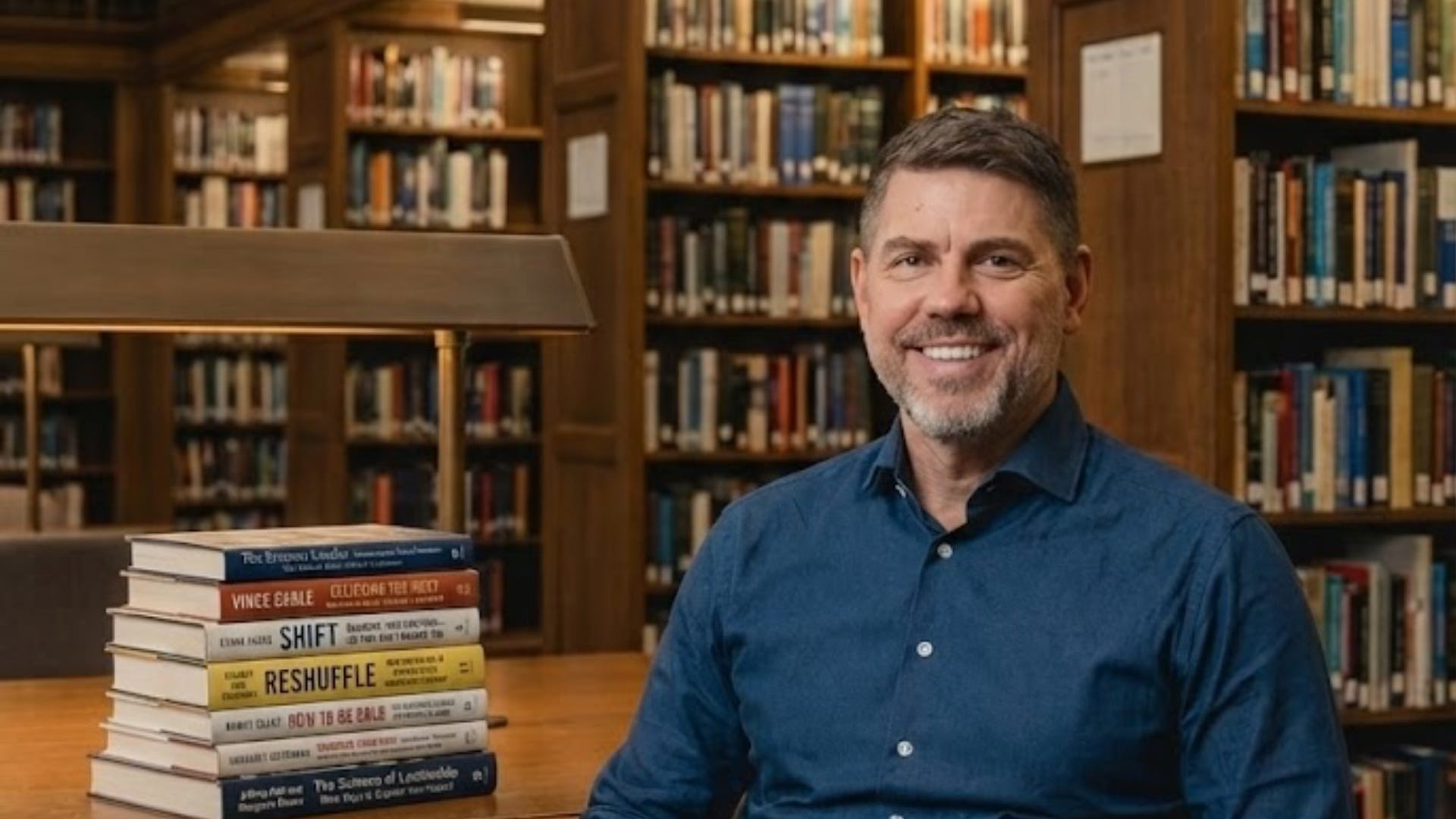
While I’ve been assembling Top 10 lists of Creative Leadership Books for more than a decade, three issues challenged my doing so in 2025. The first is the continuing proliferation of other media formats that shape the popular discourse and practice of creative leadership today. Podcasts, short-form videos, blogs, and social media posts have become in many ways more influential in driving discussions and debates around creativity and leadership today than books. Moreover, many of the same ideas initially presented in books become more widely disseminated through these other formats and channels.
The second issue concerns the increasing overlap in popular discourse between the leadership in business and other sectors, particularly politics. This overlap is driven, importantly, by the aforementioned proliferation of other social media and digital formats. At the same time, the questioning of boundaries and categories of leadership has become more and more timely and even urgent in today’s fast-changing and complex environment. Expanding the boundaries of creative leadership, both for leaders with formal roles in different sectors and those whose creativity and impact address multiple contexts, suggests casting a wider net of readings from which potential insights can be drawn.
A third issue is the often blinkered non-fiction category from which I ordinarily select most “creative leadership” titles. Following Barbara Kellerman and Jeffrey Pfeffer, I’m a regular critic of the Leadership Industrial Complex that produces a never-ending and frequently insular stream of books and, as noted, other media that circumscribe discussions of creativity and leadership and privilege specific ideas and viewpoints. Recently, that stream has tended toward self-help and self-optimization topics in ways that arguably limit rather than expand the exploration of creative leadership at an historical moment in which the fearless and wide-ranging encounter with current conditions is most needed.
Mindful of these concerns, I’ve nevertheless decided to retain here a focus on non-fiction books published during the last calendar year and to recognize those titles that contribute to creative leadership thinking and practice regardless of their explicit focus on business, politics, or other pursuits. I believe that reading book-length arguments and provocations remains essential to the ongoing learning and growth of creative leaders – though I look forward, in the future, to highlighting the interventions offered by other media and, especially, the stories offered in fiction. Since I also believe that the development of creative leaders, as well as that of creative leadership as a field, benefits from the broadest possible engagement with ideas, experiences, and resources, one valuable starting place, though hardly the only one, are books like those on the following list.
The 2025 book titles that most resonantly frame creative leadership as a dynamic practice that links reflective awareness with decisive action at both individual and systemic levels. Ethan Kross, Anne-Laure Le Cunff, and Tomas Chamorro-Premuzic encourage leaders to scrutinize their emotional habits, experimental routines, and self-concepts in order to act with greater clarity and adaptability. They treat development as an ongoing discipline that strengthens judgment under pressure and widens the range of possible responses. Margaret Heffernan, Ranjay Gulati, and Suleika Jaouad show how uncertainty can invite deeper engagement rather than retreat when leaders cultivate presence, curiosity, and the courage to make timely and imaginative choices. Jeffrey Hull and Margaret Moore integrate these insights by presenting growth as a continuous inquiry into how attention, behavior, and relationships shape action. Taken together, these works argue that leaders who continually cultivate their inner selves can make more grounded decisions and respond with greater originality and steadiness amid competing demands.
A second, complementary group of books widens the horizon by examining how action taking and decision making are also shaped by shifting technological, economic, and organizational contexts. Robert E. Siegel, Sangeet Paul Choudary, and Vincent Cable illustrate how AI-driven coordination, ecosystem restructuring, and geopolitical change complicate familiar strategic moves and require leaders to interpret evolving patterns with sharper situational awareness. Their analyses call for leaders who can navigate contradictions, orchestrate networks, and revise choices as conditions shift. Stephen Witt and the team of Richard E. Thaler and Alex O. Imas deepen this perspective by revealing how cognitive biases, organizational heuristics, and long-term technological bets influence the quality of decisions in high-velocity contexts. These authors challenge leaders to question inherited assumptions, understand the architectures beneath emerging trends, and act with both discipline and flexibility. They also suggest that the year ahead will reward those who can combine reflective insight with more refined sensemaking as bases of bolder, better-timed decisions that sustain creativity despite uncertainty.
CREATIVE LEADERSHIP BOOK OF THE YEAR 2025
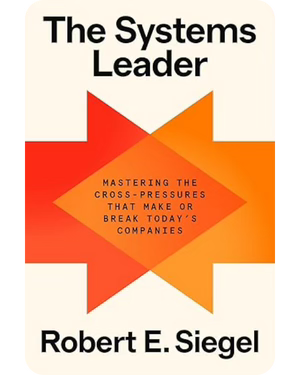
Robert E. Siegel, The Systems Leader: Mastering the Cross-Pressures That Make or Break Today’s Companies (Crown Currency)
Stanford Graduate School of Business lecturer Robert E. Siegel brings decades of experience as venture capitalist, operator, and consultant to this examination of contemporary leadership contradictions. He identifies five critical dimensions where leaders today face seemingly irreconcilable pressures: execution versus innovation, strength versus empathy, internal versus external focus, local versus global thinking, and ambition versus statesmanship. Building on insights from leaders at varied organizations including Accenture, Mubadala, Wells Fargo, Kering, and Box, Siegel proposes systems leadership as a practice of reconciling pressures that often feel irreconcilable. His dimensions pose essential questions like, how execution can coexist with experimentation, or how empathy and authority can be projected simultaneously. The book likewise challenges leaders to examine whether their current approaches to influence, geography, and purpose remain fit for a world where conflicting pressures are permanent rather than episodic. Siegel’s call to develop a “holistic capability” to hold tensions productively without demanding simplistic either-or choices is both pragmatic and aspirational, offering a blueprint for cultivating creative leadership that thrives in contemporary complexity rather than becoming overwhelmed by it.
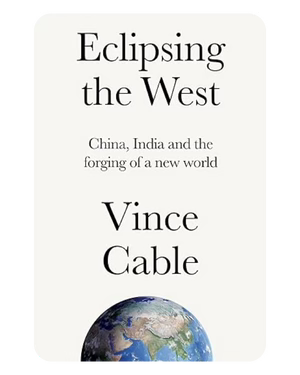
Vince Cable, Eclipsing the West: China, India and the Forging of a New World
(Manchester University Press)
Vince Cable, the development economist who served as the UK Secretary of State for Business after earlier leadership positions at Shell and the Commonwealth Secretariat, has written an exceptional data-driven analysis of the geopolitical shifts redefining global influence. His previous works on economic strategy and industrial policy, Money and Power (2021) and The Chinese Conundrum (2022), established a compelling narrative approach that blends long-term structural analysis with grounded political insight. Here, Cable investigates how China and India are creating a new economic and cultural order and whether Western leaders and institutions can adapt. His concept of “enlightened realism” offers an alternative to both naive engagement and reflexive containment, suggesting creative leadership must transcend ideological frameworks to understand fundamentally different approaches to development, technology deployment, and state-market relationships that will define the coming decades. As a result, the book pushes leaders to re-think their organizations’ assumptions about collaborative advantage, narrative power, and the capacity of leaders to engage plural worldviews rather than default to defensive strategic habits.
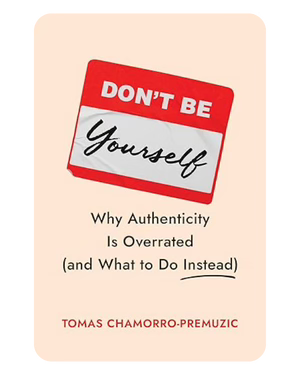
Tomas Chamorro-Premuzic, Don’t Be Yourself: Why Authenticity is Overrated (and What to Do Instead)(Harvard Business Review Press)
Drawing on extensive research and corporate advisory work, the Columbia University and Universty College London business psychologist reframes authenticity as a potential constraint when leaders cling to fixed self-concepts. Chamorro-Premuzic, well-regarded for Why Do So Many Incompetent Men Become Leaders?(2019) and I, Human (2023), suggests that effective leadership requires ongoing and imaginative self-construction, grounded humility, a disciplined commitment to personal growth, and relational intelligence rather than the unfiltered self-expression and performative authenticity. In the process, he encourages questions about how identity is crafted, how confidence can coexist with doubt, and how leaders can invest in continuous reinvention without losing their integrity. Chamorro-Premuzic’s argument invites leaders to adapt, evolve, and calibrate behaviors based on disciplined self-awareness, aspirations, and situational requirements rather than always striving to express our “true selves.”
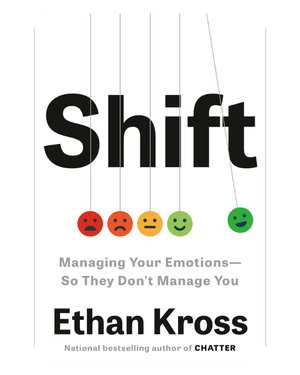
Ethan Kross, Shift: Managing Your Emotions – So They Don’t Manage You (Crown)
Ethan Kross, the University of Michigan psychologist whose bestseller Chatter (2021) transformed our understanding of inner dialogue, expands the conversation by exploring emotional regulation as a core practice of leadership. Challenging persistent myths about emotions, he moves beyong conventional approaches like constant confrontation and strategic avoidance to argue that emotions are information systems that can function like immune responses by alerting us to environmental conditions. Kross pushes creative leaders, in particular, to consider whether our emotional habits and regulatory tools widen or narrow our capacity for imaginative problem solving and better decision-making. His analysis urges reflection on how our micro-shifts in attention, language, and context can create significant changes in team culture and decision quality. The book also raises a central question for today’s uncertain environments: how can leaders cultivate a steadier internal climate while remaining fully engaged with the emotional realities of their organizations? The answer takes the form of four critical “shifting” domains – perspective reframing, attention redirection, relationship leveraging, and environmental reshaping – that serve as practical strategies for what Kross terms “emotional agility” in high-pressure creative environments where sustained performance demands sophisticated self-regulation.
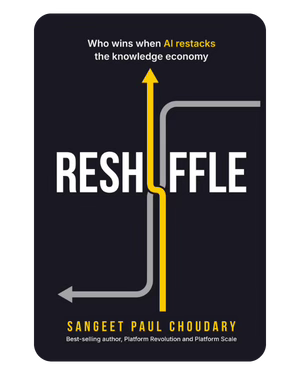
Sangeet Paul Choudary, Reshuffle: Who Wins When AI Restacks the Knowledge Economy(Independently published)
Platformation Labs founder and UC Berkeley Haas School of Business senior fellow Sangeet Paul Choudary, author of the bestselling Platform Revolution (2016, with Geoffrey G. Parker and Marshall W. Van Alstyne) and Platform Scale (2015), advances a counterintuitive thesis about the future of AI. Rather than focusing on automation or efficiency, he emphasizes AI’s power to reconfigure and enhance coordination, reshape value flows, and reposition actors across ecosystems. To do so, Choudary identifies four critical tensions: workers versus software tools, tool providers versus purchasing firms, consolidating businesses versus disrupted industries, and empowered individuals versus entrenched incumbents. For creative leaders, especially, this reorientation raises pressing questions: When AI enables “coordination without consensus,” do traditional leadership frameworks requiring alignment become obsolete? How should leaders today design roles, partnerships, and talent pipelines when the boundaries between tasks and knowledge domains are shifting? And, what new organizational forms emerge when knowledge work migrates from humans to systems? Choudary’s systems thinking approach, illustrated through examples from shipping containers to Formula One pit stops, suggests creative leadership must shift from managing people performing tasks to orchestrating complex adaptive systems where value creation increasingly depends on sophisticated coordination architectures rather than traditional hierarchical control.
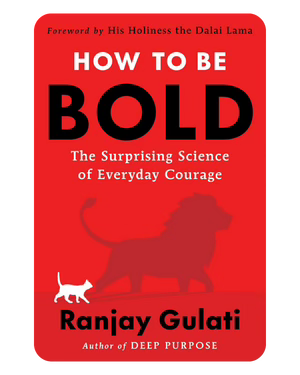
Ranjay Gulati, How to Be Bold: The Surprising Science of Everyday Courage (Harper Business)
How do organizations cultivate collective courage rather than depending on heroic individuals? What conditions enable people to act decisively amid uncertainty without recklessness? By reframing courage as the ability to act constructively amid uncertainty, interpersonal tension, or reputational risk. Harvard Business School professor Ranjay Gulati argues that boldness can be cultivated through deliberate habits and disciplined practice that strengthen conviction and reduce fear-driven decision making. His research encourages creative leaders to ask how our systems reward experimentation, how we personally respond to discomfort, and whether our cultures truly enable dissent. Like his earlier work, Deep Purpose (2022), the book offers practical reflections on aligning purpose with action, making it especially relevant to environments where creativity, innovation, and adaptability depend on leaders who model thoughtful risk taking. Ultimately, Gulati reveals that courageous people don’t eliminate fear but rather adopt thinking patterns that neutralize or moderate it, creating what he terms positive narratives that recast challenges as moral quests that inspire teams through connection and shared commitment rather than charisma or exhortation.
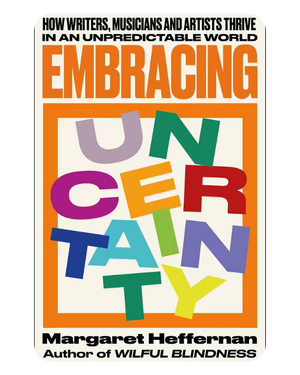
Margaret Heffernan, Embracing Uncertainty: How Writers, Musicians and Artists Thrive in an Unpredictable World (Policy Press)
Extending the argument of her previous work, Uncharted (2020), which portrayed uncertainty as inevitable rather than controllable, Margaret Heffernan examines how writers, musicians, and visual artists don’t merely tolerate ambiguity but actively run toward making the future with agency and freedom. The former BBC radio and television producer, and bestselling author of Willful Blindness (2011) argues that these artists’ relationships with uncertainty offer valuable lessons for all leaders. Her case studies illuminate habits of attention, collaboration, and resilience that challenge the managerial pursuit of predictability and efficiency. Heffernan suggests that uncertainty is not simply a constraint but a generative condition for creativity. Overall, the book appeals to leaders to reconsider how we structure time, design experiments, and engage with emergent possibilities. Heffernan also invites reflection on whether leaders genuinely cultivate the openness required for discovery or whether organizational routines (not to mention tech-enabled managerialism and algorithmic decision-making) silently reinforce control. Her insights challenge creative leaders to learn from artistic processes and methods that privilege curiosity and improvisation as essential sources of renewal in turbulent contexts.
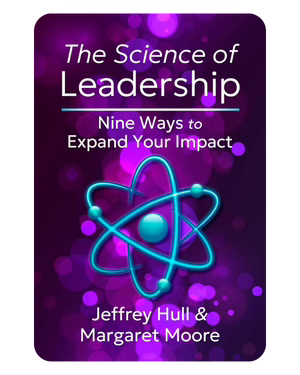
Jeffrey Hull and Margaret Moore, The Science of Leadership: Nine Ways to Expand Your Impact(Berrett-Koehler Publishers)
Jeffrey Hull and Margaret Moore synthesize more than 15,000 studies into nine interconnected capacities: self-oriented capacities (conscious, authentic, agile), other-oriented approaches (relational, positive, compassionate), and system-oriented frameworks (shared, servant, transformational). Each capacity addresses essential questions: How do leaders develop the conscious awareness to see situations clearly, including their own biases? What distinguishes authentic care from performative empathy? How do leadership habits shape energy, attention, and relationships? With their evidence-based framework, which blends psychology, neuroscience, and systems thinking, the two cofounders of the Institute of Coaching at Harvard Medical School challenge conventional leadership development by demonstrating that effective leadership isn’t measured by the leader’s own performance but by how others perform under their guidance. For creative leaders navigating exponential change and ongoing uncertainty, the authors helpfully translate complex academic research into accessible self-coaching roadmaps, arguing that leadership can and should be learned and practiced like any discipline rather than treated as innate talent. The book positions humility, care, and accountability not as “nice to haves” but as essential competencies for unlocking employee potential and engagement in contemporary organizations and deepening impact in environments marked by rapid change and generative tensions.
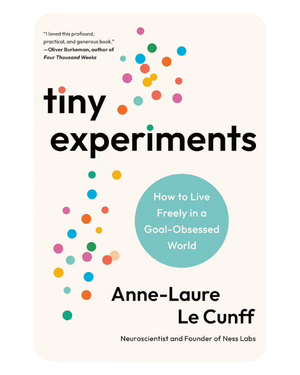
Anne-Laure Le Cunff, Tiny Experiments: How to Live Freely in a Goal-Obsessed World (Avery)
The former Google executive turned neuroscientist, and founder of Ness Labs (which publishes a highly recommended weekly newsletter), challenges the linear pursuit of goals and proposes a circular vision of growth shaped through curiosity, iteration, and small, reversible tests. Le Cunff argues that life’s inherent non-linearity makes traditional four-year degrees, ten-year career plans, and thirty-year mortgages fundamentally mismatched to actual human development patterns. Her framework, grounded in ancestral philosophy and contemporary cognitive science, poses critical questions: Why do we expect happiness to arrive upon goal achievement when research demonstrates this “arrival fallacy” consistently disappoints? And, how might treating challenges as experiments rather than pass-fail tests transform both learning and innovation? Using scientific method principles, Le Cunff demonstrates that uncertainty can represent expanded possibility and metamorphic space rather than threat or deficit. For creative leaders, her work suggests replacing rigid planning with iterative experimentation, where “productive failure” becomes essential feedback rather than career liability. The growth model she proposes, where goals emerge through conversation with the larger world rather than predetermined isolation, offers practical strategies for navigating ambiguity while maintaining forward momentum in rapidly changing environments in which traditional planning horizons increasingly prove obsolete. Le Cunff underscores the potential of experimentation as a cultural practice that enhances resilience, fosters serendipity, and keeps creative ambition aligned with lived experience.
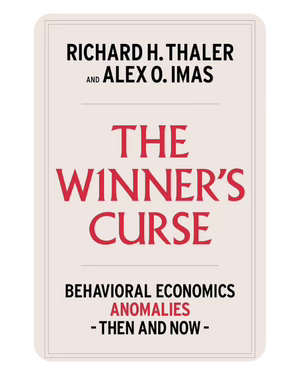
Richard H. Thaler and Alex O. Imas, The Winner’s Curse: Behavioral Anomalies – Then and Now(Simon & Schuster)
Nobel laureate Richard H. Thaler, a foundational figure in behavioral economics, joins University of Chicago economist Alex O. Imas to revisit and update earlier anomalies that challenged classical economic models. The authors extend insights from Thaler’s Misbehaving (2015) and Nudge (written with Cass Sunstein, 2009), as well as his original seminal 1990s Journal of Economic Perspectives “Anomalies” columns (written with collaborators including Daniel Kahneman and Amos Tversky), by examining how new data and experimental approaches refine earlier theories of judgment and decision making. The eponymous “winner’s curse,” where auction victors systematically overpay, appears not just in oil lease bidding but in publishing acquisitions and professional football draft trades. For creative leaders, these phenomena raise unsettling questions: If even experts with sophisticated analytical resources fall prey to systematic biases like loss aversion and the endowment effect, what organizational safeguards become necessary? How do financial markets’ persistent inefficiencies (evidenced by meme stocks and cryptocurrency volatility) challenge assumptions about market rationality underlying strategic decisions? The book urges leaders to test how narratives of rationality obscure emotional, social, and contextual influences on behavior – and quietly if consistently distort strategic and creative decisions. Thaler and Imas also highlight how small design choices can produce disproportionate effects on team dynamics and innovation, prompting reflection on how leaders structure incentives, frame decisions, and cultivate awareness of cognitive patterns.
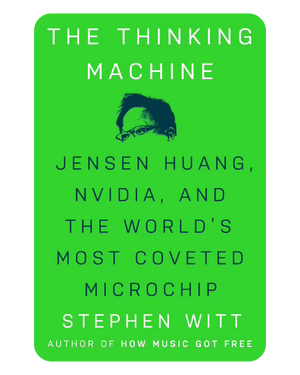
Stephen Witt, The Thinking Machine: Jensen Huang, Nvidia, and the World’s Most Coveted Microchip(Viking)
The story of Nvidia’s ascent and the relentless drive behind CEO Jensen Huang becomes a study in how technical imagination, strategic persistence, and disciplined storytelling can reshape an entire computational era. What begins as the evolution of a niche graphics component becomes, for Stephen Witt, the journalist and author of How Music Got Free, a deeper inquiry into how leaders cultivate conviction and maintain clarity while navigating technological volatility. The narrative shows how long-horizon bets take root only when organizational cultures protect curiosity and sustain inventiveness across cycles of pressure and opportunity. It also traces the executional demands facing a firm positioned at the center of the global AI supply chain, illustrating how design choices, narrative framing, and ecosystem influence reinforce one another when ambition meets disciplined action. As the race for “the world’s most coveted microchip” intensifies, Witt’s account offers a series of concrete reflections on balancing innovation with operational rigor, managing global interdependencies, and steering teams through accelerating competitive dynamics. The takeaways for creative leaders of the resulting case study include interrogating how audacity and discipline coexist in their own decision making, how culture enables or constrains breakthrough performance, and how lessons from the microchip race might inform the next wave of innovation in their broader business ecosystems.
Two additional recommendations that specifically support building a creative leadership (and life) through better habits and journaling.
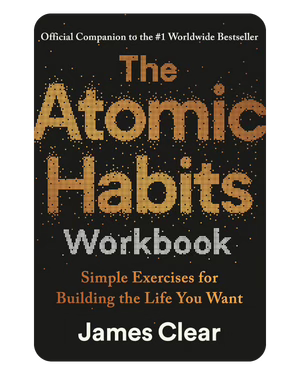
James Clear, The Atomic Habits Workbook: Simple Exercises to Building the Life You Want (Avery)
Based on Atomic Habits, his 25-million copy bestseller from 2018, James Clear offers a structured workbook designed to transform theory into practice. Clear’s method emphasizes the cumulative impact of small behavioral adjustments, supported by reflective prompts and environmental design strategies. The workbook encourages leaders to examine how their habits shape attention, energy, and creative output. It raises practical questions about which routines reinforce adaptive thinking and which silently constrain innovation. For creative leaders balancing competing demands, the exercises offer a disciplined yet approachable way to experiment with new behaviors, reinforce identity shifts, and embed learning in daily life. Clear’s latest contribution strengthens the link between habit formation and long-term creative capacity, underscoring that sustained leadership development emerges from repeated, intentional practice.
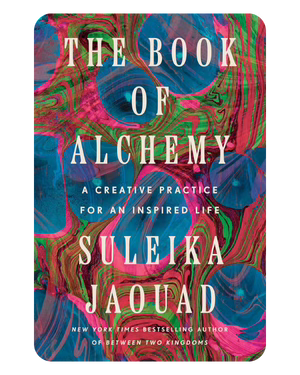
Suleika Jaouad, The Book of Alchemy: A Creative Practice for an Inspired Life (Random House)
Writer and artist Suleika Jaouad, known for Between Two Kingdoms (2021), offers a reflective and tactile guide to creative renewal. Blending memoir, artistic exercises, and philosophical insight, she presents creativity as a lifelong process of transmutation shaped by vulnerability, ritual, and embodied attention. Jaouad prompts and inspires leaders to reconsider how they relate to uncertainty, rest, and the emotional textures of daily practice. Her reflections challenge productivity-driven cultures by asking how individuals can create space for intuition and imaginative depth. The book empowers creative leaders to explore how personal storytelling, sensory engagement, and slow observation can reawaken meaning and replenish depleted reserves of energy. Jaouad’s contribution is both poetic and practical, offering a path for leaders seeking greater resilience and imaginative grounding in turbulent times.