


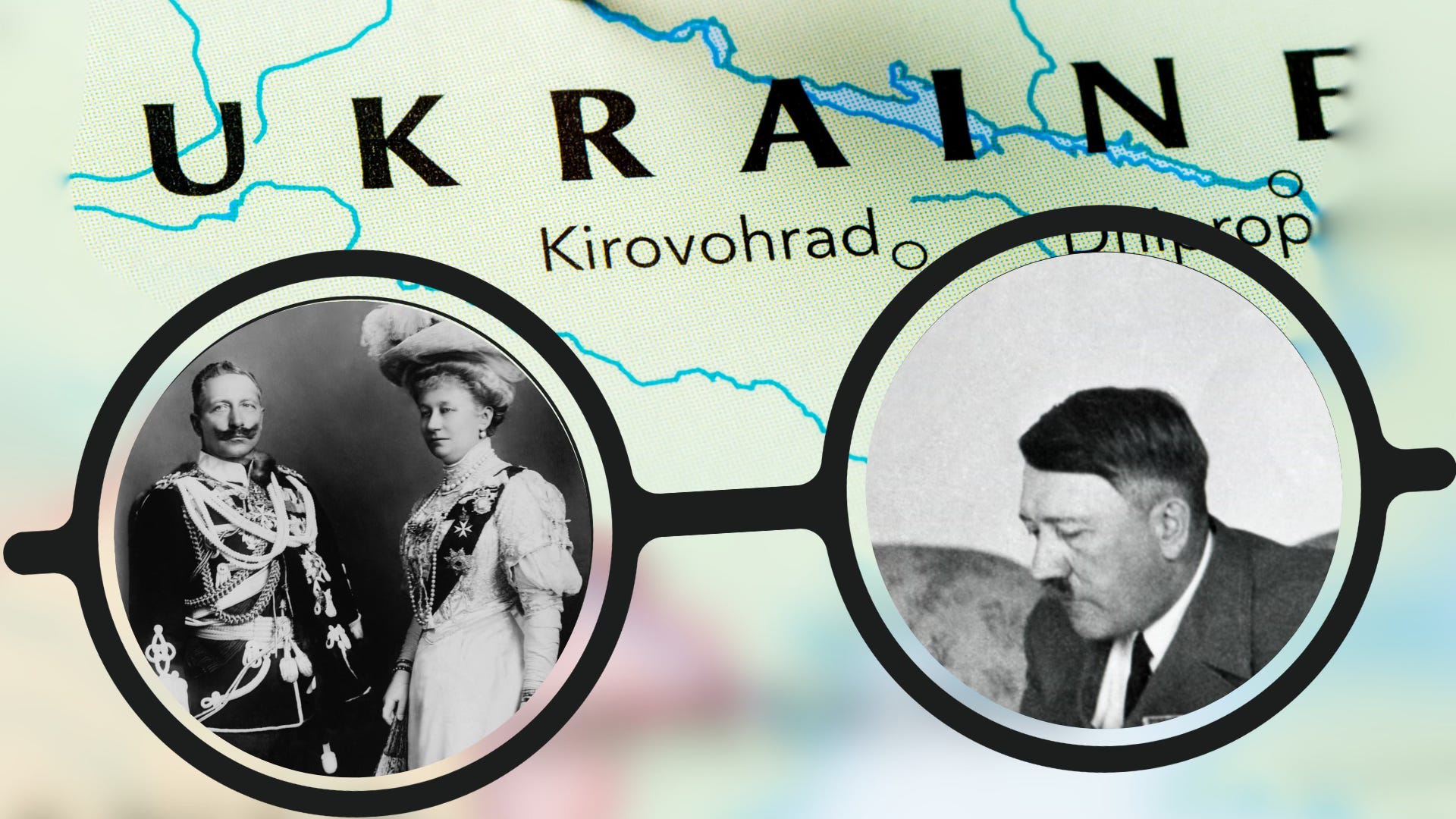
The following article may seem to some readers unusual for this Substack or – at least to those who have signed up expecting only insights and suggestions about developing one’s leadership as craft or re-booting creative leadership – a tangential excursion from creative and innovative businesses into the geopolitical realm.
While the subject of “Two Wars, Two Lenses” concerns how we might approach a fundamentally political topic, the discussion aims to raise several general issues that potentially speak to leaders across many other settings. First, all leaders need to accept the inevitable trade-offs between identifying potentially illuminating metaphors and historical parallels and appreciating the complexity and uniqueness of every strategic situation. While distilling and communicating resonant simplicity from messy complexity is a vital leadership skill, in other words, a common risk for business and political leaders alike is oversimplification and engendering groupthink around that messaging.
A second general issue foregrounded in the piece is the need for leaders of all stripes to develop and deploy better contextual intelligence. That imperative begins with leaders determining what is salient, that is, what matters in give strategic situations. Again, acknowledging trade-off is crucial – here, between a focus on specific, galvanizing historical comparisons and varied, often contradictory facts on the ground. Historical context, indeed, is an especially challenging in an era of both intensified short-term thinking in business and electoral politics and the flattening of the past by social and other digital media that collapse the vast, differentiated timeline of history into a single, homogenized field.
Third, recognizing the roles of social, digital, and platform media in our lives and leadership today point to a particular context that this Substack will consistently explore: the informational, narrative, and discursive dynamics that powerfully shape our leadership understanding and practice. Elsewhere, for example, we will feature analyses of how today’s popular leadership discourse is increasingly driven by platform technologies, social media, and AI, and how that discourse privileges certain aspects of and approaches to leadership and marginalizes others (think about how ‘leadership’ is circumscribed and marketed on LinkedIn).
With the “Two Wars, Two Lenses” piece, the aim is to deepen understanding of the complexity, contexts, and narratives of a current profoundly challenging leadership situation. As a final note, while posted here at Crafting Leadership, the article is also avalable at On Global Leadership. We’ll have much more to say in coming weeks about future joint activities between Crafting Leadership, the Creative Leadership Hub, and OGL, but for now we believe the piece represents the kind of thought leadership that is relevant to audiences and followers across the sites. As always, we look forward to hearing your reactions and feedback. Thanks for being here and reading.
When Russia invaded Ukraine in February 2022, Western leaders immediately reached for historical analogies to frame their response. The comparison that dominated discourse was predictable: Vladimir Putin as Adolf Hitler, Ukraine as Czechoslovakia, and the West facing a Munich moment requiring resolve rather than appeasement.
Yet this reflexive turn to the 1930s and the run-up to World War II, while emotionally satisfying and politically expedient, may obscure a more complex and ultimately more instructive historical parallel: the path to World War I in the early 1900s, when Europe’s great powers sleepwalked into catastrophe not because they failed to confront external aggression, but because they could not escape the structural contradictions of their own making.
More fundamentally, the very act of selecting such historical analogies can reveal as much about contemporary power dynamics as it does about historical truths. The choice between viewing current events through the lens of 1914 versus the 1930s reflects not merely analytical preference but profound disagreements about global order, institutional legitimacy, the distribution of responsibility for international instability, and the priorities of leaders going facing the future.
The Seductive Clarity of the 1930s Lens
The appeal of the Hitler analogy extends beyond its analytical utility to its political function. Like Nazi Germany’s systematic repudiation of the post-Versailles order, Putin’s Russia has consistently challenged the post-Cold War settlement through sequential territorial acquisitions in Georgia (2008), Crimea (2014), and now Ukraine. According to this view, both leaders employed similar authoritarian tactics: testing Western resolve through incremental aggression, exploiting democratic hesitation, and framing expansion as historical correction rather than conquest.
Yet this framing serves clear political purposes beyond historical analysis. Equating Putin with Hitler mobilizes Western public opinion while simultaneously constraining policy debate. Few politicians can advocate negotiation or compromise when facing “the new Hitler.” The analogy transforms complex geopolitical tensions into moral absolutes, making certain policy options politically untenable regardless of their strategic merit. President Zelensky’s elevation to Churchillian status serves similar mobilization functions while deflecting attention from the more uncomfortable question of whether Western policies contributed to current tensions.
Such institutional parallels seem equally compelling but require more detailed critical examination. Just as the League of Nations proved impotent against fascist aggression, contemporary international institutions have appeared inadequate to address today’s great power competition. The Kellogg-Briand Pact of 1928, which formally outlawed war as an instrument of national policy yet proved powerless against Japanese, Italian, and German aggression, finds its contemporary echo in repeated UN General Assembly resolutions condemning Russian actions while lacking enforcement mechanisms.
However, this parallel obscures how institutions like the International Criminal Court and sanctions regimes function differently for different actors. The ICC’s highly selective prosecutions (pursuing African leaders and Russian officials while avoiding Western leaders responsible for civilian casualties in Iraq, Libya, or Afghanistan) reveal these institutions as instruments of geopolitical influence rather than wholly neutral arbiters of international law.
Current sanctions deployed against Russia likewise represent the determined efforts of a dollar-based and Euro-American governed financial system rather than collective and unified international action. The freezing of Russian central bank reserves worth over $300 billion and exclusion from SWIFT demonstrate how economic interdependence, rather than creating mutual restraint, can become weaponized when one side controls essential economic infrastructure. From many non-Western perspectives, these measures represent less a principled defense of international law than a selective application of economic coercion by a declining hegemon seeking to preserve its institutional advantages.
These contemporary actions also echo the destructive economic warfare of the 1930s, when competing currency blocs and trade preferences replaced multilateral cooperation. Britain’s abandonment of the gold standard in 1931 and subsequent creation of the sterling bloc, followed by the Ottawa Agreements of 1932 establishing Imperial Preference, demonstrated how economic interdependence could fragment into exclusive spheres when great powers prioritized unilateral advantage over collective stability (Eichengreen, 2019). Similarly, the United States’ Smoot-Hawley Tariff Act of 1930 triggered retaliatory measures that reduced global trade by over 25% between 1929 and 1934, showing how economic nationalism could rapidly unravel interdependent systems (Irwin, 2011).
Even more significantly, the 1930s analogy deflects attention from how NATO expansion, despite repeated Russian warnings, paralleled the alliance building that contributed to 1914’s escalation dynamics. The admission of former Warsaw Pact members (starting with Poland, Czech Republic, and Hungary in 1999) and Soviet republics (Estonia, Latvia, and Lithuania in 2004), while understandable from their security perspectives, represented a fundamental revision of the post-Cold War settlement from Russian viewpoints. This expansion occurred despite U.S. diplomat and Cold War architect of containment George Kennan’s prescient 1997 warning that it would be “the most fateful error of American policy in the entire post-Cold War era” (Kennan, 1997).
The Uncomfortable Mirror of 1914
The pre-World War I parallel offers a more complex but potentially more accurate diagnostic frame, one that distributes responsibility across multiple actors rather than identifying single aggressors. In the decade before 1914, all European powers contributed to escalation through their inability to adapt outdated political and economic models to changed circumstances. The Triple Alliance binding Germany, Austria-Hungary, and Italy faced the competing Triple Entente linking France, Russia, and Britain, creating interlocking commitments that transformed local conflicts into continental wars. The Franco-Russian Alliance of 1894 and the Entente Cordiale between Britain and France in 1904 created treaty obligations that effectively eliminated diplomatic flexibility when crises emerged.
Contemporary parallels extend beyond formal alliance structures to underlying strategic dynamics. NATO’s eastward expansion, while driven by legitimate security concerns of new members, created the same encirclement dynamics that contributed to German strategic anxiety before 1914. Kaiser Wilhelm II’s abrupt dismissal of Otto von Bismarck in 1890 eliminated Germany’s most skilled practitioner of flexible diplomacy, replacing calculated ambiguity with erratic personal rule that alarmed European capitals and contributed to the rigid alliance systems that would prove so catastrophic. General Helmuth von Moltke the Younger, lacking his famous uncle’s strategic flexibility, turned contingency planning into rigid doctrine that required Germany’s attacking France through Belgium regardless of the war’s origins.
Russia’s response today, seeking to establish buffer zones through force, mirrors Austria-Hungary’s desperate attempts to preserve influence in the Balkans against rising nationalism. Austrian Chief of Staff Franz Conrad von Hötzendorf spent years advocating preventive war against Serbia and Italy, unable to recognize that his multinational empire’s survival depended on avoiding the very conflicts he sought.
Through this lens, Ukraine appears not as Czechoslovakia requiring defense but as Belgium in 1914: the smaller nation whose crisis activates alliance systems and triggers broader conflict. This perspective does not excuse Russian aggression but places it within a broader pattern of great power competition where all major actors have contributed to escalation through rigid adherence to incompatible strategic visions. Even Russia’s relatively moderate leaders like Foreign Minister Sergey Sazonov became prisoners of mobilization timetables and alliance commitments, discovering too late that supporting Serbian nationalism meant triggering European catastrophe.
The pre-1914 era’s institutional innovations proved inadequate when tested by genuine crises, much like today’s international legal mechanisms. The Hague Peace Conferences of 1899 and 1907 created arbitration systems and laws of war that worked for minor disputes but collapsed when core interests were at stake. Contemporary international law exhibits similar selectivity: effective against weaker states but ignored when major powers perceive existential interests.
The particular institutional innovation of having supranational leaders rather than national governments propose military deployment, as seen in European Commission President Ursula von der Leyen’s advocacy for multinational defense forces, reflects contemporary Europe’s attempt to transcend traditional state-based decision making yet risks repeating pre-1914 patterns where well-intentioned collective security efforts escalated rather than resolved underlying tensions.
Likewise misguided was the earlier era’s faith in economic rationality, which was called out at the time by Norman Angell in his influential book, The Great Illusion (Angell, 1910, pp. 28-49). The British journalist and politician demonstrated through detailed financial analysis that conquest could no longer pay, as modern economies depended on complex credit systems and trade relationships that military action would inevitably destroy. His argument convinced many European intellectuals and policymakers that economic self-interest would prevent rational leaders from pursuing military solutions to political disputes.
Yet this confidence in economic interdependence as a peace-preserving mechanism collapsed catastrophically in August 1914, when European powers abandoned profitable trade relationships and integrated financial systems for military objectives that Angell had correctly identified as economically destructive.
The parallel with contemporary assumptions about economic interdependence constraining great power competition proves particularly unsettling: today’s leaders similarly assume that global supply chains, financial integration, trade relationships, and even driving growth though arms production create sufficient incentives for peaceful conflict resolution, potentially overlooking how these same relationships can be weaponized when fundamental interests appear threatened.
In the essential The Sleepwalkers: How Europe Went to War in 1914, Cambridge University historian Christopher Clark argues that no single actor engineered World War I (Clark, 2012). Clark, an Australian-born scholar specializing in Prussian history and modern European politics, demonstrates through meticulous archival research that all major powers contributed through their inability to transcend inherited strategic assumptions. The British Empire struggled to maintain global commitments while facing German industrial competition. France remained fixated on recovering Alsace-Lorraine lost during the Franco-Prussian War of 1871. Austria-Hungary sought to preserve multinational empire in an age of nationalism. Germany felt encircled despite, or because of, its economic dynamism.
Contemporary parallels are striking. The United States struggles to maintain global hegemony (in the second Trump administration, through actively reshaping it) while facing Chinese economic competition and internal political polarization. The European Union, designed for managing prosperity and integration in the post World War II era, confronts military and strategic demands it cannot adequately address. Russia, despite its resource wealth, feels marginalized by institutions designed and consolidated during its period of weakness. China seeks recognition as a great power within structures that institutionalize Western advantages.
As University of Toronto historian Margaret MacMillan notes in The War That Ended Peace: The Road to 1914, European leaders of the early twentieth century similarly became prisoners of their own alliance systems, unable to find diplomatic solutions because military mobilization schedules and treaty obligations left little room for flexibility (MacMillan, 2013).
The Politics of Historical Analogies
Historical analogies like these function as more than analytical tools; they serve as instruments of political mobilization and policy legitimation. The choice between 1914 and 1930s as narrative frames reflects deeper disagreements about global order, institutional legitimacy, responsibility for international instability, and leadership priorities. These competing analogies operate within what might be termed the cultural politics of historical memory, where the selection of dominant political narratives becomes a form of soft power projection (and the basis of policies justifying harder power deployment) that shapes not only policy options but the very parameters of legitimate debate.
The 1930s analogy serves Western institutional interests by portraying current arrangements as legitimate bulwarks against authoritarianism requiring defense rather than reform. It justifies increased military spending, expanded alliance commitments, and economic sanctions while deflecting questions about whether Western-dominated institutions contributed to current tensions. The framing treats sovereignty and territorial integrity as universal principles while obscuring how these same principles were violated by Western interventions in Kosovo, Iraq, and Libya. This selective application of principles reveals how analogies can function as ideological instruments that naturalize particular power arrangements while delegitimizing alternatives.
In Analogies at War, Harvard Kennedy School scholar Yuen Foong Khong demonstrated how historical analogies often serve to legitimize predetermined policy preferences rather than illuminate complex strategic realities (Khong, 1992, pp. 8-12). Khong, drawing on extensive interviews with policymakers involved in Vietnam decisions, shows that leaders typically select analogies that support their existing inclinations rather than engage in genuine analytical comparison. The emotional resonance of the Hitler comparison makes it particularly effective for mobilizing domestic support while constraining policy alternatives that might appear as “appeasement.” This dynamic transforms historical analogies from analytical tools into rhetorical weapons that can foreclose rather than inform strategic deliberation.
While less politically convenient, the 1914 parallel forces acknowledgment that institutional rigidity and strategic inflexibility can transform manageable tensions into systemic crises. It suggests that addressing current challenges requires examining how alliance expansion, economic globalization, and institutional design may have inadvertently created the conditions for conflict rather than cooperation. This framing aligns with what international relations scholar Robert Jervis classically termed the “security dilemma,” the recognition that “many of the means by which a state tries tp increase its security decrease the security of others” and inadvertently create spiraling tensions (Jervis, 1978, p. 169).
As former U.S. Ambassador to Moscow Jack Matlock predicted in 1997 testimony to the Senate Armed Services Committee, the 1914 lens likewise requires acknowledging that NATO expansion “may well go down in history as the most profound strategic blunder made since the end of the Cold War” (Matlock, 2022; Matlock 2004). Beyond the failure to include rather than exclude Russia from European security arrangements, the expansion betrayed a more basic inability to understand Russian strategic perspectives and concerns. However, this perspective demands the intellectual courage to question not just tactical implementations but the fundamental assumptions underlying post-Cold War institutional arrangements, making it inherently more challenging for established elites to embrace.
Crucially, both historical analogies reflect European and Western past experiences rather than global perspectives. Neither framework adequately captures how the majority of the world’s population views current events: not necessarily as a struggle between democracy and authoritarianism, but as an opportunity to escape from Western-dominated institutions and create more representative global governance structures.
India (and perhaps by extension much of the Global South) increasingly approaches great power competition through the lens of multipolarity, Malaysian strategic analyst Rahul Mishra recently observed, and the country has adopted a position of strategic autonomy and “multi-alignment” rather than choosing sides in ideological conflicts (Mishra, 2023, p. 43). This perspective helps explain why countries representing over 60% of global population have refused to join Western sanctions against Russia, seeing the conflict as a dispute between great powers rather than a moral crusade warranting universal alignment. The dominance of European historical analogies in Western discourse thus reflects not analytical superiority but the continued influence of Western-centered frameworks that may obscure rather than illuminate contemporary geopolitical dynamics.
The Multipolar Opportunity
Contemporary discussions of multipolarity are often viewed in the West as a challenge to international stability, but this perspective again arguably reflects the particular interests of established powers rather than objective analysis. For much of the world, multipolarity represents not a dangerous development but a welcome return to historical normality after several centuries of Western dominance.
The emergence of alternative institutions like the Shanghai Cooperation Organization, BRICS expansion, and regional payment systems reflects not mere opposition to Western leadership but legitimate demands for more representative global governance. Countries like India, Brazil, South Africa, and Indonesia (representing billions of people) have consistently advocated for UN Security Council reform, more equitable international financial institutions, and trade arrangements that serve broader interests rather than perpetuating asymmetric relationships established during colonial periods and, more recently, by the victors of World War II.
China’s Belt and Road Initiative, whatever its limitations and strategic motivations, addresses infrastructure deficits that Western-dominated institutions have failed to adequately address for decades. The Asian Infrastructure Investment Bank provides development financing without the structural adjustment conditionalities that have characterized World Bank and IMF lending. These alternatives succeed not because they oppose Western values but because they offer more favorable terms and greater respect for recipient sovereignty and interests.
Even within established institutions, the Global South (or, as some prefer, the Global Majority) increasingly challenges Western assumptions. UN General Assembly voting patterns on Ukraine-related resolutions reveal a world far more divided than Western commentary suggests. Countries representing the majority of global population have consistently abstained from or opposed sanctions on Russia, not necessarily because they support aggression but because they reject the selective application of international law and the weaponization of economic interdependence.
This broader context complicates the project of analyzing current events and formulating leadership paths forward. Rather than asking how to preserve Western-led order against authoritarian challenges, the more relevant question becomes how to create genuinely inclusive institutions that address the legitimate grievances of all major powers while maintaining effective mechanisms for conflict resolution and international cooperation.
External Enemies Versus Internal Contradictions
The distinction between external and internal diagnostic focus becomes even more crucial when examined from global rather than primarily Western perspectives. The 1930s analogy directs attention outward, toward external threats requiring unified response, but this framework assumes the legitimacy of existing institutional arrangements and the righteousness of defending them.
Current Western policy exemplifies this external focus while avoiding uncomfortable questions about institutional failures and shortcomings. President Biden’s early framing of the conflict in Ukraine as a battle between “democracy and autocracy” deflects attention not only from America’s own democratic vulnerabilities but from how democratic institutions have often been used to advance particular geopolitical interests rather than universal values. The concept of “democracy” itself becomes problematic when claims of democratic values and instituions like free speech and fair elections are used to justify interventions that violate the sovereignty of non-democratic states.
Put simply, the 1914 parallel forces leaders to examine structural contradictions within their own systems and international relationships. It suggests that the greatest dangers may arise not from external aggression but from the inability to adapt inherited institutions to genuinely changed circumstances. This perspective requires acknowledging that Western-dominated international arrangements may be not just inadequate but antiquated and actively counterproductive in a multipolar world.
Contemporary political polarization exemplifies this internal challenge across Western democracies. The rise of populist movements represents not random discontent but increasingly systematic tension between globalizing elites and populations who feel excluded from the benefits of cross-border flows of people, capital, information, goods, and technology. Brexit voters rejected not just EU membership but technocratic governance models that seemed unresponsive to their concerns. Trump supporters challenged not just political establishments but economic structures that appeared to benefit educated professionals at working-class expense.
These domestic tensions interact with international challenges in ways that neither historical analogy fully captures. Western support for Ukraine, however morally justified, occurs against a backdrop of declining infrastructure, rising inequality, and institutional trust deficits that external focus cannot address. The resources devoted to military assistance and sanctions enforcement could alternatively address domestic challenges that threaten democratic resilience more fundamentally than Russian actions.
The Leadership Challenge of Structural Honesty
Any choice between historical parallels ultimately reflects deeper questions about leadership responsibility and institutional adaptation. Churchill’s wartime effectiveness derived not from simply opposing external enemies but from recognizing that British imperial structures were obsolete at a time when democratic values required defense. Contemporary leaders face similar challenges requiring simultaneous external vigilance and internal structural reform.
The most sophisticated approach would combine support for Ukraine’s sovereignty with honest examination of how Western policies contributed to current tensions. This requires intellectual courage to acknowledge that NATO expansion, however justified from member perspectives, created security dilemmas that may have contributed to conflict escalation. It means recognizing that economic sanctions, while preferable to military action, function as instruments of coercion that may strengthen rather than weaken authoritarian control.
In essence, a better approach requires accepting that effective leadership in a multipolar world demands creating genuinely inclusive institutions rather than defending inherited structures that privilege particular actors. The post-1945 order served important functions during the Cold War and immediate post-Cold War periods, but institutional arrangements designed for American hegemony and European reconstruction may be inadequate for addressing 21st-century challenges.
Effective leadership requires what British international lawyer and foreign affairs adviser Matt Waldman has described as “strategic empathy,” the willingness and ability to understand others’ perspectives in order to anticipate actions and avoid strategic mistakes (Waldman, 2012, pp. 1-3). While Waldman wrote specifically about U.S. intervention in Afghanistan, others, notably American political scientist John J. Mearsheimer, have offered similar reflections about Western failures to understand Russian motivations regarding Ukraine(Mearsheimer, 2014). Neither advocates fuller understanding to mean moral equivalence or abandoning allies, but rather as the basis for recognizing that sustainable security requires addressing root causes alongside immediate threats.
The most sophisticated leadership approach would consequently combine external vigilance with substantive internal structural reform. This could mean supporting Ukraine’s sovereignty while simultaneously examining whether current Western policies, alliance commitments, and institutions adequately address 21st-century realities. Specifically, it requires the intellectual honesty to ask whether NATO expansion, Western-centered economic policies and infrastructure, or domestic political structures have inadvertently contributed to current instabilities by perpetuating conflictual rather than cooperative international positioning.
Such dual awareness is undeniably more complex than focusing solely on external enemies or internal contradictions. But history suggest that tragedies occur when leaders cannot escape the limitations of their own strategic assumptions, whether those assumptions involve appeasing aggressors or rigidly adhering to obsolete frameworks. The most dangerous leadership failure may be the inability to maintain simultaneous awareness of genuine external threats and genuine internal structural challenges.
True strategic wisdom lies not in choosing between external vigilance and internal reform but in developing frameworks that address legitimate grievances across the international system while maintaining effective mechanisms for conflict resolution. This requires moving beyond historical analogies that privilege particular perspectives toward more inclusive approaches that acknowledge the complex motivations of all major actors.
The alternative (continued reliance on frameworks that divide the world into democracies and autocracies, defenders and aggressors, legitimate and illegitimate actors) risks perpetuating the very dynamics that transformed manageable tensions into systemic crises in both 1914 and the 1930s. Only by combining honest acknowledgment of Western institutional limitations with principled opposition to aggression can leaders navigate the structural transitions that define our current moment while creating foundations for more stable and equitable international cooperation.
As University of Toronto political historian Timothy Snyder concludes in The Road to Unfreedom, “Politics is international, but repair must be local” (Snyder, 2018, p. 277). Defending democracy, in other words, requires more than opposing authoritarian enemies. That call for honest confrontation with democracy’s internal vulnerabilities includes acknowledging how economic inequality, institutional sclerosis, and political tribalism have weakened democratic resilience across many European and North American states that have acted to support Ukraine as a democracy under attack. Only through such structural honesty can leaders navigate the multipolar transitions that define our current historical moment.
References
Norman Angell, The Great Illusion: A Study of the Relation of Military Power to National Advantage, New York: G.P. Putnam’s Sons, 1910; https://ia601305.us.archive.org/29/items/cu31924007365467/cu31924007365467.pdf
Christopher Clark, The Sleepwalkers: How Europe Went to War in 1914, London: Allen Lane, 2012.
Barry Eichengreen, Golden Fetters: The Gold Standard and the Great Depression, Oxford: Oxford University Press, 2019.
Douglas A. Irwin, Peddling Protectionism: Smoot-Hawley and the Great Depression, Princeton: Princeton University Press, 2011.
Robert Jervis, “Cooperation Under the Security Dilemma,” World Politics, Vol. 30, No. 2 (January 1978): 167-214; https://www.jstor.org/stable/2009958
George F. Kennan, “A Fateful Error,” New York Times, February 5, 1997; https://www.nytimes.com/1997/02/05/opinion/a-fateful-error.html
Yuen Foong Khong, Analogies at War: Korea, Munich, Dien Bien Phu, and the Vietnam Decisions of 1965, Princeton: Princeton University Press, 1992.
Margaret MacMillan, The War That Ended Peace: The Road to 1914, New York: Random House, 2013.
Jack F. Matlock, Jr., “Jack Matlock: Ukraine Crisis Could Have Been Avoided,” The Transnational, May 27, 2022; https://transnational.live/2022/05/28/jack-matlock-ukraine-crisis-should-have-been-avoided/
Jack F. Matlock, Jr., Reagan and Gorbachev: How the Cold War Ended, New York: Random House, 2004.
John J. Mearsheimer, “Why the Ukraine Crisis Is the West’s Fault,” Foreign Affairs 93, no. 5 (2014): 77-89; https://www.foreignaffairs.com/articles/russia-fsu/2014-08-18/why-ukraine-crisis-west-s-fault
Rahul Mishra, “From Non-Alignment to Multi-Alignment: Assessing India’s Foreign Policy Shift,” The Round Table: The Commonwealth Journal of International Affairs and Policy Studies, Volume 112, pp. 43-56, published online, 14 Feb 2023; https://doi.org/10.1080/00358533.2023.2165367
Timothy Snyder, The Road to Unfreedom: Russia, Europe, America, New York: Tim Duggan Books, 2018.
Matt Waldman, “Strategic Empathy: The Afghanistan Intervention Shows Why the U.S. Must Empathize With Its Adversaries,” New America Foundation, 2012; https://static.newamerica.org/attachments/4350-strategic-empathy-2/Waldman%20Strategic%20Empathy_2.3caa1c3d706143f1a8cae6a7d2ce70c7.pdf
Hey, great read as always. How do you think leaders can best develop that contextual intelligence, given the current media landscape? Always aprecaite your deep dives!