


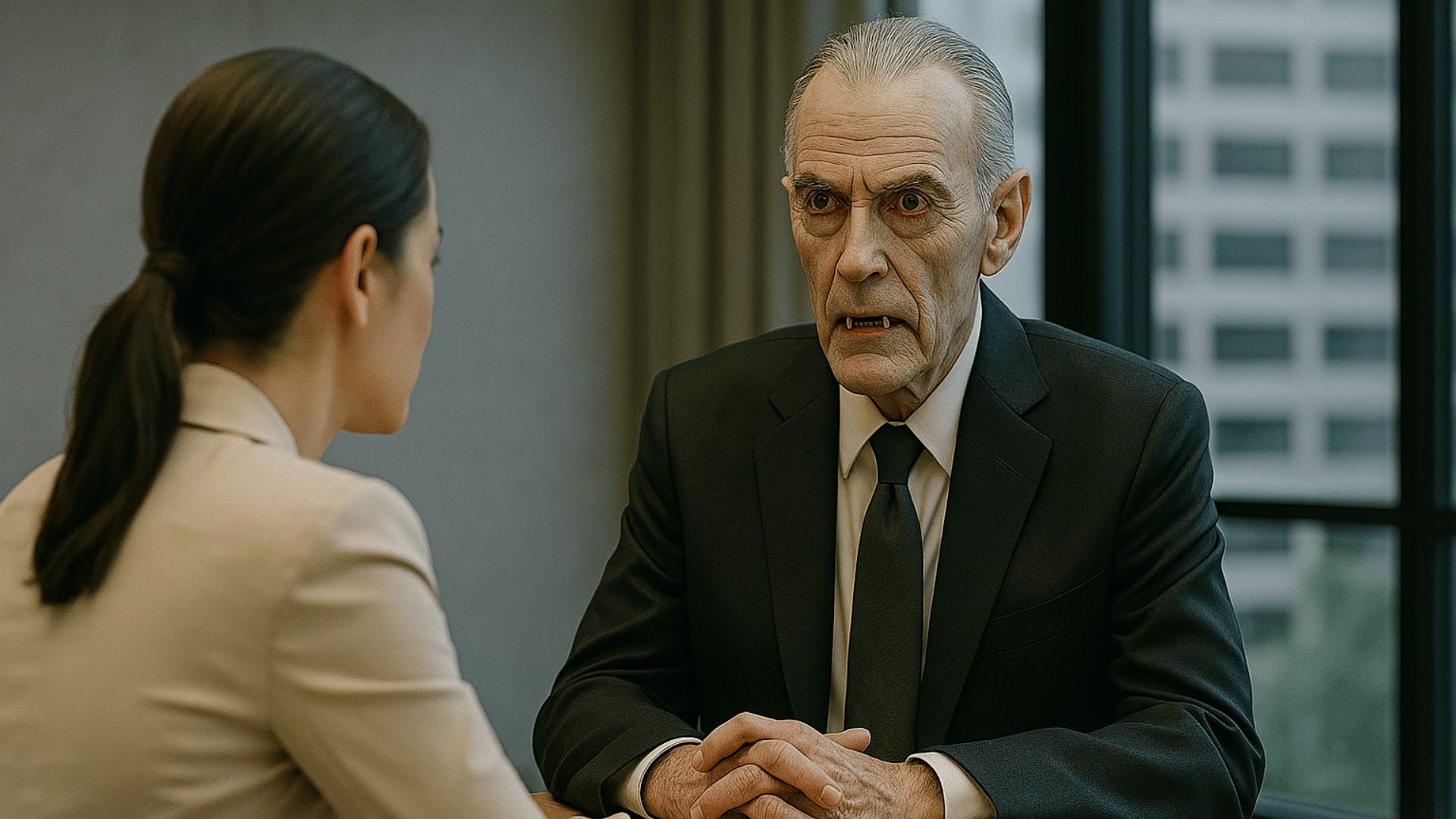
Zombies have repeatedly shuffled through the cultural imagination of recent decades, in a surplus of books, films, video games and television series. As scholars from across disciplines have noted, these tireless hordes of the undead serve as potent allegories for various anxieties of our age – from the depredations of late capitalism and rampant consumerism to the hollowing of individual personalities and hunger for meaningful social relations to the environmental and social cataclysms of climate change and political extremism (Lauro 2017). In economics, the concept of ‘Zombie Economics’ gained traction in the 2010s, particularly following the financial crisis. This critique of market liberalism looked at the dead ideas behind an economic system choked by debt and infected by self-centered people barely able to eke out an existence or to invest in growth yet propped up by accommodating policies and weak oversight (Quiggin 2012). Several years ago, I also briefly considered the related challenge of ‘zombie business cultures’ – organizations mired in dysfunctional routines and fixed mindsets, lurching through repetitive activities with little genuine vitality or responsiveness to shifting contexts (Slocum 2020).
More recently, in a provocative academic article by an international trio of scholars (two psychologists and a management researcher), the view has been turned to contemporary leadership thought and practice. In “Zombie Leadership: Dead Ideas That Still Walk Among Us,” S. Alexander Haslam, Mats Alvesson, and Stephen D. Reicher argue that otherwise substantial progress in the field of leadership has been “undermined by a strong residual commitment to an older set of ideas which have been repeatedly debunked but which nevertheless resolutely refuse to die.” Besides providing an incisive summary of these ideas, they recognize zombie leadership lives on “because it flatters and appeals to elites, to the leadership industrial complex that supports them, and also to the anxieties of ordinary people seemingly beyond their control.” Importantly, the authors observe that these ideas are also “propagated in everyday discourse surrounding leadership but also by the media, popular books, consultants, HR practices, policy makers, and academics who are adept at catering to the tastes of the powerful and telling them what they like to hear” (2024: 1).
This incisive diagnosis of the leadership industrial complex and the popular discourses supporting it extends to leadership coaching, as well. Having evolved rapidly over the last three decades, leadership and executive coaching has itself become infested with ‘zombie’ concepts that, while increasingly debunked by research, refuse to remain buried. The meteoric growth of the leadership coaching industry has been staggering: global annual spending on coaching professionals and services now exceeds $4.5 billion (ICF, 2023). With promises of enhanced leadership success (often coupled with greater personal happiness and more meaningful interactions with others), an expansive ecosystem of coaches, consultants, and self-anointed ‘thought leaders’ or ‘recognized experts’ has emerged to energetically market their individual stories, proprietary development approaches, and stepwise formulas for helping leaders. Turbo-charged by social media’s incessant thrum of personal branding, virality, and engagement-above-all metrics, much of leadership coaching has fallen prey to the ‘zombie leadership’ phenomenon that Haslam, et al, decry – a web of frequently flawed myths that nevertheless shamble on, largely impervious to evidence or corroboration.
Concerningly, leadership coaching’s zombie infestation mirrors the broader contagion afflicting their leader clients and as well as the general management of their organizations. As Bayes Business School dean André Spicer argues in Business Bullshit (2017), the modern corporation has largely morphed into a ‘zombie’ institution, mindlessly pursuing ‘fads, fashions, and fictions’ while neglecting its core purpose. Spicer contends that the relentless pressure to appease shareholders and demonstrate short-term gains breeds an epidemic of superficial ‘bullshit’ – vapid mission statements, hollow initiatives, and decontextualized best practices – that crowd out substantive value creation and delivery. Leadership coaching, in thrall to many of the same reductive quick-fixes and context-blind universals as the leaders and organizations it seeks to service, risks degenerating into a bullshit-peddling zombie itself.
Axioms of Zombie Leadership Coaching
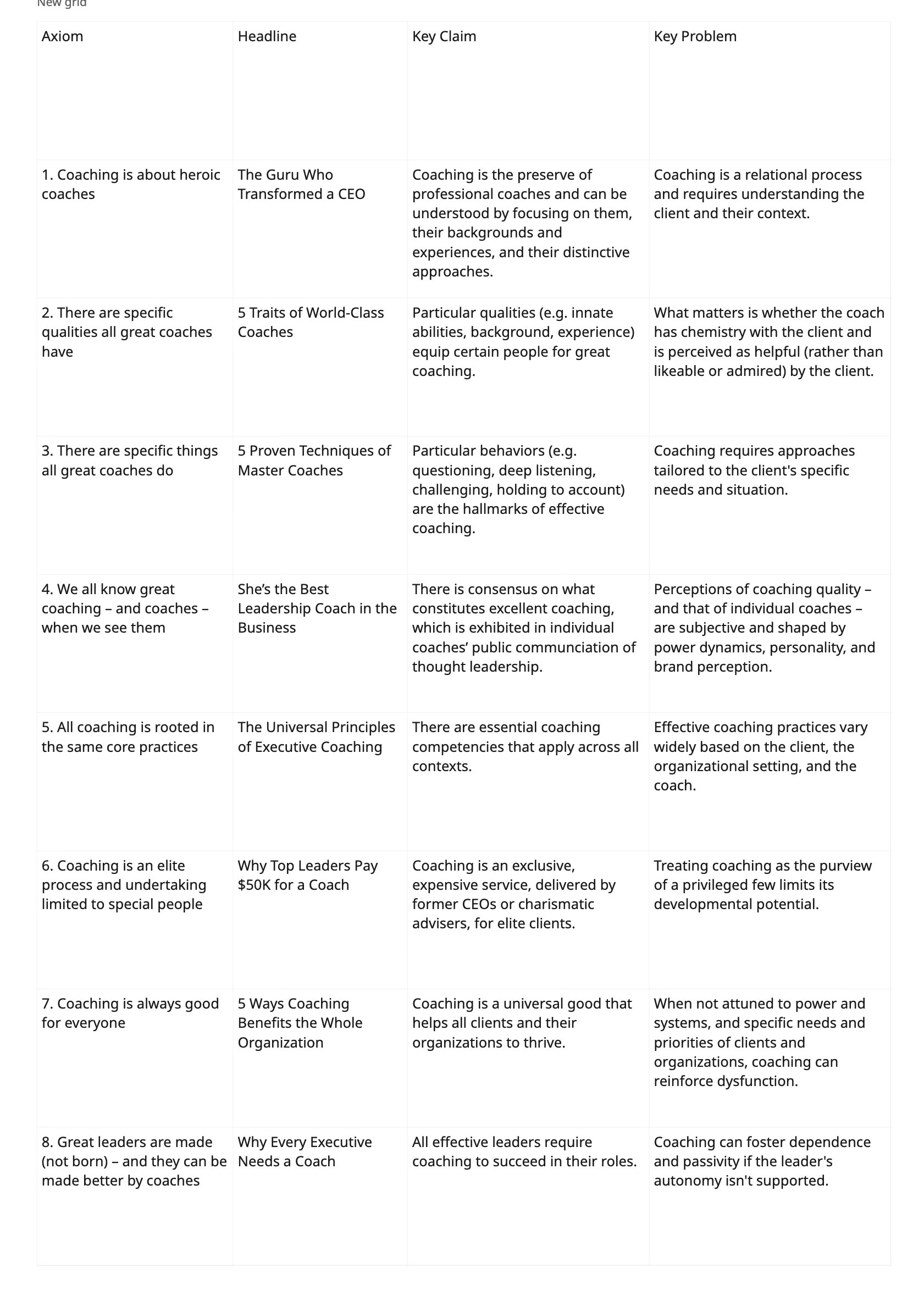
Against this backdrop, and adapting Haslam et al’s taxonomy of Zombie Leadership, it is possible to generate a summary table of eight core axioms of Zombie Leadership Coaching. They are phrased strongly and, as such, aim to capture the tone and quality of self-evident truth – and urgent opportunity – that often suffuses the presentation of ideas about leadership coaching in popular discourse and social media, in particular.
.
Leadership Coaching Fallacies
Collectively, these axioms speak to core fallacies about leadership and, in turn, leadership coaching that are still perpetuated by Zombie Leadership Coaching. Fundamentally, there persists the assumption that leadership coaching is all about individual leaders. Zombie coaches fixate myopically on singular leaders – their specific needs, traits, habits, and often idiosyncratic quirks – while neglecting the intrinsically collective, relational foundations of leadership. In the coaching industry's formative years, Richard Kilburg underpinned his conceptual understanding and definition of executive coaching as targeting individual clients “as a person and as a leader in a given organization” (1996: 137). Three decades later, this restrictive leader-centrism persists, even as research consistently confirms that effective leadership most often emerges from inclusive, multi-directional group processes, not solitary heroic actions (Denis et al., 2012; Raelin, 2016).
Another persistent fallacy involves the notion that universal leadership competencies exist. Zombie coaches peddle specious notions of universally effective leadership qualities – vision, authenticity, charisma, ad nauseam – insisting mastery of a standard competency checklist ensures success in any context. Mega-selling guides like The Leadership Challenge (Kouzes & Posner, 2023 – now in its 7th edition) and copious psychometric assessments, along with a steady stream of leaders’ autobiographies, cement this illusion of a monolithic ‘great leader’ archetype. Even more complicating is the recent prioritization of ‘soft’ or, better-said, ‘human’ skills. Yet metanalyses reveal limited evidence for any consistent individual predictors of effective leadership across contexts and cultures (Morgeson, 2005; Zaccaro, 2007).
These still heroic figures at the center of Zombie Leadership mythology are complemented – indeed, addressed and mirrored – by heroic Leadership Coaches. As ‘recognized experts’ with distinctive approaches, strong personal brands, and many social media followers, these elite coaches perpetuate the myth that coaching works anytime, anywhere. Zombie coaches hawk coaching as a decontextualized, one-size-fits-all panacea. Have a problem, project, transition, or potential to improve? Hire a coach, follow their proprietary process, and soon, you're a leadership dynamo! While seasoned coaches tailor their approach, much coaching methodology appears to remain inattentive to the decisive impact of followers’ needs, team dynamics, organizational systems, and socio-cultural milieus on what constitutes effective, contextually-calibrated leadership (Osborn et al., 2002).
Perhaps most troublingly, zombie coaching operates under the delusion that coaching is a neutral, power-blind process. Zombie coaches frame the coaching relationship as an ahistorical, apolitical bubble magically insulated from the ubiquitous power asymmetries and identity-linked assumptions that shape all human interaction. Best-selling manuals paint an idealized partnership of fluid authenticity and rapport, yet as David Clutterbuck cautions, coaches’ and clients’ positionality profoundly colors their interpersonal dynamics (2010: 75). By sidestepping power and identity, too many coaches risk reinforcing zombie myths and privileged mindsets rather than challenging clients to examine their complicity in inequitable systems.
These zombie coaching tropes hold an undeniable allure, flattering coaches’ self-image as alchemists of interpersonal and organizational transformation while promising executives smartly engineered, context-agnostic, fully human ‘solutions.’ Moreover, they find an inexhaustibly fertile breeding ground in today’s frenetically churning social media ecosystem.
Leadership Coaching Click-bait
Eye-catching posts touting ‘The 5 Essential Habits of Inspiring Leaders,’ click-baity articles breathlessly profiling ‘The Renegade CEO Upending an Industry,’ LinkedIn broetry providing straightforward ‘leadership lessons’ from every current social or political headline, sports or entertainment event, or executive decision: such easily digestible content, precision-tuned to capture our attention and rack up engagement metrics, saturates the digital ecosystem. Propelled by algorithms that privilege virality over veracity, the online thought leadership-industrial complex prizes contagious content over nuanced wisdom or even evidence-based behaviors. With rare exceptions posted by renowned management researchers and institutions committed to communicating on social platforms, subtler takes grounded in emergent research or frontline insight are increasingly crowded out by pithy leadership listicles and vapid motivation-speak.
The result is an unending stream of simplistic leadership memes and larger-than-life leadership and entrepreneurial success stories that present, in aggregate, a caricatured and decontextualized conception of what leadership demands and how to attain it.
For leadership coaches, the seductions of social media-genic soundbites and plug-and-play tools are obvious: they flatter both coaches’ and clients’ hunger for silver bullets – personal-branding tags for the former and identity-affirming ‘secret sauce’ formulas that elevate the latter over the uncoachable and middling leadership masses. Ambitious coaches face intense pressure to appeal to this algorithmic logic by posting readable and memorable nostrums and listicles. ‘Smart nudges,’ targeted algorithmic recommendations, and formulaic, template-guided habit-building plans promise science-backed short-cuts to behavior change – and tempt coaches to abrogate our contextual, critical, and reflective thinking.
But as global surveys attest, the vast majority of off-the-shelf leader development programs – including generic executive coaching components – yield negligible lasting behavior change or performance impact (Kaiser & Curphy, 2013; Gurdjian et al, 2014). Cocooned in coaching echo chambers, executives may blissfully consider their individual transformations successful – but in the organizational trenches, colleagues often paint a more equivocal picture of meaningful change or substantive growth and welcome the opportunities to grow their trust, shared commitment, and accountability together (Kets de Vries, 2005).
Equally unsettling is the prospect that these seductive yet specious leadership memes are now being reanimated and amplified by an emergent generation of AI-driven chatbots and avatars. Fed on immense tranches of past leadership literature, case studies and motivational effluvia, yet bereft of tacit insight into the decisive contingencies of organizational life, these platforms threaten to regurgitate leadership lessons and behavioral nudges unmoored from the concrete dilemmas and relationship dynamics confronting flesh-and-blood leaders. By privileging leaders’ acontextual personal growth and charismatic self-actualization over the prosaic, perpetual work of mobilizing collective engagement and painstakingly negotiating stakeholders' competing priorities, such systems risk propagating a zombie model of leadership (and its coaching) even further unhinged from organizational realities.
Conscientious coaches would be naïve to imagine their practices can remain safe from the contagion of these ambient discourses and tools. These memes suffuse the cultural air leaders breathe, the leadership imaginaries and expectations they lug into coaching. When our mental models and conversational habits unselfconsciously mirror the easily distortive vocabulary of ‘authentic,’ ‘transformational,’ or ‘servant’ leadership archetypes that swamp the blogosphere, or when we instinctively process our clients through psychometric categories and pop-neuroscience concepts, we become inadvertent carriers of zombie leadership’s virus.
In succumbing unreflectively to the seductive frames and tools devised by the growing ranks of self-anointed coaching and HR tech gurus – whose incentives often skew more toward crafting compellingly consumable content than rigorously validating their methodologies in diverse contexts – we risk outsourcing our sense-making capacity to conceptual schemas increasingly untethered from any situated coaching practice. The more coaches scour our leader-clients’ profiles through the lenses of decontextualized personality assessments, 360s, and EQ inventories, the more we constrain substantive, often messy dialogues into the confines of standardized ‘best-practice’ behavioral rubrics, and the more coaching attention can drift from the intricate, idiosyncratic system dynamics enveloping the leader we've contracted to support.
It is a common human tendency to default to interpreting persons, predicaments and appropriate conduct through tidy stereotypes and memorable stories, not nuanced systemic models. For coaches swimming against this cognitive tide in seeking to apprehend leadership dilemmas in their buzzing complexity, zombifying pressures encroach from all sides – clients’ expectations for streamlined solutions; coaching credentialing bodies’ competency checklists; our own craving for coherent narratives and battle-tested tools to assuage the anxiety of each engagement's open-ended novelty. To resist the siren song of zombie coaching tropes and hone a practice of relentless situational attunement demands an uncommon fusion of what Jim Collins described as humility and ‘fierce resolve’ in looking beyond the stubbornly undying and tirelessly promoted idea of great individual coaches working to transform great individual leader-clients (Collins, 2001; Drath et al., 2008).
References
David Clutterbuck (2010) “Coaching Reflection: The Liberated Coach,” Coaching: An International Journal of Theory, Research and Practice, 3(1), 73-81.
Jim Collins (2001) “Level 5 Leadership: The Triumph of Humility and Fierce Resolve,” Harvard Business Review, January 2001.
Jean-Louis Denis, Ann Langley, and Viviane Sergi (2012) “Leadership in the Plural,” Academy of Management Annals, 6(1), 211-283.
Wilfred H. Drath, Cynthia D. McCauley, Charles J. Palus, Ellen Van Velsor, Patricia M.G. O'Connor, and John B. McGuire (2008) “Direction, Alignment, Commitment: Toward a More Integrative Ontology of Leadership,” The Leadership Quarterly, 19(6), 635-653.
Pierre Gurdjian, Thomas Halbeisen, and Kevin Lane (2014) “Why Leadership-Development Programs Fail,” McKinsey Quarterly, January 1, 2014, 121-126; https://www.mckinsey.com/featured-insights/leadership/why-leadership-development-programs-fail#/
S. Alexander Haslam, Mats Alvesson, and Stephen D. Reicher (2023) “Zombie Leadership: Dead Ideas that Still Walk Among Us,” The Leadership Quarterly 35 (2024): 101770.
International Coaching Federation (2023) “2023 ICF Global Coaching Study”; https://coachingfederation.org/resources/research/global-coaching-study/
Robert B. Kaiser and Gordy Curphy (2013) “Leadership Development: The Failure of an Industry and the Opportunity for Consulting Psychologists,” Consulting Psychology Journal, 65(4), 294-302.
Manfred F.R. Kets de Vries (2005) “Leadership Group Coaching in Action: The Zen of Creating High Performance Teams.” Academy of Management Perspectives, 19(1), 61-76.
Richard R. Kilburg (1996) “Toward a Conceptual Understanding and Definition of Executive Coaching,” Consulting Psychology Journal: Practice and Research, 48(2), 134.
James M. Kouzes and Barry Z. Posner (2023) The Leadership Challenge: How to Make Extraordinary Things Happen in Organizations, Hoboken, NJ, Jossey-Bass.
Sarah J. Lauro, ed. (2017) Zombie Theory: A Reader, University of Minnesota Press.
Frederick P. Morgeson (2005) “The External Leadership of Self-Managing Teams: Intervening in the Context of Novel and Disruptive Events” Journal of Applied Psychology, 90(3), 497-508.
Richard N. Osborn, James G. Hunt, and Lawrence (2002) “Toward a Contextual Theory of Leadership,” The Leadership Quarterly, 13(6), 797-837.
John Quiggin (2012) Zombie Economics: How Dead Ideas Still Walk Among Us, Princeton University Press.
Joseph A. Raelin, ed. (2016) Leadership-as-Practice: Theory and Application, London, Routledge.
David Slocum (2020) “Zombie Business Cultures,” LinkedIn, February 26, 2020; https://www.linkedin.com/pulse/zombie-business-cultures-david-slocum/ .
André Spicer (2017) Business Bullshit, Routledge.
Stephen J. Zaccaro (2007) “Trait-based Perspectives of Leadership,” American Psychologist, 62(1), 6-16.