


Creative leadership is undergoing a fundamental reimagining. As I’ve previously argued, the discourse and practice of creative leadership that prevailed during the second half of the twentieth and early twenty-first centuries – and celebrated gifted individuals, who propelled forward exceptional teams or organizations by producing a circumscribed set of creative artefacts, and helped to promulgate self-defining creative industries in the marketplace – has declined and dispersed (Slocum 2025a).
The 2020s have increasingly demonstrated how creative leadership today is a more collective practice, adaptive to more varied and uncertain contexts, and thoroughly connected with algorithmically-governed and AI-augmented digital platforms. My argument here is that developing and sustaining an ongoing practice of creative leadership today can be helpfully understood through the lens of mastery.
That turn to mastery is meant to be precise. Although popular and industry discourses often conflate mastery with excellence, they represent fundamentally distinct if potentially mutually reinforcing orientations toward creative work, leadership, and lives.
To wit, excellence often describes the outward standard of achievement, such as the awarded campaign, the profitable product, or the celebrated innovation. Mastery, by contrast, represents what bestselling peak performance author, Budd Stulberg, in his outstanding new book, The Way of Excellence, calls the internal “infinite game” of becoming, an ongoing practice that sustains excellence precisely because it exists independently of external validation (2026).
Contemporary research on creative expertise provides a similar bearing. University of Buckingham psychologist Kathryn Friedlander, in her valuable The Psychology of Expertise and Creative Performance (2024), suggests that mastery reflects not merely persistence but the gradual integration of technical skill, imagination, and contextual understanding within a domain of practice.
For creative leaders navigating algorithmic capitalism’s volatility, AI’s accelerating capabilities, and constant platform disruption, this distinction becomes critical. In other words, excellence should be understood not as a guiding orientation but as a contingent outcome of mastery. While often valuable, tangible, and the basis of substantive rewards, excellence defined as an end in itself is largely incapable of sustaining creative leadership.
I. The Cognitive Architecture of Mastery
The distinction between excellence and mastery illuminates why some leaders sustain creative output across shifting conditions while others falter when external rewards diminish or market exigencies change. Using Stulberg’s and Friedlander’s books as contemporary touchstones, we can understand mastery as a commitment to excellence for its own sake rather than primarily for external recognition or reward.
This orientation proves especially relevant to creative leaders whose identities become entangled with what Stulberg terms “pseudo-excellence,” evident in the fleeting approval of markets, algorithms, and followers. Where pseudo-excellence demands intensity and perpetual novelty, true mastery requires what he characterizes as “consistency over intensity,” suggesting that leadership develops not through heroic sprints but through sustained rhythms of deliberate practice.
Examining what distinguishes peak proficiency from mere competence, Friedlander identifies multidimensional complexity as the hallmark of mastery: by this, she means a sophisticated integration of technical skill, aesthetic sensitivity, and mental imagery cultivated through disciplined practice over time. Her findings confirm that excellence emerges not primarily from talent but from deliberate and exploratory practice, the systematic engagement with increasingly complex challenges that refine and coordinate these multiple dimensions simultaneously.
For creative leaders, the call for deliberate practice suggests mastery functions as an operating system to maintain what, for Stulberg, is a way of excellence even when external conditions vary or prove unfavorable. Importantly, while Artificial Intelligence can enhance the technical aspects of creative work, the technology does not alter the fundamental distinction between mastery as human judgment and excellence as technical or hybrid output.
Friedlander’s work likewise demonstrates how creative mastery emerges from the convergence of multiple capabilities rather than from any single driver such as talent or practice alone. Drawing on a wide range of performance domains, from music and acting to memory sports and scientific research, she argues that creative expertise develops through “multifactorial” models integrating technical skill, aesthetic sensitivity, imagination, and contextual knowledge (Friedlander 2024; 2025).
In this view, mastery reflects not merely the accumulation of experience but the gradual coordination of dimensions into what she describes as a richer internal representation of a given domain’s structures and possibilities. Creative experts come to perceive patterns, tensions, and expressive opportunities that remain invisible to novices because their understanding of the field’s underlying architecture remains incomplete.
Read alongside Stulberg’s emphasis on disciplined consistency, Friedlander’s research helps clarify why sustained practice generates mastery rather than mere repetition. Deliberate engagement with increasingly complex challenges does more than refine technique: it develops what she terms an “architectonic ability to understand” an overall domain – that is, the capacity to grasp the deeper structural and expressive relationships that make creative work meaningful within its cultural context (Friedlander 2024).
Such perception evidences practical mastery by not simply executing existing forms but by reinterpreting them, extending or recombining established conventions in ways that appear innovative yet remain intelligible to their audiences. From this perspective, excellence emerges not as the direct aim of practice but as the occasional outward manifestation of a more fundamental internal transformation involving the gradual expansion of a practitioner’s capacity to perceive, interpret, and respond creatively within a field of practice.
II. Good Work and the Craft of Attentive Leadership
Broadening our consideration of mastery and excellence beyond individual psychology, we enter the territory of ethics and atentie leadership. In Good Work: When Excellence and Ethics Meet, Howard Gardner, Mihaly Csikszentmihalyi, and William Damon propose a tripartite focus for understanding mastery in professional contexts. They argue that genuinely good work must be technically excellent, personally engaging, and ethically sound – three criteria that creative leaders increasingly struggle to balance as market pressures privilege technical excellence while subordinating human engagement and social ethics (2001).
The “good work” framework suggests that mastery for creative leaders requires attending simultaneously to craft quality, intrinsic motivation, and broader social responsibility, a combination they find rare but essential for sustaining meaningful work across a career. This ethical dimension grows more urgent as AI systems capable of generating technically proficient creative outputs challenge leaders to articulate what makes human creativity not merely different but inimitable.
If mastery provides the internal architecture, craft provides the mode of engagement with others and dynamic environments. Creative leadership, from this vantage point, represents not a static set of frameworks to be applied but an ongoing practice demanding attentiveness to what NYU and LSE sociologist Richard Sennett calls the “materials” at hand: that is, human relationships, organizational dynamics, market signals, and cultural contexts (2008).
Sennett’s work on craft is foundational to my understanding of the current practice of creative leadership. His definition of craftsmanship as “the desire to do a job well for its own sake” is an orientation that resists instrumentalization even while remaining able to produce instrumental results (9). The distinction matters because it locates the source of sustained performance in the quality of attention exercised by craftspeople (and those practicing the craft of leadership) rather than in their outcomes alone. That quality of attention can also be seen at the heart of the increasingly sophisticated mental representations of their domain built by expert practitioners, which Friedlander observed.
Likewise, in his insistence on “consistency over intensity,” Stulberg sharpens the craft argument by clarifying why many creative leadership cultures quietly undermine mastery even while claiming to celebrate it. Whereas intensity privileges visible exertion, urgency, and performative busyness, consistency privileges the quieter repetition through which judgment, taste, and discernment are refined. Read through Sennett’s craft lens, Stulberg helps explain why leadership can often look unimpressive in the short term yet prove decisive over time.
Exploring this understanding through an exploration of motorcycle repair, social philosopher Matthew Crawford demonstrates how mastery involves cultivating what he terms “attentiveness” to subtle signals within complex systems, such as the barely audible sounds and vibrations that reveal underlying mechanical problems before they manifest as failures (Crawford, 2009). The particular craft he focuses on offers a curious if deep-rooted connection to a central source in Stulberg’s book: namely, Robert Pirsig’s iconic meditation on how we perceive value and the barriers we often erect between the soul and the machine, Zen and the Art of Motorcycle Maintenance (2008/1974).
That temporal factor is important. While popular leadership discourse often portrays creativity as episodic inspiration, Stulberg reframes it as a daily practice governed by self-chosen standards and prolonged engagement with increasingly complex problems. This connects directly with Sennett’s notion of craftsmanship as having an ethical relationship to work rather than merely a means to recognition. For creative leaders, the implication is at once sobering and liberating: excellence becomes an emergent property of their practice (and their ongoing commitment to mastery), not a separate target to be chased.
In turbulent environments, this form of attentiveness translates into the sensitivity to weak signals, a capacity to distinguish signal from noise, and a willingness to adjust course based on feedback that others might dismiss or overlook. Rather than being reducible to technique, attentive leadership develops through prolonged engagement with specific materials and contexts, accumulating tacit knowledge that eludes easy codification.
To take a practical example, longtime music producer Rick Rubin’s approach to creative production shows how creativity emerges through patient attention rather than forced innovation. Rubin’s practice centers on creating conditions where creativity can emerge organically rather than manufacturing it through prescribed methods or techniques (2023). His emphasis on listening, waiting, and allowing work to develop at its own pace contrasts sharply with the intensity-driven and formulaic output models that dominate many contemporary creative industries. Rubin’s patient attentiveness privileges a more holistic process over stepwise, product-driven work, and aligns with older perspectives on mastery.
III. Judgment, Discipline, and the Deep Roots of Mastery
Although the ancient Stoic Epictetus never wrote a systematic treatise on mastery in the modern sense, themes close to mastery and excellence appear repeatedly across three parts of his surviving work. Taken together, they arguably articulate a conception of excellence as disciplined practice in judgment, self-command in the face of varying impressions, and the proper use of one’s faculties. While dating from the late first and early second centuries BCE, these pieces retain their significance for leaders today as AI systems generate outcomes more and more rapidly while the distinctively human contribution turns to reside in discernment, curation, and contextual judgment.
To open his Enchiridion (Handbook; especially Chapters 1-5), Epictetus offers a deceptively simple distinction: some things are within our control and others are not. What lies within our control are not outcomes, reputations, or market reactions, but our judgments, intentions, and responses to events. Mastery therefore begins not with performance but with discernment. The disciplined leader learns to separate signal from noise, commitment from circumstance, and responsibility from contingency. In contemporary creative environments saturated with algorithmic metrics and instant feedback, this Stoic distinction becomes less antiquarian advice than practical leadership guidance.
Elsewhere, in the Discourses (I.1 and I.4), Epictetus repeatedly returns to a second idea closely aligned with what we have seen craft theorists describe as attentiveness. He argues that human beings are constantly confronted by impressions, interpretations of events that invite immediate reaction. Mastery lies in learning to pause in the handling of impressions and before granting assent. This discipline of judgment parallels what Sennett describes as the craftsperson’s attentive engagement with materials and what Crawford observes in mechanical diagnosis: put simply, the cultivated ability to notice subtle signals before acting on them. Where algorithmic systems respond instantly to stimuli, the Stoic craftsman of leadership inserts a moment of reflection in which judgment can intervene.
In a final section of the Discourses, translated as “On Training” (Discourses III.12), Epictetus most directly treats mastery as a practice, using analogies with athletics. No significant capability emerges suddenly, he observes, with improvement instead occurring through repeated engagement with difficulty rather than through flashes of inspiration. Mastery develops gradually through disciplined practice, precisely the “consistency over intensity” that Stulberg identifies as the internal architecture of excellence. Difficult circumstances, in this sense, are not interruptions of mastery but rather the environments through which it is forged.
Read alongside the craft tradition, in other words, Epictetus thus reinforces the deeper claims in this discussion that excellence emerges as the visible by-product of a less visible discipline of judgment. Leaders who anchor their practice in that discipline are less vulnerable to the distortions of pseudo-excellence precisely because their orientation does not depend on external validation. Their work becomes an ongoing craft of attention, discernment, and response rather than a pursuit of applause, followers, or likes.
IV. From Individual Craft to Collective Mastery
To sustain ongoing craft work casts light on the need for shared standards, mutual accountability, and distributed expertise that no one individual can sustain alone. Organizations cultivate this dimension of collective mastery when they develop communities of knowledge and practice that elevate rather than homogenize individual contributions. Even the Stoics, often mischaracterized as solitary moralists, understood mastery as a social discipline; Epictetus taught that philosophical training occurred through dialogue, critique, and the shared examination of judgments.
In our time, because the 10,000 hours of deliberate practice famously identified by Anders Ericsson are often misconstrued as a solitary, atomized pursuit, it is essential to recognize that such effortful training requires a pre-existing community to define its benchmarks of excellence (Ericsson et al., 1993). While the individual practitioner performs the labor of refining mental representations, it is the community of practice that provides the regime of competence and the curricula of challenges that make such labor productive (Lave & Wegner, 1991). Without such a social architecture to provide a directional signal, the consistency over intensity advocated by Stulberg would lack the necessary alignment with the evolving standards and ethical demands of the professional domain.
When we draw together Ericsson’s and Lave and Wegner’s perspectives, we see that mastery functions as the vital bridge between individual human capital and collective social capital. Although the rigors of deliberate practice develop the technical proficiency and aesthetic sensitivity Friedlander describes, it is through legitimate peripheral participation that these skills are translated into leadership influence. By moving from the margins to the center of a community, the creative leader ensures that their quest for mastery is not merely a self-referential infinite game but a generative contribution to the shared knowledge and collective resilience of the organization.
While AI tools may support this cultivation of skills through knowledge management and pattern recognition, human judgment remains necessary to maintain the ethical and relational qualities that make communities exploratory and generative rather than merely exploitative and efficient. In fact, more broadly, for creative leaders, particularly, the work of evaluative communities, mentors, and institutional structures are crucial to shaping opportunities for development and recognition.
Returning to Stulberg’s concept of pseudo-excellence then helps us to clarify why algorithmic platform environments can distort a practice committed to building mastery. When leaders optimize for metrics that reward novelty, speed, or visibility, attentiveness to materials and relationships erodes. Crafting leadership, by contrast, requires the courage to work against (or, at least, be indifferent to) these incentives without rejecting platforms outright.
Put more briefly, if mastery begins as an individual orientation to craft, it necessarily expands into a collective and systemic concern, because sustained creative practice is always shaped and constrained by the structures within which it unfolds.
V. Systems Dimensions of Mastery
Besides attentiveness, the collective mastery of complex systems demands the capacity to perceive structures beneath surface events. Systems thinking pioneer Donella Meadows emphasizes that systems mastery requires developing an “ability to perceive patterns beneath complexity” (2008, p. 2). She observes that leaders typically fail because they fixate on events – think immediate crises, quarterly results, specific client deliverables, viral moments – rather than on the underlying structures that generate those events or, more fundamental still, on the paradigms that make certain structures seem to us natural or inevitable.
For Meadows, mastery represents “the capacity to dance with systems” rather than attempting to control them (2008, p. 170), a shift in leadership approach from mechanistic management toward ecological stewardship. While machine learning excels at detecting patterns in historical data, the irreducibly human contribution involves questioning which patterns matter for the present and future, recognizing emergent structures before they fully manifest, and exercising judgment about when to intervene and when to allow systems to self-organize.
Stulberg’s “infinite game” language complements Meadows’ insistence that mastery lies not in controlling systems but in learning how to remain in a productive relationship with them. Both perspectives reject the fantasy of quick cognitive closure (made increasingly easy and appealing by AI) in favor of ongoing immersion and integration. Practically, this rejection can take the form of developing a capacity to perceive deeper structural relationships within a domain, an ability that distinguishes genuine mastery from surface competence. For creative leaders, this ongoing commitment and work helps to reframe systems thinking from an analytical tool into a lived discipline.
Again, here, the Stoic tradition offers surprisingly modern resonance for today’s leaders. When Epictetus advised students to focus their effort on what lies within their control while accepting the broader order of events, he was articulating a stance remarkably close to what Meadows later described as “dancing with systems.” Both perspectives reject the illusion that complex systems can be fully controlled, that is, and instead emphasize disciplined participation within constraints. Mastery, in both accounts, lies not in domination but in developing the perceptual and ethical capacities required to engage complexity intelligently.
The systems perspective also connects directly to the concept of “personal mastery”developed by Peter Senge in his foundational writings about learning organizations. In The Fifth Discipline, Senge describes personal mastery as “the discipline of continually clarifying and deepening our personal vision,” explicitly distinguishing it from mere competence (Senge, 2006, p. 7). Where competence involves achieving defined standards, mastery represents a “lifelong calling” requiring a “commitment to truth,” by which he means a willingness to see reality as it actually is rather than as organizational biases or personal preferences would have it appear (160).
Such a commitment proves especially challenging for creative leaders whose work often involves building compelling narratives and aspirational visions and then realizing them. Developing personal mastery requires leaders to move forward while holding simultaneously both idealized possibilities and unvarnished assessments of current reality and its demands.
VI. Learning and Mastery in AI-Augmented Environments
Using learning loops offers a practical expression of these systems insights by allowing us to map interdependent levels of leadership integration. As I’ve explored elsewhere, the current complex and paradoxical environment urges the extension of organizational learning pioneer Chris Argyris’s double-loop learning model into a triple-loop learning framework. While the triple-loop approach has been explored by other researchers (Tosey, Visser, and Saunders, 2011), I believe it has particular resonance for understanding and practicing creative leadership today (Slocum 2025b).
A very brief review helps to show why. Single-loop learning, we may recall, focuses on “doing things right,” executing established techniques and correcting errors within existing frameworks. Double-loop learning interrogates underlying assumptions and goals, asking “Are we doing the right things?” Leaders like Microsoft’s Satya Nadella have demonstrated this capacity by fostering what he calls a “learn-it-all” rather than “know-it-all” culture, questioning the tech company’s foundational assumptions about competition and collaboration.
However, algorithmic capitalism, AI integration, and the changing role of human judgment and creativity increasingly demand a third loop that transforms not just what leaders do or believe but who they become. Third-loop learning confronts systemic contradictions where competing frameworks – say, AI logic versus human judgment or Chinese relational harmony versus Western individual merit – make mutually exclusive demands simultaneously. The question posed shifts from whether we do something right or we do the right thing to, “How do we navigate when ‘right’ itself is conflicted or contradictory?” (Slocum 2025b).
Read alongside triple-loop learning, Stulberg’s work helps distinguish adaptation from mastery. Single- and double-loop learning can still be gamed in pursuit of external recognition and rewards, whereas third-loop learning requires a shift in identity that cannot be externally validated (at least immediately). This explains why many organizations claim to be “learning organizations” while remaining structurally incapable of mastery.
Stulberg’s emphasis on values-anchored practice in The Way of Excellence also exposes a blind spot in many AI-enabled systems initiatives. While machine learning can accelerate feedback loops, it cannot determine which loops are worth sustaining. That determination of value, and the systems mastery from which it emerges, remains irreducibly human, grounded in judgment about meaning, not merely performance.
Mastery at this level involves the capacity to lead through what can be called polycontextual environments, holding incompatible paradigms in productive tension rather than prematurely resolving them. Here, Artificial Intelligence serves as both tool and catalyst: while AI accelerates feedback, pattern recognition, and optimization within existing frames, mastery resides in the distinctly human work of determining which frames are worth sustaining, revising, or abandoning altogether.
VII. Discipline, Passion, and the Limits of Mastery
At this stage of the argument, mastery appears less as a technique and more as an orientation toward complexity. For creative leaders, the central question becomes how discipline, passion, and judgment allow individuals and collectives to remain productively engaged with uncertainty over time.
Seen across this integration of craft practice, systems thinking, and learning theory, mastery entails unavoidable trade-offs. Leaders pursuing mastery must sacrifice the convenience of the hack, the shortcut, the quick win, or the viral moment for the slower rigor of sustained practice, from which excellence may emerge but which it cannot replace. Discipline, in this sense, does not suppress passion but stabilizes it, allowing care for the work to endure beyond moods, incentives, or ephemeral recognition. The Stoic training described by Epictetus similarly joined discipline and care for the work, insisting that character develops through sustained attention rather than bursts of emotional intensity.
Stulberg’s contribution clarifies this relationship further. Passion, in his account, is not flickering emotional intensity but enduring care for the work itself. Discipline provides the structure that protects that care from volatility, distraction, or ego. Such protection proves especially difficult in team or market environments that reward intensity over consistency and innovation over refinement.
Yet this discomfort serves a purpose. Mastery emerges not despite difficulty but through it, as leaders develop the versatility required to engage paradox and complexity productively. When passion becomes synonymous with urgency or self-sacrifice it accelerates burnout and reinforces pseudo-excellence. However, when anchored by discipline, passion becomes the sustaining energy that makes long-term mastery possible.
This is not to suggest that mastery is a neutral or universally accessible ideal. The capacity for sustained practice depends on access to time, psychological safety and trust, institutional permission, and communities of learning – conditions unevenly distributed across organizations, cultures, and careers. Framing mastery as cultivated rather than innate, and as collective rather than individually heroic, can to help prevent it from hardening into an exclusionary standard.
It is also necessary to reiterate that mastery is historical. At its best, it draws on accumulated wisdom while adapting to emergent conditions, connecting traditions such as Stoic discipline with contemporary insights from systems thinking and organizational learning.
Understood in this way, creative leadership mastery is neither simplistically nostalgic nor superficially romantic. It is a practiced commitment to showing up with care, for oneself and others, even when conditions make that difficult. A final takeaway from Stulberg’s work is its clarification of why mastery feels demanding without becoming joyless, and meaningful without becoming sentimental.
For creative leaders facing algorithmic ascendancy, platform volatility, and increasingly contradictory demands, mastery therefore offers not a destination but a way of pathfinding. It represents less a solution to complexity than a discipline for engaging it over time, cultivating the attentiveness, judgment, and ethical orientation that sustained creative work requires. As AI systems generate technically proficient outputs at scale, the distinctively human contribution shifts toward interpretation, discernment, and meaning. The enduring work of creative leadership thus lies not in competing with machines at speed or volume, but in sustaining the ongoing practices of mastery through which individuals and communities continue to produce work that is both excellent and good.
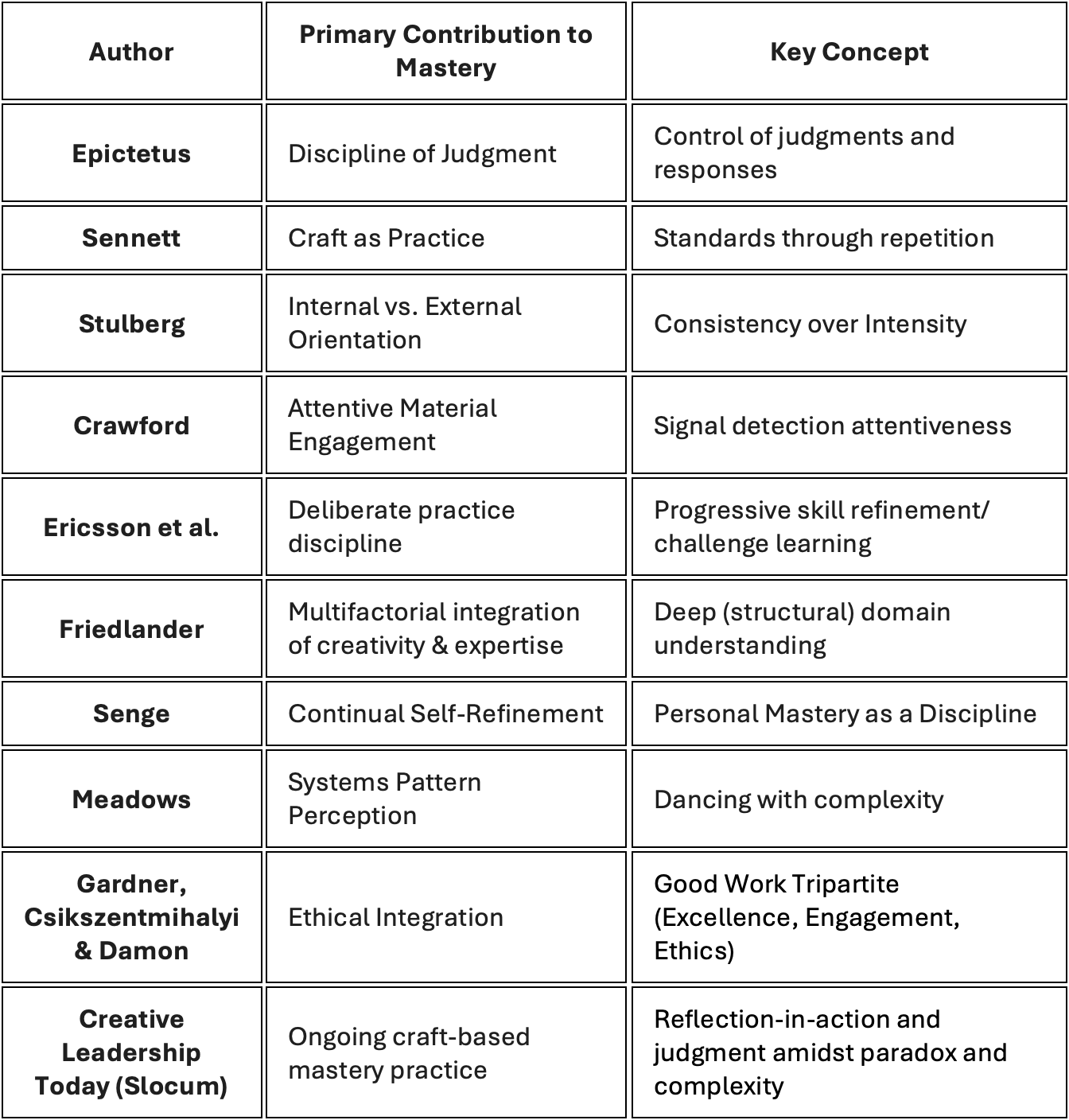
Table 1: Summary of Key Mastery Sources
References
Matthew B. Crawford (2009) Shop Class as Soulcraft: An Inquiry Into the Value of Work, Penguin.
Epictetus (2022) The Complete Works: Handbook, Discourses, & Fragments, ed. and trans. Robin Waterfield, University of Chicago Press.
K. Anders Ericsson, Ralf T. Krampe, and Clemens Tesch-Römer (1993) “The Role of Deliberate Practice in the Acquisition of Expert Performance,” Psychological Review, 100 (3):363-406; https://doi.org/10.1037/0033-295X.100.3.363
Kathryn J. Friedlander (2024) The Psychology of Creative Performance and Expertise, Routledge.
---------- (2025) “Response to Commentaries on The Psychology of Creative Performance and Expertise,” Journal of Expertise, Vol. 8(4), pp. 283-297; https://www.journalofexpertise.org/articles/volume8_issue4/JoE_8_4_Friedlander_Response.pdf
Howard Gardner, Mihaly Csikszentmihalyi, and William Damon (2001) Good Work: When Excellence and Ethics Meet, Basic Books.
Jean Lave and Etienne Wenger (1991) Situated Learning: Legitimate Peripheral Participation, Cambridge University Press.
Donella H. Meadows (2008) Thinking in Systems: A Primer, Chelsea Green Publishing.
Robert Pirsig (2008/1974) Zen and the Art of Motorcycle Maintenance: An Inquiry Into Values, Mariner Books Classics/William Morrow & Company.
Rick Rubin (2023) The Creative Act: A Way of Being, Penguin.
Peter M. Senge (2006) The Fifth Discipline: The Art and Practice of the Learning Organization, rev. and updated ed., Doubleday.
Richard Sennett (2008) The Craftsman, Yale University Press.
David Slocum (2025a, February 20) “The Rise and Fall of Creative Leadership,” Crafting Leadership Substack;

----------- (2025b, November 13) “Creative Leadership Today,” Crafting Leadership Substack; https://www.craftingleadership.com/p/creative-leadership-today
Brad Stulberg (2026) The Way of Excellence: A Guide to True Greatness and Deep Satisfaction in a Chaotic World, Harper One.
Paul Tosey, Max Visser, and Mark NK Saunders (2011) “The Origins and Conceptualizations of ‘Triple-loop’ Learning: A Critical Review,” Management Learning, 43(3), 291-307; https://journals.sagepub.com/doi/10.1177/1350507611426239