



Part I of this series argued that a leadership program sells undeclared functions, particularly private reassurances for participants and defensible decisions for buyers, that do not depend on leaders improving. Here, drawing on credence-good economics, institutional theory, and management fashion, I ask why buyers inspect those functions so little, and then I introduce five positional figures, scholars among them, who operate the arrangement and cast shadows of dissent. Generative and agentic AI, now the urgent subject of nearly every provider’s offerings, give each figure further reason to leave the effects of leadership industry offerings unexamined.
Readers short on time can take three points from this installment. First, buyers inspect little of the outcomes of leadership programs because inspection threatens the legitimacy that the purchase was meant to secure. Second, five figures, each defined by its position in the operation of the leadership industry, keep that arrangement running, and the dissent each one provokes often returns to the industry either as a source of authority or as a vehicle for change in how leaders are understood and developed (or both). Third, dissent that costs the dissenter something is likelier to move purchasing than dissent that earns the dissenter standing in the industry.
I. Ceremony, Fashion, and the Arena
Because undeclared functions persist most easily where programs go uninspected, our first task is to explain why buyers seldom ask for rigorous evidence of effects. Institutional theory offers a starting point, since Stanford sociologists John W. Meyer and Brian Rowan’s pioneering argument is that organizations adopt institutionalized practices ceremonially to signal their currency and win legitimacy, regardless of whether they improve performance (1977). In fact, their contention was that the more an organization’s structures derive from ceremonies and the myths animating them, the more that organization displays confidence, satisfaction, and good faith while minimizing inspection and evaluation.
The post-session satisfaction survey, the near-universal evaluation instrument for leadership programs, fits that description because it displays satisfaction and leaves behavioral change unexamined. Across training generally, 93 percent of surveyed practitioners collect satisfaction data while only 15 percent feel ready to isolate a program’s effect (Association for Talent Development, 2025).
The September 2026 special issue of Academy of Management Learning & Education (AMLE) describes this same pattern in its own trade, and its editors number themselves among those “guilty of engaging in edutainment” (Leroy et al., 2026, p. 307). They add that a focus on satisfaction offers no guarantee of development and may even distract participants from the hard work of development. Such a concession carries weight because it comes from inside the field, where incentives to make it are typically weakest. I’ll therefore treat the AMLE special issue here as a test case, since it gathers the field’s own diagnosis in a single place and month.
The same logic governs the market for managerial ideas. Columbia Business School management professor Eric Abrahamson first described the dynamics of fashion-setting community three decades ago (Abrahamson, 1996). Organizational theorist Alfred Kieser then provided the classic analysis of how management fashion closely fits leadership buyers. A fashion replaces anxiety with a name and an explanation (which echoes my account in Part I of anxiety relief), and it reduces the risk of a wrong choice while relieving managers of detailed reasoning. When top management selects a high-reputation consultancy, it can always justify the selection, and responsibility evaporates in a way that all parties find pleasant. Because objective evaluation of a complex restructuring is nearly impossible, for instance, participants want to judge it a success, and a fashion supplies the template for that judgment (Kieser, 1997, pp. 61-67).
In Kieser’s account, the arena’s consultants, professors, managers, editors, publishers, and seminar organizers widen the game by drawing in participants, play largely cooperative games, trade rhetoric as their main currency, and sense and shape what buyers want. Professors enter because they lend legitimacy, and other academics join by building theoretical frames around a fashion or by criticizing it from accepted theories, which places critics of the leadership industry inside the arena they criticize (Kieser, 1997, pp. 56-57, 63). This structure explains why critique and commerce coexist comfortably in the field. It also decides who may say what about leadership development, an important question I take up in the next section.
Generative AI represents a current case of management fashion. Business schools tailor their executive programs around corporate imperatives and executive “hot topics” such as leading with AI, according to Copenhagen Business School’s Guthey and Ferry (2026, pp. 432-433). As I discussed in Part I, the pressure on leaders to manage AI and lead its integration has become the lead selling point of programs and coaching packages. That urgency displaces attention to efficacy, since a buyer who needs leaders ready this year has little patience for asking whether a program works. A topic that arrives with a name, an explanation, and a deadline fits the pattern of a fashion, because it hands buyers a framework to adopt and a decision to defend.
II. Critique, Imitation, and the Cost of Looking
Applied to leadership scholars, the arena’s logic casts faculty as innovators of new theories, boosters of the conviction that development is not only possible but vital, gatekeepers of legitimate practice, direct providers of commercial services, and critics who gain status by distancing themselves from the commerce (Guthey & Ferry, 2026, p. 442). The editors and authors of the AMLE special issue belong to that arena on its own terms, as I do in my role on the faculty of a school of management. That said, membership implies no accusation, because the arena’s structure shapes what each position can say. Memorable terms or neologisms, which Kieser counts among a fashion’s ingredients, appear in the editors’ own coinages, “pedagoogling” and “insta-training” among them (Kieser, 1997, p. 62; Leroy et al., 2026, p. 306).
In contributions to the special issue, critique follows a routine form, since several articles fault leadership development for a deficit of context, of scale, or of attention beyond the individual, and then each offers a distinctive model in response (Ashford et al., 2026, p. 313; Palanski & Barclay, 2026, p. 332; Vassolo et al., 2026, p. 402). One article, for example, faults programs for reaching only a “high potential” minority and proposes AI-based leadership coaches as one means of reaching the forgotten majority (Ashford et al., 2026, pp. 320, 322). The proposed solution shows how readily the new technology enters a critique’s remedy, even as it leaves untouched the question of whether buyers will ask for evidence that the remedy works.
To be clear, I impute no bad faith to the authors or editors, and I remain open to disconfirming evidence, such as critiques that demonstrably changed what organizations bought. Barbara Kellerman’s suggestion to recast leadership as a creative act in which leaders and followers engage in lifelong learning faces the same test whenever I raise it in seminars or keynotes (Slocum, 2024). The foundational fashion literature of the 1990s, by Kieser and others, predates social media, and the publishers and seminar organizers it describes now have heirs in the associations, festivals, and catalogs that I’ll name in Part III. Fashion appears unavoidable wherever people compete for attention, and its extension to academia is paradoxical because, following the early sociologist Georg Simmel, fashion satisfies the need to imitate and the need to differentiate at once (Bort & Kieser, 2011, p. 656).
Generative AI sharpens that tension between imitation and differentiation, because it multiplies the volume of leadership commentary that largely reproduces predominant ideas without examining the programs, coaching, and assessments built around them. LLM systems trained on the existing corpus echo what that corpus says, and algorithmic platforms have already pulled leadership discourse toward an aspirational average (Slocum, 2025c). Imitation thus gains a tireless producer, and I expect differentiation to increasingly shrink to the vendor’s task of relabeling familiar content with the vocabulary of the moment.
A few competing explanations account for why buyers inspect so little, and the choice between them largely determines the remedy. Credence-good economics and signaling theory hold that buyers cannot judge a program’s quality even after purchase and therefore rely on proxies such as brand and credentials, which implies that better information about quality should shift purchasing (Darby & Karni, 1973; Spence, 1973). However, the ceremonial account predicts otherwise. Because inspection threatens the legitimacy that the purchase was meant to secure, organizations that prize that legitimacy will resist inspection even when information is available. A third possible explanation holds more simply that evaluation and tailoring cost more than most buyers care to pay.
The cost account finds partial support in the articles in the AMLE special issue, whose editors concede that truly customizing a program takes significant investment (Leroy et al., 2026, p. 309). It complements the other two accounts and predicts that cheaper inspection would raise demand for inspection. No study that I know of sets the three accounts against one another in the leadership market, and the data that would permit one, on procurement criteria and on how often evaluation could potentially change a renewal decision, do not appear to exist in systematic form.
Without such research, I lean toward the ceremonial account over the cost account. If cost alone explained the pattern, well-resourced buyers would report readiness to isolate effects well above the 15 percent of practitioners who do, and the research base already identifies the design features that work (Kaiser & Curphy, 2013; Lacerenza et al., 2017). Cost cannot separate the ceremonial account from the credence-good account, and a decisive test would ask whether buyers handed credible evidence of effect still renew on brand and credential. A market that rewards defensibility over demonstrated change will go on producing programs that defend more than they change (a judgment that I’ll test in Part V against buyers’ conduct).
III. Content and Recognition: The Zombie and the Hero
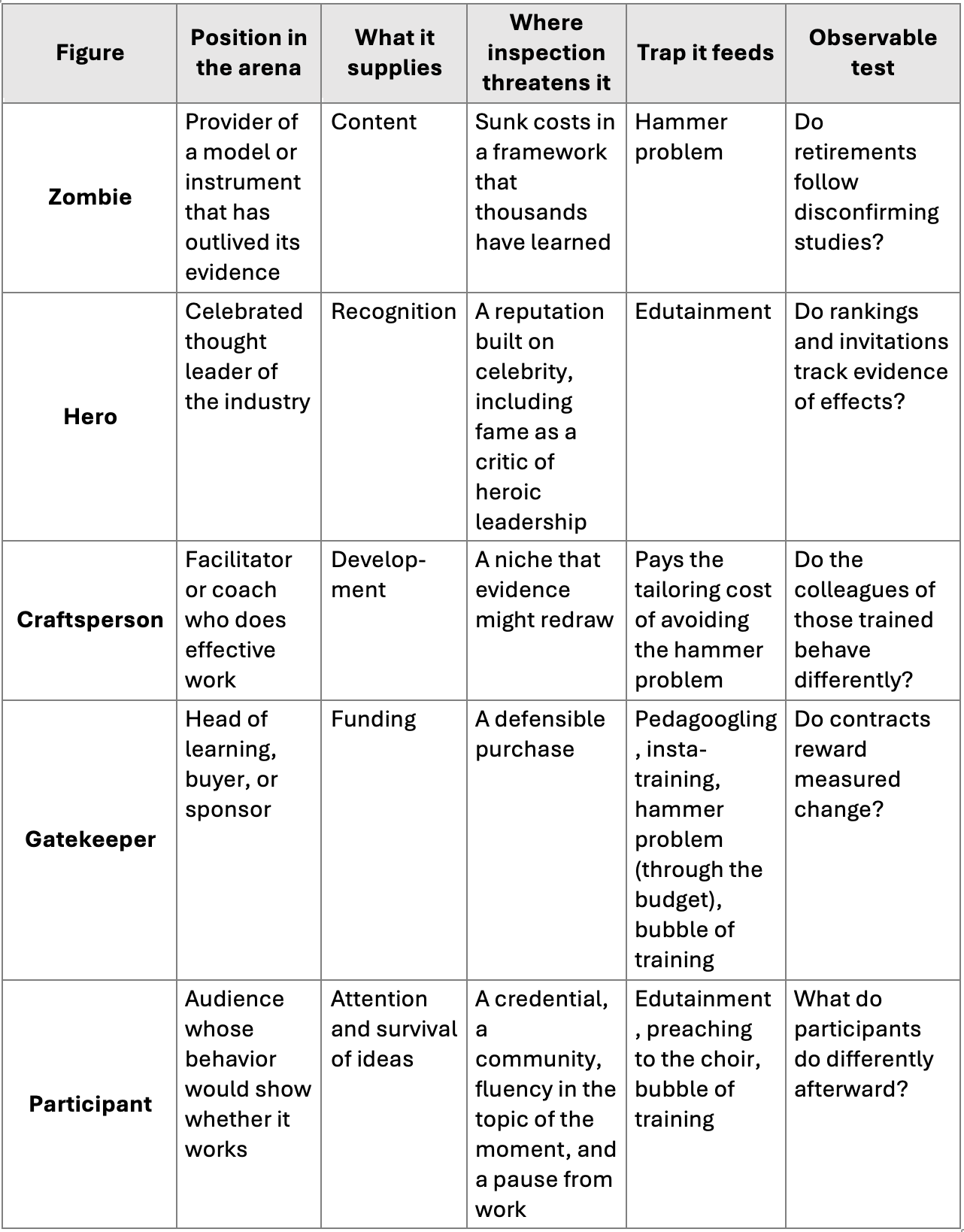
With the arena and the cost of appearing established, our next question concerns who inhabits the arena, and here explanations of a field this large often reach for individual virtue and vice, as if better people would produce better development. In this series, as an alternative, I locate the cause in the structure of the arena and offer five positional figures as heuristic types (Table 1), each defined by its position in the circulation of legitimacy and by the incentives that position creates. Because behavior often follows from position, the individuals named below illustrate positions and say nothing about the motives of those who hold them. Real careers cross positions, and scholars, myself included, belong among the figures.
I have discussed the Zombie and the Hero in earlier essays, and the Craftsperson grows out of my longstanding argument that leadership is a craft, while the Gatekeeper and the Participant appear here for the first time (Slocum, 2025a; Slocum, 2025b; Slocum, 2025d; Slocum, 2026a). I present the figures in the order that an idea about leadership and its development travels, from the model that supplies content to the stage that supplies recognition, the workshop that supplies development, the purchase that supplies funding, and the audience that decides what survives. Each description notes how generative AI alters that figure’s incentives and names the shadow of dissent or variation that the position breeds. In Part IV, I’ll look more closely at how the technology affects leadership and development efforts.
Crucially, each of these figures cast a shadow of dissent (the debunker, the celebrated critic, the exemplar, the inspector, and the skeptic), and these shadows keep the claims of each position in motion by regularly testing what that position actually supplies. Every shadow must borrow the arena’s vocabulary, venues, and credentials to be heard, and its dissent therefore guards the industry’s authority and legitimacy. Each shadow also leaves a record on which later critics, practitioners, and buyers build, which lets the same dissent carry and legitimate change. Programs then codify, label, and sell that change. Successive waves of change, for example, entrepreneurship since the late twentieth century, digital technologies and social and environmental responsibility since the early twenty-first, and now AI have each redefined what leaders are taught to be.
The Zombie
A model or instrument that keeps circulating after the evidence that once supported it has thinned, the Zombie supplies the field with content. Research on zombie leadership documents the pattern in leadership studies, tracing older ideas that critics have repeatedly debunked and that refuse to die because they flatter elites and sustain what the analysts call the leadership industrial complex (Haslam et al., 2024, p. 1). Psychologist and educational researcher Bruce Tuckman’s stage model of group development illustrates the pattern. It began as four stages drawn from a 1965 review of the literature on small-group therapy and training, gained a fifth in 1977, and later carried reservations about its universality, according to the cultural anthropologist Corina Enache (Tuckman, 1965; Tuckman & Jensen, 1977; Enache, 2026). The simplified sequence nonetheless circulates as an axiomatic managerial shorthand across workshops and platforms, since simplification speeds travel.
Because the model began in the scholarly literature, its history shows that no scholarly mechanism obliges anyone to retire its simplified descendants. Management fashion explains the gap, since successful fashions combine simplicity with ambiguity, which lets each user project personal problems onto the concept, and old fashions return as new ones (Kieser, 1997, pp. 58-59, 69). The comfort that a model offers never depended on its effects, and critics who diagnose the missing effects could not dislodge others’ embrace of it (Beer et al., 2016; Kellerman, 2012). Organizations that have trained thousands of managers on a framework also carry sunk costs that favor its survival. An AI assistant can restate a stage model with fluent authority, on demand and at a scale no workshop could match, which lowers the cost of circulation further; at the same time, nothing in the exchange checks the actual evidence for the model.
The Zombie’s shadow is the debunker that its persistence breeds, and although no debunker has yet dislodged the model, each leaves a record on which subsequent critics continue to build. Enache’s recent Substack essay, for instance, argues that organizations turned Tuckman’s heuristic into law and that teams need conditions such as shared purpose and meaningful roles more than a sequence of stages, a critique that reaches practitioners beyond the journals. Each such critique, including the research on zombie ideas, keeps the model in view even while contesting it, which suggests how the Zombie’s shadow can sustain the arena that it dissents from.
The Hero
Business schools, social media, and online platforms hold up the Hero as a thought leader who embodies the leadership industry, and events like Thinkers50 and the Global Peter Drucker Forum do the same. In that role, the Hero supplies the field with recognition, and the Hero’s ideas reinforce the field’s priorities. Thinkers50 publishes a biennial ranking known as the Oscars of management thinking, and vendors like CrossKnowledge advertise its faculty’s places on it (CrossKnowledge, 2025). The Drucker Forum calls itself the world’s leading management and leadership conference and gathers many of the same names, and its 2019 newsletter announced that eleven of the previous night’s Thinkers50 honorees would attend (Global Peter Drucker Forum, 2026; Global Peter Drucker Forum, 2019).
These two institutions advance leadership fashion most visibly through the careers they sustain, and Amy Edmondson of Harvard Business School offers the clearest case. Thinkers50 ranked her thirty-fifth in 2011, first in 2021 and 2023, and second in 2025 (Thinkers50, n.d.-a). The Forum’s 2019 newsletter named her among its attending honorees as that year’s third-ranked, and its 2025 newsletter listed her among the presenters of workshops and masterclasses (Global Peter Drucker Forum, 2019; Global Peter Drucker Forum, 2025). The 2019 newsletter also counts Herminia Ibarra, of the London Business School, and Dorie Clark, of Columbia Business School, among recent speakers, while Thinkers50 has ranked Ibarra in eight editions since 2011 and Clark in four since 2019 (Global Peter Drucker Forum, 2019; Thinkers50, n.d.-b; Thinkers50, n.d.-e). Each ranking invites a convening, and each convening gives the ranked name another stage from which to be ranked again. Subscription learning extends that cycle to a paying audience, since LinkedIn Learning lists all three scholars as instructors (LinkedIn Learning, n.d.-a; LinkedIn Learning, n.d.-b; LinkedIn Learning, n.d.-c).
Generative AI is accelerating the same cycle, since attention to the topic is already high and the arena rewards whoever names it first. Thinkers50 gave Erik Brynjolfsson its Digital Thinking Award in 2015, shared with fellow MIT economist Andrew McAfee, ranked him twenty-sixth that year, and placed him eighth in both 2019 and 2023 (Thinkers50, n.d.-c). The Wharton School’s Ethan Mollick entered the ranking in 2025 and made that year’s Digital Thinking Award shortlist (Thinkers50, n.d.-d). The ranking and award machinery that certified leadership scholars now certifies AI scholars as well, and gatherings of honorees such as the Forum’s supply the kind of room in which that certification circulates. MasterClass then converts the certification into consumer video, with Brynjolfsson teaching a class on reworking workflows with AI alongside Cat Goetze and Parth Patil (Brynjolfsson et al., n.d.) and Mollick leading a three-part series on generative AI (MasterClass, 2024). Taken together, rank, convening, and subscription reinforce one another, and nothing in the sequence requires anyone to test what participants later do differently.
Social media and short-form video have supplied a further route to the same stage, one that counts plays where the earlier routes count ranks, invitations, and subscriptions. Simon Sinek and Brené Brown each gave a TEDx talk, his in 2009 and hers in 2010, and TED’s site counts more than 71 million plays for each (Brown, 2010; Sinek, 2009). Brown extended her reach with a Netflix special, and Sinek appeared among the fifty names in the 2023 Thinkers50 ranking – though neither appears among those ranked in 2025, which suggests that platform reach and ranking recognition may only overlap intermittently (Netflix, n.d.; Thinkers50, 2023; Thinkers50, 2025).
The Hero casts the most visible shadow of the five industry figures, and several of the celebrated leadership heroes have built their reputations by criticizing heroic leadership itself. The image of leaders as solitary heroes who single-handedly drive history-making group success counts among the zombie ideas that research has debunked (Haslam et al., 2024, p. 3). McGill University management doyen Henry Mintzberg, whom Thinkers50 honored with its Lifetime Achievement Award in 2015, later wrote on the Drucker Forum’s blog that organizations need no “obsession with leadership” and warned against celebrating the white knight who rides in to save everybody else (Mintzberg, 2018; Thinkers50, 2015). Brown’s case for vulnerability in leaders, made in her talk, and Sinek’s case for leaders who eat last can likewise each be read as a brand defined against the invulnerable, self-serving boss (Sinek, 2014).
Critics from the academy join the same economy, since Kellerman and Jeffrey Pfeffer wrote their critiques from Harvard and Stanford, respectively, for the commercial imprint HarperBusiness (Kellerman, 2012; Pfeffer, 2015). Pfeffer’s Leadership BS is a mass-market book exhorting readers to resist the false promises of mass-market leadership books, highlighting how both reproducing and debunking dominant logics can confer status on scholars (Guthey & Ferry, 2026, pp. 437, 442). Put simply, the critique of heroic leadership becomes a credential for heroic standing, because the stage that confers recognition on the celebrant confers it equally on the debunker. I expect generative AI to widen that stage, since an assistant can summarize and imitate the already celebrated idea on request, and a ranked name can circulate everywhere at once, sparing the audience the effort of reading anyone else.
IV. Development and Funding: The Craftsperson and the Gatekeeper
The Craftsperson
If the first two figures supply the field with content and recognition, the next two decide what gets developed and paid for. The Craftsperson, an original thinker, program designer, facilitator, or coach who does effective work in agencies, plants, and boardrooms with little public attention, performs the function that the field advertises and the market finds hardest to see. In my account of craft, leadership is practiced through work that gets the hands dirty, draws from the heart, sharpens awareness, and refines practice daily. A hypothetical facilitator illustrates such a practice by observing an engineering team, spending a week with them on a handover problem, returning three months later to observe again and to ask the participants’ colleagues what has changed, and revising her approach according to what she sees and what they say.
Her method embodies the design features associated with effective training suggested by the editors of the AMLE special issue, among them needs analysis, practice, feedback, and spaced sessions, which makes the approach a matter of design as much as temperament. Her reflective stance also resembles critical performativity, an active and ongoing engagement with practice that nevertheless stays critical of it (Alvesson & Spicer, 2012). At a larger scale, a survey of the co-workers of 11,480 managers in eight companies found improvement among managers who followed up with colleagues and little change beyond chance among those who did not (Goldsmith & Morgan, 2004).
On the scholarly side, good leadership development can be compared with the work of master cabinetmakers, expert accountants, and surgeons who have developed their own theories and tools (Bratsis, 2026, p. 1). The Craftsperson’s shadow provides the dissent of that development, since a practice that works in offices and plants, and whose effects participants’ colleagues can see, implicitly indicts every program that cannot show the outcomes. The AMLE issue editors’ questions of what, how, when, who, why, and where name the Craftsperson’s discipline and give managers a test to apply before they buy, build, or renew a program (Leroy et al., 2026, pp. 305-306).
That test is hard to apply, though, because the Craftsperson works in the same market as the vendors around her, and buyers have little means of telling her apart from them. She sells her services, may protect her methods as proprietary, and can harden into a Zombie when she treats her approach as universal and unchanging. Credentials do not reliably separate her from others who are similarly credentialed, particularly in expanding professions, like leadership coaching, that, by the count of the International Coaching Federation (ICF), numbers more than 120,000 practitioners (International Coaching Federation, 2025). Reach fares no better here as a signal, because the ventures that I introduced in Part I show scale without showing effect. Strategyzer’s canvas, used by more than six million practitioners by the company’s own count, tells a buyer how widely a tool has spread yet nothing about whether those who use it perform differently (Strategyzer, n.d.). The Disruptive Leadership Institute materials that I reviewed report no evidence of that kind either (Disruptive Leadership Institute, n.d.).
Evidence from the people who work beside participants offers a sturdier signal. Every provider could track and publish evidence that the colleagues of those it trains behave differently, and any buyer could ask for it to better understand potential outcomes. The signal gains importance as buyers search catalogs today for AI readiness, because pressure falls increasingly on even careful practitioners to relabel proven methods in the new (and often fashionable) vocabulary, and a label of that kind cannot distinguish her from other vendors who append an AI module to an old design. Colleagues’ accounts remain valuable even after relabeling; in other words, another expectation that deserves testing (and that I’ll return to in Part V).
The Gatekeeper
All industries and arenas have gatekeepers, and in Part I introduced a hypothetical leadership industry Gatekeeper in the form of a chief learning officer facing a skeptical finance director (though the figure could equally be a procurement officer or sponsoring executive). This buyer commissions programs and coaching, pays for much of what the other figures supply, and buys defensibility along the way. That translates for our chief learning officer into the renewal of a vendor with strong satisfaction scores and, when asked by the finance director what changed, an answer about the vendor’s brand, accreditations, and peer clients.
The answer works because selecting a high-reputation provider can allow top management to justify the choice of nearly whatever follows, though many managers are diligent and base their decisions in some evidence. Because boards and chief executives now ask what the organization is doing about AI, a program on leading with AI becomes an easy purchase to defend. A buyer who declines this fashionable program invites more scrutiny than a buyer who purchases one that no one evaluates, which updates the old maxim that no one gets fired for buying IBM.
Ironically, a familiar dynamic can blame organizational barriers that block the application of what participants learn rather than the provider. Such an internal focus implicates the buyer, who should be aware of those barriers. McKinsey’s own consultants listed overlooked context first among four reasons that programs fail, and critics inside the academy report the same context deficit (Gurdjian et al., 2014; Palanski & Barclay, 2026, p. 332). A deficit that survives more than a decade of such warnings suggests that purchasing sustains it more than ignorance does. The Gatekeeper’s shadow here is the skeptical finance director who challenges his chief learning officer and whose queries cost the Gatekeeper the comfort of an unevaluated purchase.
Underwriters make the Gatekeeper’s choice still easier to defend, since brands, accreditors such as AACSB, EQUIS, and AMBA, and the rankings around them absorb blame that an unconventional decision might attract. Vendors of dashboards and metrics serve the Gatekeeper as instruments of defense, and professional associations form a second family of underwriters whose power to compel demand is the compliance function described in Part I. The IEEE reports that credits from its professional development suite, leadership programs included, satisfy annual license renewal requirements for professional engineers (IEEE Spectrum, n.d.). Such regimes mark who belongs, a function that the historical sociology of credentialing documents (Collins, 1979). They can also feed on themselves, as renowned Australian transformational coach Rod Francis publicly explained why he dropped this ICF accreditation of his coach training program after a decade (Francis, 2026).
V. Attention and Survival: The Participant and the Traps of Development
The Participant
Whether any development programs work would show first in the behavior of the Participant, the audience for the activities of all of the others and the most ambiguous of the five, because her actions depend on which of the other four figures hold sway. A hypothetical manager completes an AI leadership workshop, posts the badge online, and returns to the same meetings, where her colleagues cannot say what, if anything, has changed. Her position fits what organizational research describes, since reflective questioning is often discouraged and fitting in pays in the short run (Alvesson & Spicer, 2016). Extending an observation from the fashion literature to the program participant who collects a credential while changing little, we can conclude that many management seminars attract paying participants who mostly hope for confirmation and seldom for enlightenment (Kieser, 1997, p. 64).
Empty talk that substitutes for action gives a Participant reason to use specialized vocabulary (Pfeffer & Sutton, 1999; Spicer, 2017). A meta-analysis of coaching found stronger effects on affective than on skill outcomes, a pattern that accords with participants receiving belonging, status, and a pause from work – benefits that count as real even when behavioral change is slight (Jones et al., 2016; Petriglieri & Petriglieri, 2010). The Participant’s shadow is the skeptic who attends, performs with expected enthusiasm, and keeps what the critical literature calls a cynical distance. That posture protects the individual and can reproduce the power it rejects (Fleming & Spicer, 2003). Whereas such costless dissent seems unlikely to change purchasing, the participant who reports evidence back to colleagues or declines the next program pays a visible price and signals more, because only a costly act gives a buyer information that attendance and enthusiasm cannot supply.
As I argued in Part I, belonging requires a shared subject, and AI has become the topic that leaders feel they must discuss to keep pace with their peers. Fluency in its vocabulary and a ready opinion on its organizational consequences signal membership, and the signal can arrive in a single workshop or webinar whether or not her understanding grows or her work changes. If the signal is what the Participant acquires, evidence of changed practice becomes irrelevant to her sense of having benefited.
The Traps of Development
The AMLE special issue editors name six traps that undermine leadership development (Leroy et al., 2026, pp. 306-310). The editors leave the incentives behind the traps unstated, and I have mapped the traps onto the five figures in Table 1. “Pedagoogling,” a last-minute pileup of unfocused learning objectives, serves a Gatekeeper who must satisfy many constituencies. “Edutainment,” entertaining in the hope that the ideas stick, serves the Hero, whose stage presence sells the workshop, and the Participant, who rewards it. “Insta-training,” the assumption that development materializes right after an intervention, fits a budget or reporting cycle better than a human life.
The hammer problem, in which one set of content serves every participant (as if it’s a nail), describes the Zombie at work, and the editors’ explanation that tailoring takes significant investment points toward the Gatekeeper’s budget as well. Preaching to the choir, which the editors trace to developers who let their own passions do the talking, finds its reward in the self-selected Participant who already believes. The bubble of training, with skills developed apart from the larger unit, organizational, or industry system, follows from a Gatekeeper who buys for individuals and a Participant who prefers to stay inside it. Read this way, the traps persist as equilibria that serve interests, and the editors’ remedy of a sharper theory answers the Craftsperson’s problem without touching the Gatekeeper’s.
The shadows suggest where deeper change originates, since dissent that earns the dissenter genuine standing, as the Hero’s critique does, tends to be absorbed by the arena that supplies the standing, guarding the field’s authority even as it carries change forward. Dissent that costs something keeps its force, as when a Gatekeeper demands evidence, a Craftsperson reports what participants’ colleagues say, or a high-profile coach-trainer such as Rod Francis surrenders an institutional accreditation after a decade. Before approving a purchase, an executive can therefore ask which kind of dissent has entered the room – say, a finance director’s question that can delay or reshape the deal, or a critic’s kickoff talk that the vendor books and the budget ignores. The test of dissent becomes the observable outcomes, like whether a finance director’s objection leads to renegotiated terms, a narrower scope, or a delayed signature, and whether a critic’s kickoff talk ever moves a budget line, a deadline, or a vendor commitment.
Table 1. The five figures who operate and legitimate the leadership industry
Part III will explore three kinds of standing as they circulate among the five figures, asking what feeds, platforms, and machines do to that circulation and its dissent. Then, in Part IV, I’ll turn to what generative and agentic AI changes for each figure and its shadow. And, finally, Part V will ask which shadows can move the field, taking up AI again among other priorities.
References
Abrahamson, E. (1996). Management fashion. Academy of Management Review, 21(1), 254-285. https://business.columbia.edu/faculty/research/management-fashion
Alvesson, M., & Spicer, A. (2012). Critical leadership studies: The case for critical performativity. Human Relations, 65(3), 367-390. https://openaccess.city.ac.uk/id/eprint/15571/
Alvesson, M., & Spicer, A. (2016). The stupidity paradox: The power and pitfalls of functional stupidity at work. Profile Books. https://profilebooks.com/work/the-stupidity-paradox/
Ashford, S. J., Wellman, N., & Sweeten, J. R. (2026). Leadership should not be a luxury good: Scaling leader development for the forgotten majority. Academy of Management Learning & Education, 25(3), 313-330. https://doi.org/10.5465/amle.2024.0590
Association for Talent Development. (2025, April 30). ATD research: Organizations struggle with measuring the impact of training [Press release]. PRWeb. https://www.prweb.com/releases/atd-research-organizations-struggle-with-measuring-the-impact-of-training-302441494.html
Beer, M., Finnström, M., & Schrader, D. (2016, October). Why leadership training fails, and what to do about it. Harvard Business Review. https://hbr.org/2016/10/why-leadership-training-fails-and-what-to-do-about-it
Bort, S., & Kieser, A. (2011). Fashion in organization theory: An empirical analysis of the diffusion of theoretical concepts. Organization Studies, 32(5), 655-681. https://doi.org/10.1177/0170840611405427
Bratsis, M. E. (2026, September 22). Six traps to avoid in leadership development programs. AOM Insights. Academy of Management. https://journals.aom.org/doi/10.5465/amle.2026.0496.summary
Brown, B. (2010, June). The power of vulnerability [Video]. TEDxHouston. TED. Retrieved October 24, 2026, from https://www.ted.com/talks/brene_brown_the_power_of_vulnerability
Brynjolfsson, E., Goetze, C., & Patil, P. (n.d.). Revolutionize your workflows with AI [Online course]. MasterClass. https://www.masterclass.com/classes/revolutionize-your-workflows-with-ai
Collins, R. (1979). The credential society: An historical sociology of education and stratification. Academic Press. https://amzn.to/4ANmry9
CrossKnowledge. (2025, November 26). CrossKnowledge faculty members named to Thinkers50 2025 ranking. https://www.crossknowledge.com/faculty-expert/crossknowledge-faculty-members-named-to-thinkers50-2025-ranking/
Darby, M. R., & Karni, E. (1973). Free competition and the optimal amount of fraud. Journal of Law and Economics, 16(1), 67-88. https://chicagounbound.uchicago.edu/jle/vol16/iss1/7/
Disruptive Leadership Institute. (n.d.). About us. https://www.disruptiveleadership.institute/about-us/
Enache, C. (2026, May 22). Roasting frameworks: The Tuckman model. Substack.
Fleming, P., & Spicer, A. (2003). Working at a cynical distance: Implications for power, subjectivity and resistance. Organization, 10(1), 157-179. https://wrap.warwick.ac.uk/9942/
Francis, R. (2026, September 23). Why I’m walking away from the ICF after a decade of program accreditation [Post]. LinkedIn. https://www.linkedin.com/pulse/why-im-walking-away-from-icf-after-decade-program-rod-francis-jf50e/
Global Peter Drucker Forum. (2026). About the Global Peter Drucker Forum [Brochure]. https://www.druckerforum.org/fileadmin/user_upload/2026/about/DruckerForum_About_A4_digital.pdf
Global Peter Drucker Forum. (2025). Newsletter 2025/06. https://www.druckerforum.org/newsletter/2025/06.shtml
Global Peter Drucker Forum. (2019). Newsletter 2019/14. https://www.druckerforum.org/newsletter/2019/14.html
Goldsmith, M., & Morgan, H. (2004, August 25). Leadership is a contact sport: The “follow-up factor” in management development. strategy+business, 36. https://www.strategy-business.com/article/04307?pg=all
Gurdjian, P., Halbeisen, T., & Lane, K. (2014, January 1). Why leadership-development programs fail. McKinsey Quarterly. https://www.mckinsey.com/featured-insights/leadership/why-leadership-development-programs-fail
Guthey, E., & Ferry, N. (2026). The leadership industry and the cultural production of leadership. Academy of Management Learning & Education, 25(3), 427-451. https://doi.org/10.5465/amle.2024.0548
Haslam, S. A., Alvesson, M., & Reicher, S. D. (2024). Zombie leadership: Dead ideas that still walk among us. The Leadership Quarterly, 35(3), Article 101770. https://doi.org/10.1016/j.leaqua.2023.101770
IEEE Spectrum. (n.d.). IEEE professional development suite teaches in-demand skills. https://spectrum.ieee.org/ieee-professional-development-suite
International Coaching Federation. (2025). Coaching industry continues global growth with $5.34 billion USD revenue. https://coachingfederation.org/blog/coaching-industry-continues-global-growth-with-5-34-billion-usd-revenue-new-research-reveals/
Jones, R. J., Woods, S. A., & Guillaume, Y. R. F. (2016). The effectiveness of workplace coaching: A meta-analysis of learning and performance outcomes from coaching. Journal of Occupational and Organizational Psychology, 89(2), 249-277. https://doi.org/10.1111/joop.12119
Kaiser, R. B., & Curphy, G. (2013). Leadership development: The failure of an industry and the opportunity for consulting psychologists. Consulting Psychology Journal: Practice and Research, 65(4), 294-302. https://doi.org/10.1037/a0035460
Kellerman, B. (2012). The end of leadership. Harper Business. https://www.publishersweekly.com/978-0-06-206916-0
Kieser, A. (1997). Rhetoric and myth in management fashion. Organization, 4(1), 49-74. https://doi.org/10.1177/135050849741004
Lacerenza, C. N., Reyes, D. L., Marlow, S. L., Joseph, D. L., & Salas, E. (2017). Leadership training design, delivery, and implementation: A meta-analysis. Journal of Applied Psychology, 102(12), 1686-1718. https://doi.org/10.1037/apl0000241
Leroy, H., Dragoni, L., Avolio, B., Giessner, S., Anisman-Razin, M., & Van Quaquebeke, N. (2026). Putting the science beneath the practice: Advancing theory in leadership development [From the editors]. Academy of Management Learning & Education, 25(3), 305-312. https://doi.org/10.5465/amle.2026.0496
LinkedIn Learning. (n.d.-a). Amy Edmondson [Instructor page]. https://www.linkedin.com/learning/instructors/amy-edmondson
LinkedIn Learning. (n.d.-b). Dorie Clark [Instructor page]. https://www.linkedin.com/learning/instructors/dorie-clark
LinkedIn Learning. (n.d.-c). Herminia Ibarra [Instructor page]. https://www.linkedin.com/learning/instructors/herminia-ibarra
MasterClass. (2024, August 28). MasterClass announces new 3-part series led by bestselling author Ethan Mollick: Achieve More With GenAI [Press release]. HR Dive. https://www.hrdive.com/press-release/20240828-masterclass-announces-new-3-part-series-led-by-bestselling-author-ethan-mol-1/
Meyer, J. W., & Rowan, B. (1977). Institutionalized organizations: Formal structure as myth and ceremony. American Journal of Sociology, 83(2), 340-363. https://acawiki.org/Institutionalized_organizations:_Formal_structure_as_myth_and_ceremony
Mintzberg, H. (2018, November 25). Communityship beyond leadership. Global Peter Drucker Forum. https://www.druckerforum.org/blog/communityship-beyond-leadership-by-henry-mintzberg/
Netflix. (n.d.). Brené Brown: The Call to Courage [Documentary special]. Netflix Media Center. https://media.netflix.com/en/only-on-netflix/81010166
Palanski, M., & Barclay, L. J. (2026). The leader in context: Developing leaders by adopting a self-in-systems approach. Academy of Management Learning & Education, 25(3), 331-349. https://doi.org/10.5465/amle.2024.0562
Petriglieri, G., & Petriglieri, J. L. (2010). Identity workspaces: The case of business schools. Academy of Management Learning & Education, 9(1), 44-60. https://iedp.com/articles/identity-workspaces/
Pfeffer, J. (2015). Leadership BS: Fixing workplaces and careers one truth at a time. HarperBusiness. https://www.publishersweekly.com/9780062383167
Pfeffer, J., & Sutton, R. I. (1999). The smart-talk trap. Harvard Business Review, 77(3), 134-142. https://hbr.org/1999/05/the-smart-talk-trap
Sinek, S. (2009, September). How great leaders inspire action [Video]. TEDxPuget Sound. TED. Retrieved October 24, 2026, from https://www.ted.com/talks/simon_sinek_how_great_leaders_inspire_action
Sinek, S. (2014). Leaders eat last: Why some teams pull together and others don’t. Portfolio. https://www.penguinrandomhouse.com/books/311389/leaders-eat-last-by-simon-sinek/9780698166806
Slocum, D. (2024, October 7). Suitcase words, hollow men, and authority baiting: Toward greater creative business leadership literacy. The Creative Leadership Hub. https://www.creativeleadershiphub.com/suitcase-words-leadership/
Slocum, D. (2025a, April 9). The undead in the executive suite: Zombie and vampire leadership today. Crafting Leadership. Substack. https://www.craftingleadership.com/p/the-undead-in-the-executive-suite
Slocum, D. (2025b, April 24). Zombie leadership coaching: Misguided myths haunting the industry. Crafting Leadership. Substack. https://www.craftingleadership.com/p/zombie-leadership-coaching-misguided
Slocum, D. (2025c, December 21). The algorithmic tyranny of the aspirational average leader. Crafting Leadership. Substack. https://www.craftingleadership.com/p/the-algorithmic-tyranny-of-the-aspirational
Slocum, D. (2025d, October 19). Crafting leadership. Crafting Leadership. Substack. https://www.craftingleadership.com/p/crafting-leadership
Slocum, D. (2026a, June 2). Certainty entrepreneurs: Popular leadership discourse between the industrialization of reassurance and the discipline of inquiry. Crafting Leadership. Substack. https://www.craftingleadership.com/p/certainty-entrepreneurs
Spence, M. (1973). Job market signaling. Quarterly Journal of Economics, 87(3), 355-374. https://doi.org/10.2307/1882010
Spicer, A. (2017). Business bullshit. Routledge. https://www.routledge.com/Business-Bullshit/Spicer/p/book/9781138911673
Strategyzer. (n.d.). Mastering business models: How to design and assess winning business models. https://www.strategyzer.com/training-programs/mastering-business-models-how-to-design-and-assess-winning-business-models
Thinkers50. (2015, October 1). Henry Mintzberg to receive Thinkers50 Lifetime Achievement Award [Press release]. https://thinkers50.com/media/2015-press-releases/henry-mintzberg-to-receive-thinkers50-lifetime-achievement-award/
Thinkers50. (2023). Thinkers50 ranking 2023 [Web page]. https://thinkers50.com/t50-ranking/list-2023/
Thinkers50. (2025). Thinkers50 ranking 2025 [Web page]. https://thinkers50.com/t50-ranking/
Thinkers50. (n.d.-a). Amy Edmondson [Web page]. https://thinkers50.com/biographies/amy-edmondson/
Thinkers50. (n.d.-b). Dorie Clark [Web page]. https://thinkers50.com/biographies/dorie-clark/
Thinkers50. (n.d.-c). Erik Brynjolfsson [Web page]. https://thinkers50.com/biographies/erik-brynjolfsson/
Thinkers50. (n.d.-d). Ethan Mollick [Web page]. https://thinkers50.com/biographies/ethan-mollick/
Thinkers50. (n.d.-e). Herminia Ibarra [Web page]. https://thinkers50.com/biographies/herminia-ibarra/
Tuckman, B. W. (1965). Developmental sequence in small groups. Psychological Bulletin, 63(6), 384-399. https://doi.org/10.1037/h0022100
Tuckman, B. W., & Jensen, M. A. C. (1977). Stages of small-group development revisited. Group & Organization Studies, 2(4), 419-427. https://doi.org/10.1177/105960117700200404
Vassolo, R. S., Weisz, N., Rivarola, R. Q., Willi, A., Coraiola, D. M., & Cornejo, D. (2026). Toward a model of top management team strategic leadership development. Academy of Management Learning & Education, 25(3), 402-426. https://doi.org/10.5465/amle.2024.0575